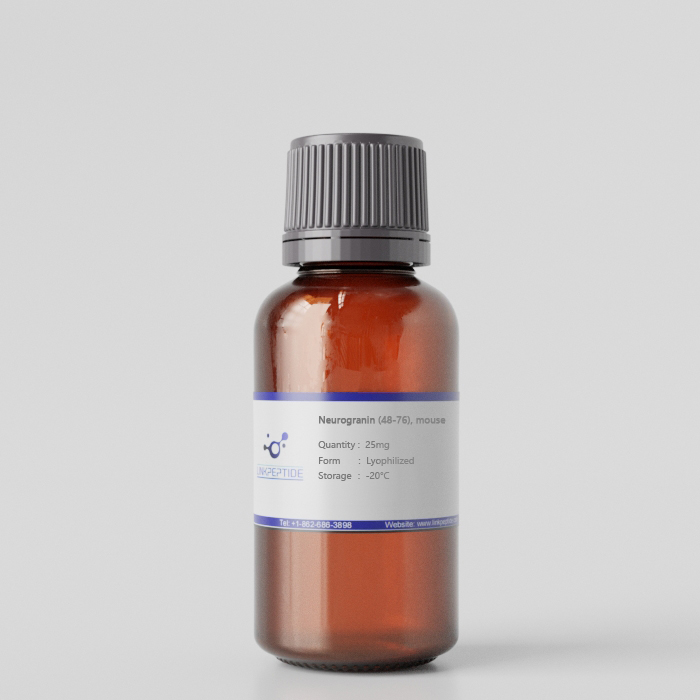
Product Name: Neurogranin (48-76), mouse
Sequence One Letter Code: SGECGRKGPGPGGPGGAGGARGGAGGGPS-OH
Sequence Three Letter Code: Ser-Gly-Glu-Cys-Gly-Arg-Lys-Gly-Pro-Gly-Pro-Gly-Gly-Pro-Gly-Gly-Ala-Gly-Gly-Ala-Arg-Gly-Gly-Ala-Gly-Gly-Gly-Pro-Ser-OH
Chemical Formula:C91H148N36O34S1
Molecular Weight: 2322.7
Purity: 95%
Form: Lyophilized
Storage Conditions: - 20 °C
Research Area: Alzheimer's Disease
Source / Species: mouse
Conjugation: Unconjugated
Code Nacres: NA.26
Application: Neurogranin (48–76), mouse is a synthetic peptide corresponding to residues 48–76 of murine neurogranin, a dendritically localized postsynaptic protein involved in calcium–calmodulin signaling. Neurogranin plays a central role in synaptic plasticity, long-term potentiation, and cognitive processes. The 48–76 fragment has been identified as a predominant neurogranin-derived peptide in brain and cerebrospinal fluid, with elevated levels reported in Alzheimer’s disease. This peptide is used in studies examining synaptic dysfunction, neurodegenerative mechanisms, and biomarker validation for cognitive decline. It supports biochemical assays, antibody characterization, and mechanistic investigations into calcium-dependent signaling pathways implicated in learning, memory, and neurodegeneration.
Current Research: Neurogranin (48–76), mouse is a synthetic peptide corresponding to amino acid residues 48–76 of murine neurogranin (Ng), a neuron-specific, dendritically enriched postsynaptic protein that plays a critical role in calcium–calmodulin (CaM)–dependent signaling. Neurogranin is highly concentrated in dendritic spines of excitatory neurons, where it modulates synaptic responsiveness by regulating the availability of calmodulin in a calcium-sensitive manner. Through this function, neurogranin directly influences synaptic plasticity, long-term potentiation (LTP), and higher-order cognitive processes such as learning and memory. The 48–76 region encompasses key elements of the calmodulin-binding domain, including residues necessary for calcium-dependent interaction with CaM. Under basal calcium conditions, neurogranin binds calmodulin and effectively sequesters it within dendritic compartments. Upon synaptic activation and increased intracellular Ca²⁺ levels, calmodulin dissociates and activates downstream effectors such as CaMKII and calcineurin. This tightly regulated cycle is essential for activity-dependent synaptic strengthening and remodeling. As a result, the 48–76 fragment represents a structurally and functionally significant segment of the protein. Proteolytic processing of full-length neurogranin generates stable peptide fragments detectable in brain tissue and cerebrospinal fluid (CSF). Among these, the 48–76 fragment has emerged as one of the predominant neurogranin-derived peptides identified in biochemical and mass spectrometry analyses. In recent years, increasing attention has focused on neurogranin fragments as biomarkers of synaptic degeneration. Elevated CSF neurogranin levels have been consistently reported in Alzheimer’s disease (AD), where they correlate with synaptic loss and cognitive decline. Unlike general neuronal injury markers, neurogranin is considered more reflective of postsynaptic dysfunction, making it particularly valuable for assessing early synaptic impairment in prodromal and mild cognitive impairment stages. In neurodegenerative research, Neurogranin (48–76), mouse is widely used to investigate mechanisms of synaptic vulnerability. Studies frequently examine how amyloid-β toxicity, tau pathology, oxidative stress, or excitotoxic signaling alter neurogranin expression, cleavage, and release. Because synaptic dysfunction precedes overt neuronal loss in many neurodegenerative disorders, defined neurogranin fragments serve as molecular tools for dissecting early pathogenic processes. Experimental systems may include cultured neurons, brain slice preparations, or transgenic mouse models of amyloid or tau pathology. This peptide also supports biomarker assay development and validation. Synthetic Neurogranin (48–76) is commonly used as a calibration standard, immunogen, or epitope-mapping reagent in ELISA and mass spectrometry–based quantification workflows. Its defined sequence enables antibody characterization, including specificity testing and affinity evaluation against mid-region neurogranin epitopes. In translational studies, such standardized peptides are essential for assay harmonization across laboratories investigating CSF or plasma neurogranin levels in aging and dementia cohorts. Beyond biomarker applications, the peptide facilitates mechanistic investigations into calcium-dependent signaling pathways. In vitro binding assays can assess interactions between the 48–76 region and calmodulin under varying calcium concentrations. Structural and biophysical studies, including surface plasmon resonance or fluorescence-based binding assays, help define kinetic parameters and competitive interactions with other CaM-binding proteins. These approaches contribute to a more precise understanding of how neurogranin modulates synaptic signal integration. Overall, Neurogranin (48–76), mouse represents a functionally relevant fragment of a key postsynaptic regulator of calcium signaling. Its identification as a predominant CSF peptide associated with Alzheimer’s disease has positioned it at the intersection of molecular neuroscience and clinical biomarker research. By enabling detailed analysis of synaptic signaling mechanisms, neurodegenerative pathology, and quantitative assay development, this peptide serves as a valuable tool for advancing research into cognitive decline and synaptic dysfunction.
Get a Quote
 LinkPeptide