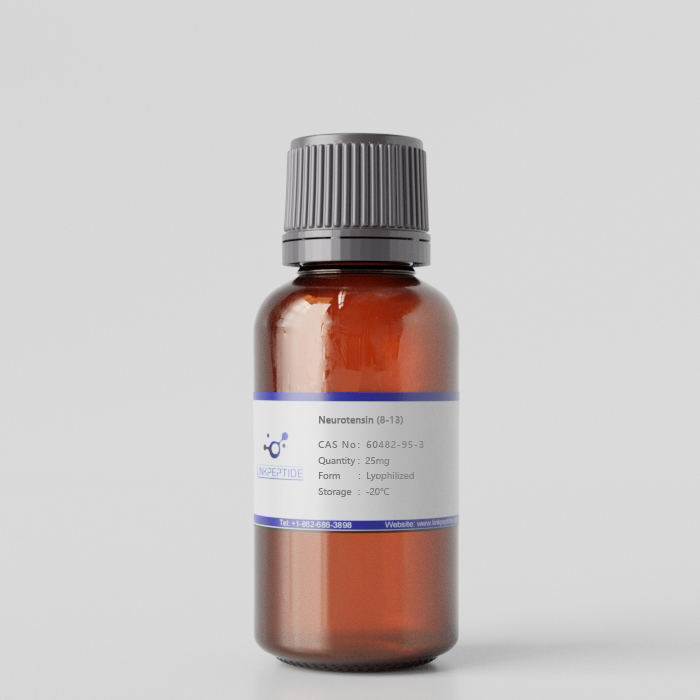
Product Name: Neurotensin (8-13)
Sequence One Letter Code: RRPYIL
Sequence Three Letter Code: H-Arg-Arg-Pro-Tyr-Ile-Leu-OH
Cas No: 60482-95-3
Chemical Formula:C38H64N12O8
Molecular Weight: 817
Purity: 95%
Form: Lyophilized
Storage Conditions: - 20 °C
Research Area: Neurological Disease Research
SMILES: CC[C@H](C)[C@@H](C(=O)NC(CC(C)C)C(=O)O)NC(=O)[C@H](CC1=CC=C(C=C1)O)NC(=O)[C@@H]2CCCN2C(=O)[C@H](CCCN=C(N)N)NC(=O)[C@H](CCCN=C(N)N)N
IUPAC: 2-[[(2S,3S)-2-[[(2S)-2-[[(2S)-1-[(2S)-2-[[(2S)-2-amino-5-(diaminomethylideneamino)pentanoyl]amino]-5-(diaminomethylideneamino)pentanoyl]pyrrolidine-2-carbonyl]amino]-3-(4-hydroxyphenyl)propanoyl]amino]-3-methylpentanoyl]amino]-4-methylpentanoic acid
INCHIKEY: DQDBCHHEIKQPJD-IZHGMHMJSA-N
INCHI:
InChI=1S/C38H64N12O8/c1-5-22(4)30(34(55)48-28(36(57)58)19-21(2)3)49-32(53)27(20-23-12-14-24(51)15-13-23)47-33(54)29-11-8-18-50(29)35(56)26(10-7-17-45-38(42)43)46-31(52)25(39)9-6-16-44-37(40)41/h12-15,21-22,25-30,51H,5-11,16-20,39H2,1-4H3,(H,46,52)(H,47,54)(H,48,55)(H,49,53)(H,57,58)(H4,40,41,44)(H4,42,43,45)/t22-,25-,26-,27-,28?,29-,30-/m0/s1
Source / Species: human, rat, bovine, mouse
Conjugation: Unconjugated
Code Nacres: NA.26
Application: Neurotensin (8–13) is the C-terminal hexapeptide fragment representing the minimal sequence required for high-affinity binding and activation of neurotensin receptors (NTSR1/NTSR2). This region reproduces many biological effects of full-length neurotensin, including modulation of dopaminergic and GABAergic neurotransmission. In the central nervous system, it influences dopamine release in regions such as the prefrontal cortex and nucleus accumbens. Neurotensin (8–13) is widely employed in neuroscience research to study receptor pharmacology, neurotransmitter regulation, and peptide-mediated signaling. It supports investigations relevant to psychiatric and neurodegenerative disorders, including schizophrenia and Parkinsonian models.
Current Research: Neurotensin (8–13) is the C-terminal hexapeptide fragment of the endogenous tridecapeptide neurotensin, representing the minimal sequence required for high-affinity binding and activation of neurotensin receptors NTSR1 and NTSR2. This short fragment retains most of the biological activity of full-length neurotensin, making it a widely used pharmacological tool for studying neurotensin receptor signaling and neuromodulatory functions in central and peripheral systems. Structural and Receptor-Binding Properties The biological activity of neurotensin is largely determined by its C-terminal region, with residues 8–13 forming the core receptor recognition motif. Neurotensin receptors belong to the class A G protein–coupled receptor (GPCR) family. NTSR1 primarily couples to G_q/11 proteins, leading to phospholipase C activation, inositol trisphosphate (IP₃) production, and intracellular calcium mobilization. NTSR2 can also activate similar signaling pathways, though with distinct tissue distribution and regulatory roles. Neurotensin (8–13) reproduces these receptor interactions, enabling controlled activation of neurotensin signaling without the additional N-terminal residues present in the full-length peptide. Modulation of Neurotransmitter Systems In the central nervous system, neurotensin functions as a neuromodulator influencing dopaminergic, GABAergic, and glutamatergic pathways. Neurotensin (8–13) has been shown to modulate dopamine release in key brain regions such as the prefrontal cortex and nucleus accumbens. These areas are critically involved in reward processing, cognition, and motor control. By interacting with dopaminergic circuits, neurotensin signaling can alter D2 receptor–mediated responses and influence synaptic plasticity. This interplay underlies the peptide’s relevance in neuropsychiatric and neurodegenerative research. Applications in Neuroscience Research Neurotensin (8–13) is widely employed in: Receptor binding and pharmacology studies Intracellular calcium and second messenger assays Dopamine release measurements Electrophysiological recordings Behavioral studies in rodent models Because it retains receptor-activating capacity while offering a simplified structure, the hexapeptide is particularly suitable for dissecting receptor-mediated signaling pathways in vitro and in vivo. Relevance to Psychiatric and Neurodegenerative Disorders Altered neurotensin signaling has been implicated in schizophrenia, Parkinson’s disease, addiction, and mood disorders. Neurotensin (8–13) is used in experimental models to investigate: Dopaminergic dysregulation Antipsychotic drug interactions Motor function modulation Neuroprotective signaling pathways In Parkinsonian models, neurotensin receptor activation influences dopamine transmission and motor circuitry, providing insight into potential modulatory mechanisms. In psychiatric research, neurotensin–dopamine interactions are explored to better understand receptor cross-talk and therapeutic targeting. Peripheral and Gastrointestinal Effects Although primarily studied in the CNS, neurotensin receptors are also expressed in peripheral tissues, including the gastrointestinal tract. Neurotensin (8–13) can influence smooth muscle contraction, secretion, and inflammatory responses, expanding its utility beyond central neurobiology. Experimental Advantages Minimal active receptor-binding sequence High-affinity activation of NTSR1 and NTSR2 Reproducible neuromodulatory effects Suitable for biochemical, electrophysiological, and behavioral assays Facilitates structure–activity relationship investigations Research Significance Neurotensin (8–13) provides a streamlined and functionally potent tool for studying neurotensin receptor pharmacology and neuromodulation. By reproducing key biological actions of the full-length peptide, it supports mechanistic investigations into neurotransmitter regulation, receptor signaling, and disease-associated alterations in dopaminergic pathways. Its application spans basic neuroscience to translational research in psychiatric and neurodegenerative disorders.
Get a Quote
 LinkPeptide