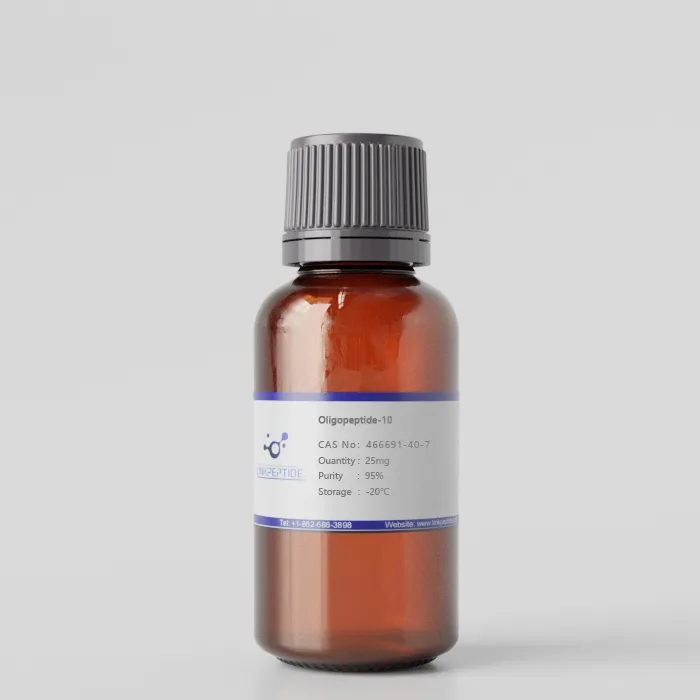
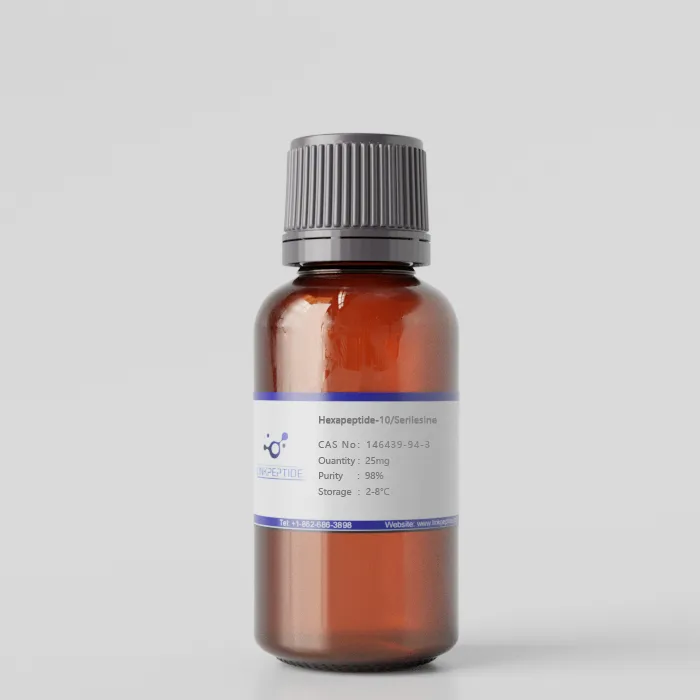
Product Name: Oligopeptide-10
Cas No: 466691-40-7
Purity: 95%
Storage: Keep in dark and cool dry place -5~8 degree Celsius
Sequence: FAKALKALLKALKAL-NH2
Molar Mass: 1598.1
Chemical Formula: C78H140N20O15
IUPAC Name: (2S)-6-amino-N-[(2S)-1-[[(2S)-1-[[(2S)-6-amino-1-[[(2S)-1-[[(2S)-1-[[(2S)-1-[[(2S)-6-amino-1-[[(2S)-1-[[(2S)-1-[[(2S)-6-amino-1-[[(2S)-1-[[(2S)-1-amino-4-methyl-1-oxopentan-2-yl]amino]-1-oxopropan-2-yl]amino]-1-oxohexan-2-yl]amino]-4-methyl-1-oxopentan-2-yl]amino]-1-oxopropan-2-yl]amino]-1-oxohexan-2-yl]amino]-4-methyl-1-oxopentan-2-yl]amino]-4-methyl-1-oxopentan-2-yl]amino]-1-oxopropan-2-yl]amino]-1-oxohexan-2-yl]amino]-4-methyl-1-oxopentan-2-yl]amino]-1-oxopropan-2-yl]-2-[[(2S)-2-[[(2S)-2-amino-3-phenylpropanoyl]amino]propanoyl]amino]hexanamide
SMILES: C[C@@H](C(=O)N[C@@H](CC(C)C)C(=O)N[C@@H](CCCCN)C(=O)N[C@@H](C)C(=O)N[C@@H](CC(C)C)C(=O)N[C@@H](CC(C)C)C(=O)N[C@@H](CCCCN)C(=O)N[C@@H](C)C(=O)N[C@@H](CC(C)C)C(=O)N[C@@H](CCCCN)C(=O)N[C@@H](C)C(=O)N[C@@H](CC(C)C)C(=O)N)NC(=O)[C@H](CCCCN)NC(=O)[C@H](C)NC(=O)[C@H](CC1=CC=CC=C1)N
InChIKey: XWZAWHJNTHSHGD-SIDOVBMKSA-N
InChI: InChI=1S/C78H140N20O15/c1-43(2)37-59(64(84)99)94-66(101)49(12)86-72(107)56(30-20-24-34-80)91-75(110)61(39-45(5)6)96-68(103)51(14)88-74(109)58(32-22-26-36-82)93-77(112)63(41-47(9)10)98-78(113)62(40-46(7)8)97-69(104)52(15)89-73(108)57(31-21-25-35-81)92-76(111)60(38-44(3)4)95-67(102)50(13)87-71(106)55(29-19-23-33-79)90-65(100)48(11)85-70(105)54(83)42-53-27-17-16-18-28-53/h16-18,27-28,43-52,54-63H,19-26,29-42,79-83H2,1-15H3,(H2,84,99)(H,85,105)(H,86,107)(H,87,106)(H,88,109)(H,89,108)(H,90,100)(H,91,110)(H,92,111)(H,93,112)(H,94,101)(H,95,102)(H,96,103)(H,97,104)(H,98,113)/t48-,49-,50-,51-,52-,54-,55-,56-,57-,58-,59-,60-,61-,62-,63-/m0/s1
Application:
Oligopeptide-10 is a bioactive peptide known for its powerful skin-balancing and clarifying properties, making it especially valuable in cosmetic research targeting blemish-prone and troubled skin. With strong antimicrobial activity against skin-associated bacteria, it helps support a clearer complexion while reducing the appearance of breakouts and surface congestion. Oligopeptide-10 also aids in soothing visible redness and reinforcing the skin’s natural defense barrier. Its excellent stability and compatibility with gels, serums, and lightweight emulsions make it ideal for formulations focused on promoting clarity, refining texture, and restoring a smoother, healthier-looking complexion.
Current Research:
Oligopeptide-10: Current Research Overview
Oligopeptide-10 is a synthetic cationic antimicrobial peptide (AMP) used in cosmetics primarily for acne-prone and blemish-prone skin. It is a short chain rich in positively charged amino acids (especially lysine and arginine), designed to mimic the structure and function of the skin’s natural antimicrobial peptides, such as defensins and cathelicidins.
In cosmetic formulas, Oligopeptide-10 is typically positioned as a “smart anti-acne peptide” that helps control problematic bacteria—especially Cutibacterium (Propionibacterium) acnes—while being milder and more barrier-friendly than aggressive antibacterial agents or high levels of acids and peroxides.
Mechanism of Action: Antimicrobial Peptide + Biofilm Disruption
Oligopeptide-10 is engineered along the same principles as natural antimicrobial peptides:
Cationic, membrane-targeting action
The peptide carries multiple positive charges, which are attracted to the negatively charged bacterial cell membrane. Once associated with the membrane, Oligopeptide-10 can disrupt its integrity, leading to leakage of cellular contents and reduced microbial viability. This mode of action targets bacterial membranes, not specific metabolic pathways, which helps lower the risk of classical resistance mechanisms.
Activity against acne-associated bacteria
In vitro testing from suppliers commonly shows that Oligopeptide-10 has strong activity against C. acnes, as well as action against other skin-relevant microbes involved in breakouts and secondary infections. This makes it suitable for comedone- and papule/pustule-prone skin.
Biofilm and synergy with acids
Oligopeptide-10 is often used in combination with salicylic acid, lauric acid, or other lipophilic acids. Data from technical dossiers suggest a synergistic effect: the acids help loosen and solubilize sebum/biofilm structures and partially weaken bacterial defenses, while the peptide amplifies the antimicrobial impact. This synergy allows lower levels of traditional actives, which can help reduce irritation.
Overall, Oligopeptide-10 sits squarely within the trend of mild, microbiome-aware antibacterial systems that support clearer skin while respecting the barrier.
Place in Modern Cosmetic Peptide Science
Within the broader peptide landscape, Oligopeptide-10 is best described as:
An antimicrobial peptide (AMP) analogue,
A microbiome-managing anti-acne active, and
A supportive barrier ingredient when formulated correctly.
Unlike classic signal peptides (collagen-boosting) or matrix peptides (firming), Oligopeptide-10’s main role is to regulate the microbial ecosystem on the skin’s surface. This aligns with current thinking about acne not just as “too much oil” but as a dysbiosis problem—an imbalance in the flora, combined with inflammation and follicular hyperkeratinization.
Many modern formulations pair Oligopeptide-10 with:
BHA/AHA systems (e.g., salicylic, mandelic, or lactic acid),
Niacinamide for inflammation and barrier support,
Soothing agents to counteract redness and sensitivity.
This allows brands to claim “clearer skin without harsh stripping” and supports long-term use on young and sensitive skin.
In Vitro and Application Data
Most publicly available information on Oligopeptide-10 comes from supplier testing and technical brochures, along with secondary reviews of cosmetic antimicrobial peptides. Commonly reported findings include:
Significant reduction in C. acnes counts in culture at relatively low peptide concentrations.
Broader antimicrobial action against other gram-positive and selected gram-negative skin flora involved in breakouts.
Evidence that combining Oligopeptide-10 with salicylic or lauric acid enhances antibacterial efficacy at lower concentrations of each active.
On the application side, small-scale user or in-house studies often describe:
Reduced number and severity of blemishes over several weeks of use.
Improvements in skin texture and clarity in oily and acne-prone volunteers.
Good tolerability, with fewer reports of dryness and peeling compared with traditional high-strength anti-acne regimens.
These data are mainly cosmetic-grade (not pharmaceutical trials), but the mechanistic rationale aligns well with broader AMP and acne research.
Safety and Formulation Considerations
Oligopeptide-10 is a synthetic, high-purity peptide used at low active levels in leave-on formulas. Typical product formats include:
Anti-blemish serums and spot treatments,
Oil-control and acne-prone moisturizers,
Clarifying toners, essences, and pads.
Standard safety and irritation testing from suppliers indicate good skin compatibility at recommended levels, especially when paired with barrier-supportive ingredients. As with other cosmetic peptides, it is intended purely for non-medical, aesthetic purposes—supporting clearer-looking skin, less congestion, and improved texture.
Get a Quote
 LinkPeptide