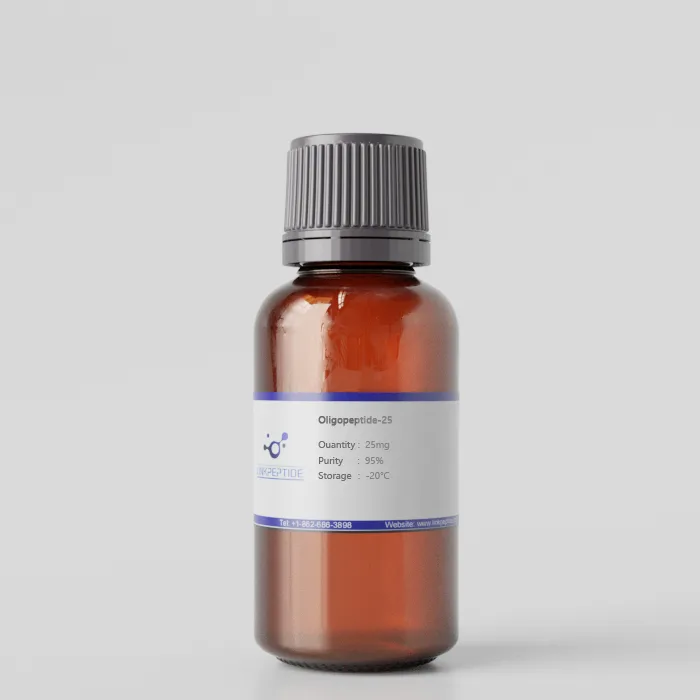
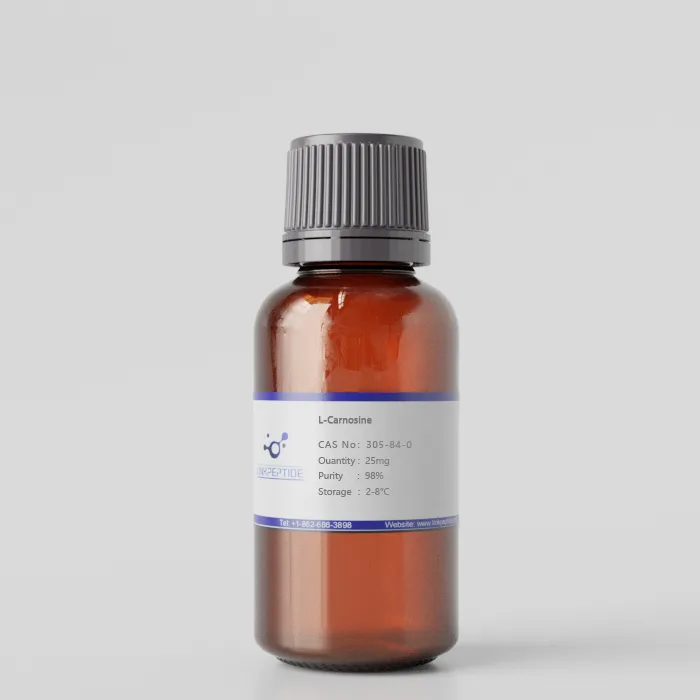
Product Name: Oligopeptide-25
Purity: 95%
Storage: Keep in dark and cool dry place -5~8 degree Celsius
Application:
Oligopeptide-25 is a bioactive peptide complex designed to support skin rejuvenation, smoothness, and improved radiance. Composed of short-chain amino acids with excellent skin affinity, it is widely used in cosmetic research targeting enhanced firmness, refined texture, and a more youthful appearance. Oligopeptide-25 helps support studies on boosting skin vitality, improving elasticity, and reducing the look of fine lines through optimized cellular communication. Its high stability and compatibility with serums, emulsions, and advanced anti-aging formulations make it ideal for developing treatments focused on revitalization, luminosity, and overall skin resilience.
Current Research:
Oligopeptide-25: Research Overview
Oligopeptide-25 is a synthetic dodecapeptide (12 amino acids) used as a functional cosmetic peptide in anti-aging and skin-repair research. It is composed of arginine, aspartic acid, glutamic acid, glutamine, glycine, isoleucine, leucine, serine, and tyrosine residues arranged in a defined sequence. This composition gives the peptide a mixed profile of basic, acidic, polar, and hydrophobic side chains, supporting both aqueous solubility and interaction with cellular and extracellular targets in the skin.
In cosmetic science classifications, Oligopeptide-25 is grouped with matrix-acting oligopeptides that mimic fragments of endogenous proteins, especially collagen. Naturally occurring collagen fragments, released during matrix turnover, act as signaling molecules (matrikines) that stimulate fibroblasts to synthesize new extracellular matrix components. Oligopeptide-25 is designed to imitate this feedback system and support the physiological repair process of the dermis.
Structure–Function Considerations
The sequence of Oligopeptide-25 provides multiple functional motifs:
Acidic residues (aspartic acid, glutamic acid) capable of coordinating ions and interacting with positively charged domains on matrix and cell-surface proteins.
Basic arginine residues that may contribute to binding to negatively charged components such as glycosaminoglycans and cell membranes.
Neutral polar side chains (serine, glutamine) associated with hydrogen bonding and hydration.
Hydrophobic branched-chain residues (isoleucine, leucine) that improve peptide–protein and peptide–lipid interactions.
This balance of residues enables the peptide to act as a small signaling ligand in the dermal environment, with potential binding to receptors or matrix-associated sites regulating fibroblast behavior.
Effects on Dermal Extracellular Matrix
Experimental and supplier data for Oligopeptide-25 and closely related collagen-mimetic oligopeptides report:
Stimulation of collagen synthesis in human fibroblast cultures, particularly collagen type I and type III, which are central to dermal structure and tensile strength.
Enhanced production of other extracellular matrix components such as fibronectin and glycosaminoglycans, contributing to improved dermal density and hydration capacity.
Modulation of matrix metalloproteinases (MMPs) and their tissue inhibitors (TIMPs), supporting a more favorable balance between collagen degradation and neosynthesis.
In vitro dermal models show that exposure to such matrikine-like peptides increases fibroblast proliferation and matrix deposition, consistent with the concept of Oligopeptide-25 as a matrix-regulating oligopeptide.
Barrier and Surface-Repair Aspects
Beyond deep-dermal effects, Oligopeptide-25 is often described in ingredient dossiers as contributing to barrier repair and surface-level regeneration:
Increased synthesis of structural proteins and matrix elements indirectly supports epidermal–dermal junction integrity, helping maintain mechanical coupling between epidermis and dermis.
By promoting a more robust dermal matrix, the peptide may assist the overlying epidermis in maintaining regular microrelief and reduced surface roughness in experimental models.
Improvements in barrier-related parameters (such as reduced transepidermal water loss) have been reported for formulations containing collagen-mimetic oligopeptides, which is consistent with enhanced dermal support and better organization of the stratum corneum.
These effects remain at the cosmetic level, focusing on structural support and recovery of physiological balance rather than pharmacological intervention.
Anti-Wrinkle and Texture Parameters
Instrumental cosmetic studies with oligopeptide-based anti-aging formulations often measure:
Changes in wrinkle depth and volume using profilometry or 3D optical imaging.
Alterations in skin roughness parameters and fine-line scoring.
Elasticity and firmness indices obtained via cutometry or related biomechanical tests.
For Oligopeptide-25, technical descriptions emphasize its role in mitigating the appearance of lines and wrinkles by reinforcing collagen networks and improving dermal resilience. The mechanism is indirect: by boosting matrix synthesis and moderating degradation, the dermis better resists mechanical folding and can partially restore lost support beneath wrinkle-prone regions.
Physicochemical and Formulation Properties
Oligopeptide-25 is typically supplied as a high-purity, lyophilized white powder. Key technical attributes include:
Molecular size in the oligopeptide range, allowing diffusion within aqueous phases and potential penetration into superficial dermal layers when formulated in suitable delivery systems.
Good water solubility, enabling incorporation into serums, gels, emulsions, sheet masks, and eye-area formulations.
Compatibility with common cosmetic excipients, including humectants, emollients, and other peptides.
Stability studies of similar cosmetic oligopeptides highlight the importance of controlled pH, antioxidant systems, and cool-down addition to preserve peptide integrity over product shelf life.
Research Focus
Current research interest around Oligopeptide-25 can be summarized as:
Characterization of its matrikine-like signaling and impact on collagen synthesis.
Evaluation of its contribution to dermal repair and remodeling in in vitro and ex vivo skin models.
Assessment of its role in improving surface texture, firmness, and barrier-related parameters when incorporated into topical cosmetic formulations.
These research themes place Oligopeptide-25 within the broader category of bioactive cosmetic peptides that leverage endogenous repair pathways to support structural maintenance of the skin.
Get a Quote
 LinkPeptide