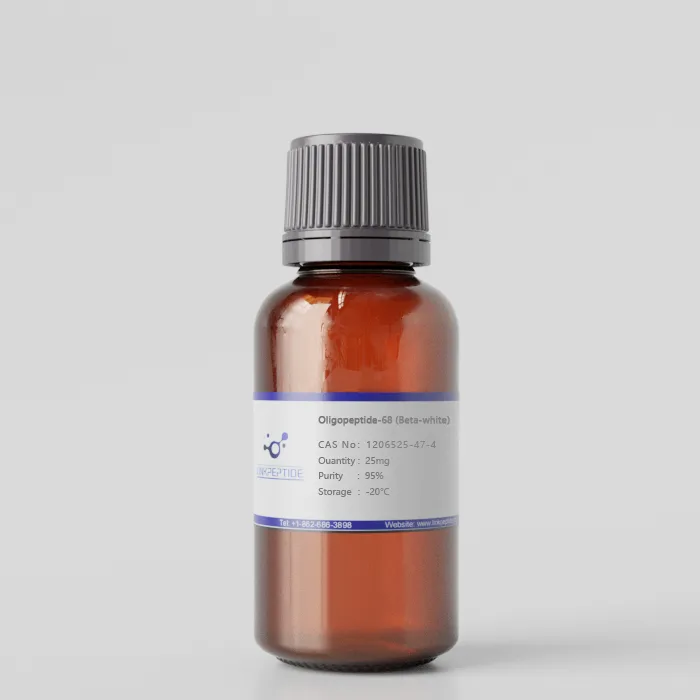
Product Name: Oligopeptide-68 (Beta-white)
Cas No: 1206525-47-4
Purity: 95%
Storage: Keep in dark and cool dry place -5~8 degree Celsius
Sequence: H-Gly-Arg-Gly-Asp-Tyr-Ile-Trp-Ser-Leu-Asp-Thr-Gln-OH
Molar Mass: 1410.5
Chemical Formula: C62H91N17O21
IUPAC Name: (2S)-5-amino-2-[[(2S,3R)-2-[[(2S)-2-[[(2S)-2-[[(2S)-2-[[(2S)-2-[[(2S,3S)-2-[[(2S)-2-[[(2S)-2-[[2-[[(2S)-2-[(2-aminoacetyl)amino]-5-(diaminomethylideneamino)pentanoyl]amino]acetyl]amino]-3-carboxypropanoyl]amino]-3-(4-hydroxyphenyl)propanoyl]amino]-3-methylpentanoyl]amino]-3-(1H-indol-3-yl)propanoyl]amino]-3-hydroxypropanoyl]amino]-4-methylpentanoyl]amino]-3-carboxypropanoyl]amino]-3-hydroxybutanoyl]amino]-5-oxopentanoic acid
SMILES: CC[C@H](C)[C@@H](C(=O)N[C@@H](CC1=CNC2=CC=CC=C21)C(=O)N[C@@H](CO)C(=O)N[C@@H](CC(C)C)C(=O)N[C@@H](CC(=O)O)C(=O)N[C@@H]([C@@H](C)O)C(=O)N[C@@H](CCC(=O)N)C(=O)O)NC(=O)[C@H](CC3=CC=C(C=C3)O)NC(=O)[C@H](CC(=O)O)NC(=O)CNC(=O)[C@H](CCCN=C(N)N)NC(=O)CN
InChIKey: HPPYJXKCLMBZCN-ZDQKBINTSA-N
InChI: InChI=1S/C62H91N17O21/c1-6-30(4)50(78-56(94)40(21-32-13-15-34(82)16-14-32)74-55(93)42(23-48(86)87)71-47(85)27-69-52(90)37(70-46(84)25-63)12-9-19-67-62(65)66)59(97)76-41(22-33-26-68-36-11-8-7-10-35(33)36)54(92)77-44(28-80)58(96)73-39(20-29(2)3)53(91)75-43(24-49(88)89)57(95)79-51(31(5)81)60(98)72-38(61(99)100)17-18-45(64)83/h7-8,10-11,13-16,26,29-31,37-44,50-51,68,80-82H,6,9,12,17-25,27-28,63H2,1-5H3,(H2,64,83)(H,69,90)(H,70,84)(H,71,85)(H,72,98)(H,73,96)(H,74,93)(H,75,91)(H,76,97)(H,77,92)(H,78,94)(H,79,95)(H,86,87)(H,88,89)(H,99,100)(H4,65,66,67)/t30-,31+,37-,38-,39-,40-,41-,42-,43-,44-,50-,51-/m0/s1
Application:
Oligopeptide-68 (Beta-White) is a biomimetic peptide designed to help brighten the skin and reduce the appearance of discoloration by targeting key pathways involved in melanin production. Inspired by components of the skin’s natural signaling system, it supports research on achieving a more even, radiant complexion while minimizing the look of dark spots and uneven tone. Oligopeptide-68 is valued for its gentle yet effective activity, making it suitable for sensitive-skin brightening formulations. Its strong stability and compatibility with serums, essences, and advanced pigmentation-correcting treatments make it ideal for promoting a clearer, more luminous appearance.
Current Research:
Oligopeptide-68 (Beta-White): Current Research Overview
Oligopeptide-68, commercially known as Beta-White? (or ?-White?), is a synthetic skin-brightening signal peptide designed to regulate melanogenesis at the genetic level. It is a 12-amino-acid peptide, inspired by the interplay of TGF-β1 and MITF (microphthalmia-associated transcription factor) in pigment formation.
In cosmetic products, Oligopeptide-68 is positioned as a next-generation whitening and anti-spot active that targets both constitutive pigmentation (baseline skin tone) and facultative pigmentation (UV-induced or acquired spots such as melasma and post-inflammatory hyperpigmentation).
Mechanism of Action: TGF-β Biomimetic + MITF / Tyrosinase Pathway
Current technical and scientific sources describe Oligopeptide-68 as a TGF-β1 biomimetic peptide that acts high up in the melanogenesis cascade:
TGF-β1 agonist / biomimetic
The peptide is designed to mimic TGF-β1 signaling at the cell surface, interacting with its receptor environment. This upstream modulation leads to downstream suppression of MITF, the master transcription factor that controls melanocyte differentiation and melanogenic enzyme expression.
MITF suppression and enzyme down-regulation
By inhibiting MITF activity and expression, Oligopeptide-68 reduces the transcription of key melanogenesis genes:
Tyrosinase (TYR)
TRP-1 (TYRP1)
TRP-2 (DCT)
As a result, tyrosinase activity drops, melanin synthesis decreases, and overall pigmentation is reduced.
MSH pathway modulation
Several technical documents also describe a secondary mechanism via inhibition of melanocyte-stimulating hormone (MSH), further limiting melanin overproduction, especially under UV or hormonal stimuli.
Together, these actions give Beta-White a double brightening effect: it addresses baseline skin dullness and acquired dark spots while helping prevent future UV-induced pigmentation surges.
Place in Modern Cosmetic Peptide Science
Within the cosmetic peptide landscape, Oligopeptide-68 is classified as a melanogenesis-regulating signal peptide rather than a classic tyrosinase inhibitor like arbutin or kojic acid. It works “upstream” by modulating gene expression (MITF, TYR, TRP-1, TRP-2) instead of simply blocking the enzyme’s active site.
Key differentiators:
Genetic-level control: Regulates transcription rather than only enzyme activity.
Broader spectrum: Targets both constitutive and facultative pigmentation, useful for uneven tone, melasma, and sunspots.
Biomimetic concept: Inspired by endogenous TGF-β signaling, fitting into the trend of human-pathway-mimetic cosmetic actives.
More recent supplier material also emphasizes anti-aging benefits: Oligopeptide-68 has been reported to support collagen synthesis and fibroblast activation, contributing to improved firmness and texture in addition to brightening.
In Vitro, Ex Vivo, and Clinical Evidence
In vitro / mechanistic
Melanocyte models show reduced MITF expression and down-regulated TYR, TRP-1, TRP-2, with corresponding decreases in melanin production.
Anti-melanogenic efficacy has been benchmarked against common actives such as arbutin and vitamin C, with reports that Oligopeptide-68 can achieve equal or higher activity at comparable or lower irritation potential.
Clinical data
A notable 2016 randomized controlled study evaluated two formulations containing Oligopeptide-68 (TGF-β1 biomimetic), diacetyl boldine (DAB), additional hypopigmenting/exfoliating agents, and sunscreen in patients with facial melasma. The combination:
Produced significant reductions in melasma pigmentation,
Was reported to be equal or superior to 4% hydroquinone in efficacy on normal skin,
Showed a better safety and tolerability profile than hydroquinone.
Other technical reports on Asian volunteers show high levels of subjective satisfaction: around 80–90% of subjects reporting improvement in brightness and evenness after several weeks, in line with instrumental measurements of decreased pigmentation and increased luminosity.
Safety and Formulation Considerations
Oligopeptide-68 (CAS 1206525-47-4) is a high-purity synthetic peptide used at low active concentrations in cosmetic formulas, typically incorporated into:
Brightening and anti-spot serums,
Melasma and hyperpigmentation creams,
Daily tone-correcting moisturizers and SPF products.
It appears in modern cosmetic ingredient inventories as a permitted whitening/anti-spot agent with no special restriction flags, and has a tolerability profile similar to other cosmetic peptides when used at recommended levels.
Get a Quote
 LinkPeptide