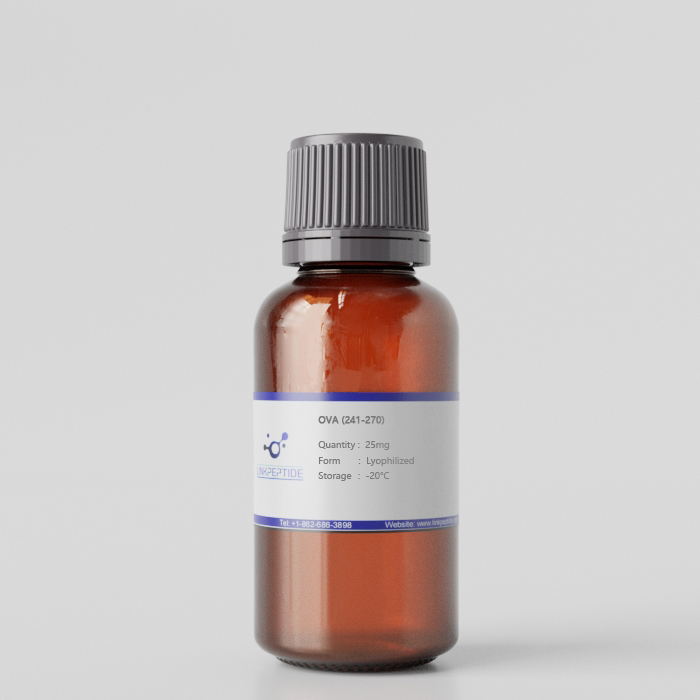
Product Name: OVA (241-270)
Sequence One Letter Code: SMLVLLPDEVSGLEQLESIINFEKLTEWTS
Sequence Three Letter Code: H-Ser-Met-Leu-Val-Leu-Leu-Pro-Asp-Glu-Val-Ser-Gly-Leu-Glu-Gln-Leu-Glu-Ser-Ile-Ile-Asn-Phe-Glu-Lys-Leu-Thr-Glu-Trp-Thr-Ser-OH
Chemical Formula:C154H246N34O51S1
Molecular Weight: 3421.9
Purity: 95%
Form: Lyophilized
Storage Conditions: - 20 °C
Research Area: Inflammation and Immunology Research
Source / Species: chicken
Conjugation: Unconjugated
Code Nacres: NA.26
Application: OVA (241–270) is a synthetic peptide corresponding to residues 241–270 of the ovalbumin protein. This region contains a well-characterized epitope that can be processed and presented by murine MHC class I molecules, particularly H-2Kᵇ, making it a valuable model antigen in immunological research. The peptide is widely used to study antigen presentation, cytotoxic T-cell activation, and adaptive immune responses in mouse models. Because ovalbumin is a well-established experimental antigen, OVA-derived peptides provide a reliable system for investigating T-cell recognition and antigen processing pathways. OVA (241–270) supports assays examining CD8⁺ T-cell responses, immune monitoring, and immune tolerance mechanisms. It is frequently applied in vaccine development studies, immunotherapy research, and experimental models exploring host immune responses and antigen-specific T-cell activation.
Current Research: Introduction to Model Antigens in Immunology Understanding how the immune system recognizes and responds to specific antigens is central to immunology research. Model antigen systems are widely used to dissect the molecular mechanisms underlying antigen processing, presentation, and T-cell activation. Among these systems, ovalbumin (OVA) has become one of the most extensively used experimental antigens in immunological studies. Synthetic peptides derived from ovalbumin allow researchers to analyze immune recognition in controlled experimental settings. One such peptide is OVA (241–270), a fragment corresponding to residues 241–270 of the ovalbumin protein. This peptide contains a well-characterized epitope capable of being processed and presented by murine MHC class I molecules, making it a valuable tool for investigating antigen presentation and cytotoxic T-cell responses. Structural and Immunological Features of OVA (241–270) The OVA (241–270) peptide represents a defined region within the ovalbumin protein that includes sequences recognized by the immune system during antigen presentation. When introduced into antigen-presenting cells, this peptide can be processed and displayed on the cell surface by major histocompatibility complex (MHC) class I molecules, particularly the murine H-2Kᵇ molecule. MHC class I presentation is essential for the activation of CD8⁺ cytotoxic T lymphocytes (CTLs). These immune cells recognize peptide–MHC complexes on infected or abnormal cells and initiate immune responses aimed at eliminating the target cells. Because the ovalbumin system is well characterized, peptides derived from OVA provide a reproducible framework for studying antigen-specific immune recognition. Applications in Antigen Presentation Studies OVA-derived peptides are widely used in experiments investigating the mechanisms of antigen processing and presentation. In these studies, researchers examine how peptides are generated, loaded onto MHC molecules, and displayed to T cells. Using a defined peptide such as OVA (241–270) allows scientists to evaluate the efficiency of antigen presentation pathways and identify factors that regulate peptide loading and presentation. These experiments help clarify how immune cells detect foreign or abnormal antigens and initiate adaptive immune responses. Because of the peptide’s compatibility with murine MHC class I molecules, it is particularly useful in mouse models of immune function. Studying CD8⁺ T-Cell Activation The OVA (241–270) peptide is frequently used in assays examining CD8⁺ T-cell activation and cytotoxic immune responses. When antigen-presenting cells display the peptide in association with MHC class I molecules, antigen-specific CD8⁺ T cells can recognize the peptide–MHC complex through their T-cell receptors. This interaction triggers a cascade of signaling events that lead to T-cell activation, proliferation, and the acquisition of cytotoxic functions. Researchers use this system to evaluate how T cells respond to antigen exposure and how different experimental conditions influence immune activation. Such studies are important for understanding immune defense mechanisms against pathogens and tumor cells. Applications in Vaccine Development and Immunotherapy Research Model antigens such as ovalbumin are widely used in vaccine development research. By using OVA-derived peptides, scientists can evaluate how vaccines stimulate antigen-specific T-cell responses and determine which immunization strategies produce the most effective immune activation. Similarly, OVA peptides are commonly used in immunotherapy research, where they serve as a model antigen for studying immune modulation and T-cell–based therapies. Because the OVA system is well characterized, it allows researchers to test new approaches for enhancing antigen-specific immune responses. These studies contribute to the development of therapeutic strategies aimed at improving immune responses against infections and cancer. Investigating Immune Tolerance and Immune Monitoring In addition to studies of immune activation, the OVA (241–270) peptide is also useful in experiments exploring immune tolerance mechanisms. Immune tolerance refers to the ability of the immune system to avoid reacting against self-antigens while still responding effectively to foreign antigens. Using defined peptides allows researchers to monitor how antigen exposure influences T-cell tolerance, deletion, or functional regulation. This approach is important for understanding autoimmune diseases and for designing therapies that modulate immune responses. Furthermore, OVA peptides can be incorporated into immune monitoring assays that measure antigen-specific T-cell responses in experimental models. Conclusion OVA (241–270) is a synthetic peptide derived from the ovalbumin protein that contains an epitope recognized by murine MHC class I molecules, particularly H-2Kᵇ. This property makes it a widely used model antigen for studying antigen presentation and cytotoxic T-cell activation. The peptide supports a variety of experimental applications, including antigen processing studies, CD8⁺ T-cell activation assays, immune monitoring, and investigations of immune tolerance mechanisms. Frequently used in vaccine development and immunotherapy research, OVA (241–270) provides a reliable and well-characterized system for exploring antigen-specific immune responses and the molecular mechanisms underlying adaptive immunity.
Get a Quote
 LinkPeptide