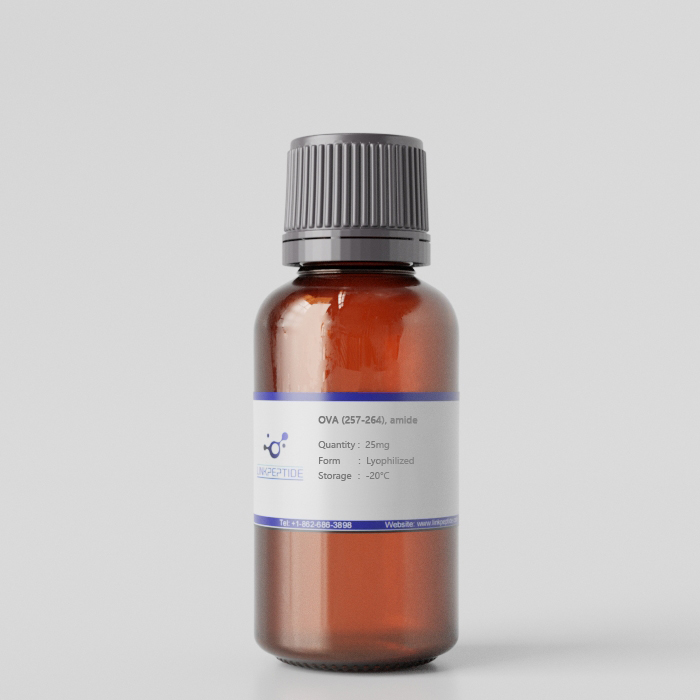
Product Name: OVA (257-264), amide
Sequence One Letter Code: SIINFEKL-NH2
Sequence Three Letter Code: H-Ser-Ile-Ile-Asn-Phe-Glu-Lys-Leu-NH2
Chemical Formula:C45H74N10O13
Molecular Weight: 962.2
Purity: 95%
Form: Lyophilized
Storage Conditions: - 20 °C
Research Area: Inflammation and Immunology Research
Source / Species: chicken
Conjugation: Unconjugated
Code Nacres: NA.26
Application: OVA (257–264), amide, is a synthetic octapeptide derived from ovalbumin and represents a well-characterized H-2Kb–restricted MHC class I epitope. This peptide is widely used as a model antigen in immunology to study antigen processing, MHC class I presentation, and CD8⁺ T cell activation. The C-terminal amidation enhances peptide stability and supports efficient binding to MHC molecules. OVA (257–264) is commonly applied in vaccine development research, immune monitoring assays, and transgenic mouse models designed to evaluate cytotoxic T lymphocyte responses. Its defined immunogenic properties make it a reliable tool for investigating T cell receptor recognition, immune regulation, and adaptive immune mechanisms. This peptide supports preclinical studies of antigen-specific immunity and immunotherapeutic strategies.
Current Research: OVA (257–264), commonly referred to as SIINFEKL, is a synthetic octapeptide derived from chicken ovalbumin and represents one of the most extensively characterized MHC class I–restricted epitopes in immunology. This peptide binds with high affinity to the murine H-2Kb molecule and is specifically recognized by CD8⁺ cytotoxic T lymphocytes (CTLs). The C-terminal amidation enhances peptide stability and can support improved resistance to exopeptidase degradation while maintaining efficient MHC binding. Due to its well-defined immunogenic properties, OVA (257–264), amide serves as a foundational model antigen for studying antigen presentation, T cell activation, and adaptive immune regulation. Within the MHC class I pathway, endogenous or cross-presented antigens are processed into short peptides that bind to MHC molecules in the endoplasmic reticulum and are subsequently displayed on the cell surface. OVA (257–264) is an ideal experimental surrogate for investigating this pathway because its binding affinity to H-2Kb is well established and its immunological responses are highly reproducible. Exogenous addition of the peptide to antigen-presenting cells (APCs) bypasses upstream proteasomal processing, allowing researchers to focus specifically on peptide–MHC loading and T cell receptor (TCR) engagement. The peptide is widely used in transgenic mouse models, particularly OT-I mice, which express a TCR specific for the OVA (257–264)/H-2Kb complex. In these systems, antigen-specific CD8⁺ T cells can be tracked with high precision, enabling detailed analysis of proliferation, effector differentiation, memory formation, and tolerance induction. Upon stimulation with SIINFEKL, OT-I T cells undergo rapid clonal expansion and produce effector cytokines such as interferon-γ. These responses provide quantitative readouts for evaluating immune activation. C-terminal amidation contributes to peptide stability by neutralizing the terminal carboxyl group, potentially enhancing resistance to enzymatic degradation during in vitro or in vivo experiments. While the core epitope sequence remains unchanged, improved stability supports consistent experimental outcomes in immune monitoring assays and vaccine evaluation studies. OVA (257–264) is central to vaccine research and immunotherapeutic development. It is frequently incorporated into nanoparticle formulations, viral vectors, dendritic cell–based vaccines, and tumor models to assess antigen-specific CTL responses. Measurement of T cell activation can be performed using ELISPOT assays, intracellular cytokine staining, tetramer-based flow cytometry, or in vivo cytotoxicity assays. Because of its defined specificity, the peptide enables precise assessment of vaccine-induced immune responses. In tumor immunology, OVA-expressing tumor cell lines are used in combination with the OVA (257–264) epitope to evaluate antigen-specific antitumor immunity. Adoptive transfer of OT-I T cells into tumor-bearing mice allows controlled investigation of CTL-mediated tumor clearance, immune checkpoint modulation, and mechanisms of immune escape. This model system has contributed significantly to understanding T cell exhaustion, costimulatory signaling, and immunotherapeutic checkpoint blockade strategies. The peptide also supports studies of peripheral tolerance and immune regulation. Controlled exposure to OVA (257–264) under tolerogenic conditions can induce anergy or deletion of antigen-specific T cells, providing insight into mechanisms that prevent autoimmunity. In summary, OVA (257–264), amide is a well-characterized H-2Kb-restricted MHC class I epitope widely used as a model antigen in immunological research. Its stability, defined TCR specificity, and compatibility with transgenic systems make it an indispensable tool for studying antigen presentation, CD8⁺ T cell activation, immune regulation, and preclinical immunotherapeutic strategies.
Get a Quote
 LinkPeptide