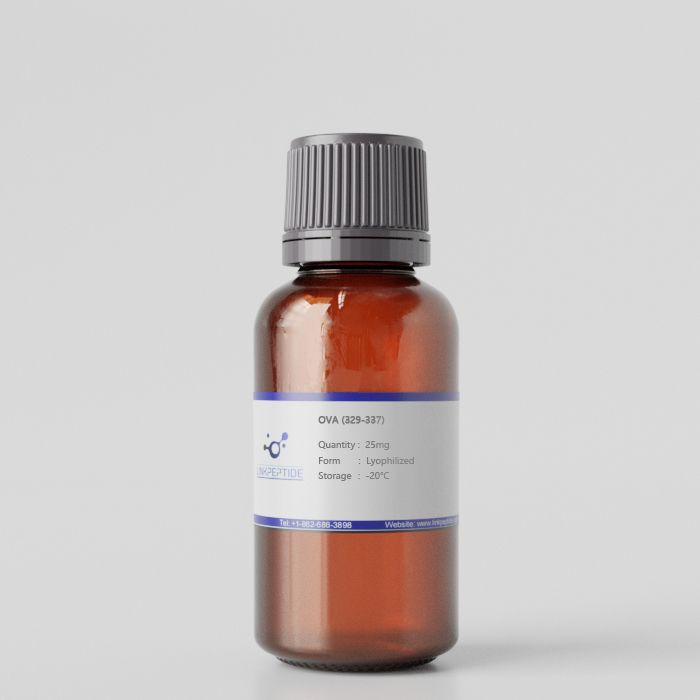
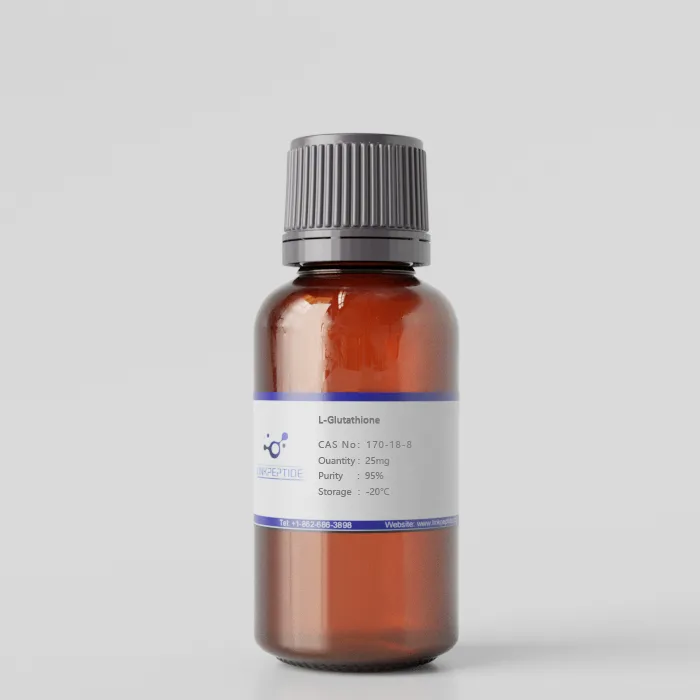
Product Name: OVA (329-337)
Sequence One Letter Code: AAHAEINEA
Sequence Three Letter Code: H-Ala-Ala-His-Ala-Glu-Ile-Asn-Glu-Ala-OH
Chemical Formula:C38H60N12O15
Molecular Weight: 925
Purity: 95%
Form: Lyophilized
Storage Conditions: - 20 °C
Research Area: Inflammation and Immunology Research
Source / Species: chicken
Conjugation: Unconjugated
Code Nacres: NA.26
Application: This peptide represents a well-characterized ovalbumin-derived epitope recognized by OT-II transgenic T-cell receptors and presented by MHC class II molecules. It is widely used as a model antigen in studies of CD4⁺ T-cell activation, antigen processing, and adaptive immune responses. The peptide supports investigations into T-cell proliferation, cytokine production, differentiation, and immune tolerance. It is a standard reagent for in vitro stimulation assays and in vivo adoptive transfer models. Applications include vaccine development research, antigen-specific immune monitoring, and mechanistic studies of T-cell receptor signaling.
Current Research: Understanding how T cells recognize antigens and orchestrate adaptive immune responses is central to immunology, vaccine development, and immunotherapy research. Because immune responses involve highly complex molecular interactions, researchers often rely on well-defined model antigen systems that allow precise experimental control. One of the most widely used models involves ovalbumin (OVA), a protein derived from chicken egg white that has become a classic antigen in immunological studies. Among the best-characterized OVA epitopes is the MHC class II–restricted peptide recognized by OT-II transgenic T-cell receptors, which has become a standard reagent for studying CD4⁺ T-cell activation and antigen-specific immune responses. The OT-II T-Cell Model System The OT-II mouse model is a transgenic system in which CD4⁺ T cells express a T-cell receptor (TCR) that specifically recognizes a defined peptide fragment of ovalbumin presented by MHC class II molecules (I-Aᵇ). Because nearly all CD4⁺ T cells in OT-II mice share the same antigen specificity, the system provides a highly controlled framework for studying antigen recognition and T-cell activation. In a normal immune response, antigen-presenting cells (APCs) such as dendritic cells internalize proteins, process them into peptide fragments, and present these peptides on MHC class II molecules. T cells that carry receptors capable of recognizing the peptide–MHC complex become activated and initiate adaptive immune responses. The OVA-derived OT-II peptide replicates this process in a controlled experimental setting, enabling researchers to precisely stimulate antigen-specific CD4⁺ T cells. Antigen Processing and MHC Class II Presentation The OT-II peptide corresponds to a defined epitope within the ovalbumin protein that is efficiently presented by MHC class II molecules. In experimental systems, antigen-presenting cells load this peptide onto their MHC class II complexes and display it on the cell surface. When OT-II CD4⁺ T cells encounter these peptide–MHC complexes, their T-cell receptors recognize the antigen and initiate intracellular signaling pathways that lead to activation. This interaction triggers several hallmark events of T-cell activation, including T-cell proliferation, cytokine secretion, and differentiation into specialized helper T-cell subsets. Because the antigenic peptide is precisely defined, researchers can carefully control antigen concentration and presentation conditions, making the system ideal for mechanistic studies of immune signaling. Applications in T-Cell Activation and Functional Studies The OT-II ovalbumin peptide is widely used to investigate CD4⁺ T-cell biology in both in vitro and in vivo systems. In cell culture experiments, the peptide is commonly applied to stimulate OT-II T cells in the presence of antigen-presenting cells. This approach enables detailed analysis of T-cell receptor signaling pathways, including early activation events such as calcium flux, kinase activation, and transcription factor induction. In addition to signaling studies, the peptide supports experiments examining T-cell proliferation and cytokine production. Activated OT-II T cells can produce cytokines such as interleukin-2 (IL-2), interferon-γ (IFN-γ), and interleukin-4 (IL-4), depending on the experimental conditions and differentiation pathways being investigated. Researchers often use these responses as readouts for immune activation or immune regulation. Investigating T-Cell Differentiation and Immune Tolerance Beyond basic activation studies, the OT-II peptide plays a key role in research on T-cell differentiation and immune tolerance. CD4⁺ T cells can differentiate into multiple functional subsets—including Th1, Th2, Th17, and regulatory T cells (Tregs)—each with distinct roles in immune responses. By stimulating OT-II T cells with the ovalbumin peptide under different cytokine environments, researchers can examine how external signals influence lineage commitment and functional specialization. This approach has provided valuable insights into the mechanisms that control immune polarization and tolerance. The peptide is also used to study immune tolerance mechanisms, including peripheral tolerance and regulatory T-cell development. These processes are crucial for preventing autoimmune disease and maintaining immune homeostasis. Use in In Vivo Adoptive Transfer Models Another important application of the OT-II peptide involves adoptive transfer experiments. In these studies, OT-II CD4⁺ T cells are transferred into recipient mice and then stimulated with the ovalbumin peptide or ovalbumin-expressing antigens. Because the transferred T cells are antigen-specific, researchers can track their activation, expansion, and migration during immune responses. These models are widely used to investigate antigen-specific immune responses in vivo, including T-cell priming in lymph nodes, effector cell trafficking, and memory T-cell formation. Such studies help reveal how immune responses develop within complex physiological environments. Relevance to Vaccine and Immunotherapy Research The OT-II ovalbumin peptide system has become an essential platform for vaccine development and immune monitoring research. By incorporating ovalbumin epitopes into experimental vaccine formulations, scientists can evaluate how different adjuvants, delivery systems, or immunization strategies influence antigen-specific CD4⁺ T-cell responses. In addition, the system is frequently used to study antigen presentation efficiency, dendritic cell function, and T-cell priming mechanisms. These insights are critical for designing more effective vaccines and immunotherapies. A Foundational Tool in Immunological Research Because of its well-defined antigen specificity, reproducibility, and compatibility with transgenic mouse models, the ovalbumin OT-II peptide has become one of the most widely used reagents in experimental immunology. It enables controlled investigation of key aspects of adaptive immunity, including antigen processing, T-cell receptor signaling, and CD4⁺ T-cell differentiation. As immunology continues to advance toward more precise therapeutic strategies, model antigen systems such as the OT-II peptide remain indispensable tools for uncovering the molecular mechanisms that govern antigen-specific immune responses.
Get a Quote
 LinkPeptide