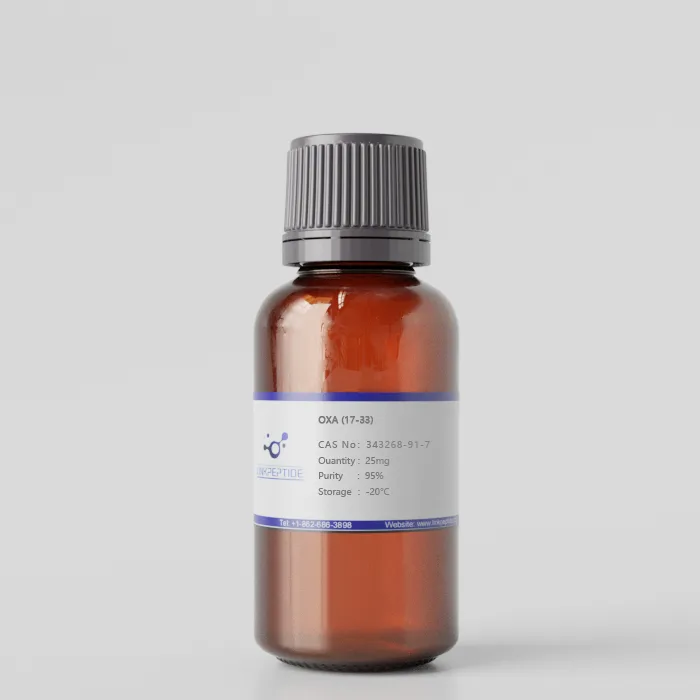
Product Name:OXA (17-33)
CAS No:343268-91-7
Purity:95%
Molar Mass:1748.98
Chemical Formula:C79H125N23O22
Storage:Store at -20 degrees Celsius
Sequence:YELLHGAGNHAAGILTL-NH2
Target:orexin-1 receptor (OX1)
Application:OXA (17-33) is a peptide fragment that acts as a selective agonist for the orexin-1 receptor (OX1). The orexin system, including OX1, is crucial for regulating wakefulness, arousal, and appetite. OXA (17-33) is used in research to explore the physiological functions of the OX1 receptor, particularly in the contexts of sleep-wake cycles, energy balance, and appetite regulation. This peptide plays a key role in studies related to sleep disorders like narcolepsy, obesity, and anxiety, where modulation of the orexin pathway offers potential therapeutic benefits. Its specificity for OX1 makes it a valuable tool for investigating orexin signaling.
Current Research:
OXA (17-33), also known as Orexin A (17-33), is a truncated peptide fragment of the endogenous neuropeptide Orexin A. This segment comprises amino acids 17 to 33 of the full-length Orexin A sequence. It functions as a potent and selective agonist for the orexin-1 receptor (OX1R), exhibiting an EC?? of approximately 8.29 nM for OX1R and 187 nM for the orexin-2 receptor (OX2R), indicating a 23-fold selectivity for OX1R over OX2R.
Structural Characteristics
The peptide sequence of OXA (17-33) is Tyr-Glu-Leu-Leu-His-Gly-Ala-Gly-Asn-His-Ala-Ala-Gly-Ile-Leu-Thr-Leu-NH?. The C-terminal amidation enhances its stability and receptor affinity.
Mechanism of Action
As an OX1R agonist, OXA (17-33) binds to and activates the receptor, which is a G protein-coupled receptor involved in regulating various physiological processes, including arousal, appetite, and energy homeostasis. Activation of OX1R by OXA (17-33) initiates intracellular signaling cascades that influence these functions.
Research Applications
Due to its high selectivity and potency, OXA (17-33) is utilized in research to study the specific roles of OX1R in physiological and pathological conditions. It serves as a valuable tool for dissecting the contributions of OX1R activation in processes such as sleep-wake regulation, feeding behavior, and neuroendocrine signaling.
Conclusion
OXA (17-33) is a truncated, potent, and selective agonist of the orexin-1 receptor, offering significant utility in research focused on the orexin system and its associated physiological functions.
Reference:
Get a Quote
 LinkPeptide