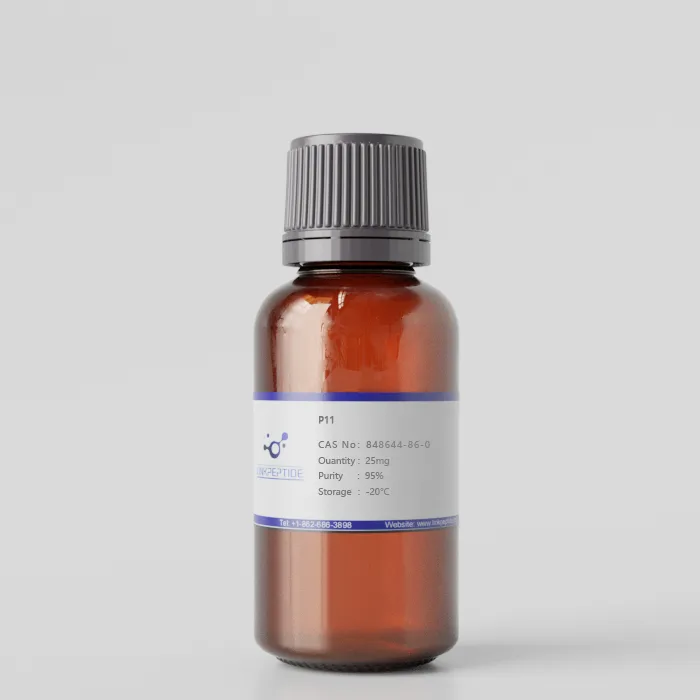
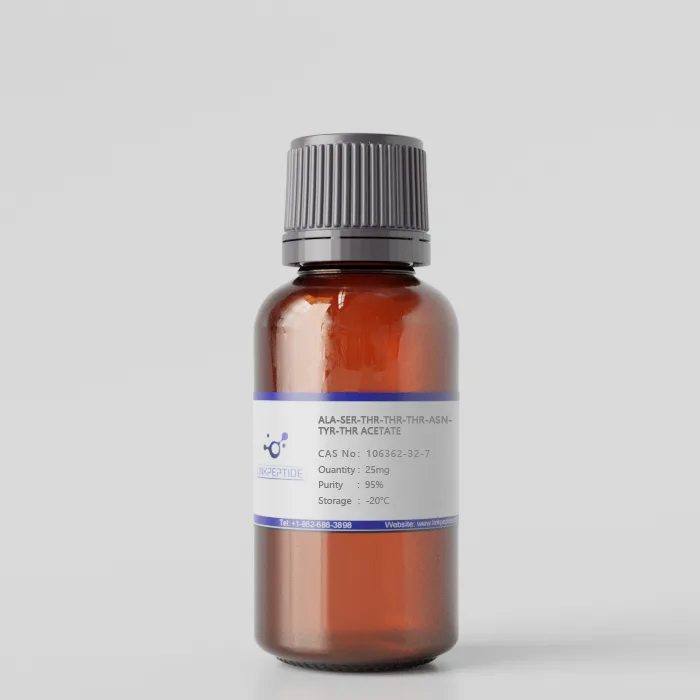
Product Name:P11
CAS No:848644-86-0
Purity:95%
Molar Mass:720.78
Chemical Formula:C30H48N12O9
Storage:Store at -20 degrees Celsius
Sequence:HSDVHK
Target:integrin integrin αvβ3-vitronectin
Application:
P11 is involved in the modulation of the integrin αvβ3-vitronectin interaction, which plays a vital role in cell adhesion, migration, and signaling. This pathway is significant in processes such as angiogenesis, cancer metastasis, and tissue repair. By influencing the binding between integrin αvβ3 and vitronectin, P11 can impact cellular responses related to tumor progression and new blood vessel formation. As a result, P11 is of interest in cancer research, where targeting this pathway could offer therapeutic opportunities for inhibiting tumor growth and angiogenesis.
Current Research:
P11 (CAS: 848644-86-0), also known as HSDVHK-NH₂, is a synthetic hexapeptide with the sequence His-Ser-Asp-Val-His-Lys-NH₂. It functions as a potent antagonist of the integrin αvβ3-vitronectin interaction, exhibiting an IC₅₀ value of 25.72 nM.
Biological Activity
Anti-Angiogenic Effects: P11 effectively inhibits the proliferation of human umbilical vein endothelial cells (HUVECs) by inducing apoptosis through caspase activation. This process is associated with increased expression of the tumor suppressor protein p53, highlighting its potential as an anti-angiogenic agent.
Integrin αvβ3 Inhibition: By specifically targeting the Arg-Gly-Asp (RGD)-binding site of integrin αvβ3, P11 disrupts its interaction with vitronectin. This inhibition is site-specific, as P11 does not affect the complex formation between denatured integrin and vitronectin, underscoring its selectivity.
Research Applications
P11 serves as a valuable tool in studies focusing on:
Angiogenesis: Investigating the mechanisms of new blood vessel formation and exploring therapeutic strategies for diseases characterized by abnormal angiogenesis, such as cancer and diabetic retinopathy.
Integrin-Mediated Cell Adhesion: Understanding the role of integrins in cell adhesion, migration, and signaling pathways, which are critical in various physiological and pathological processes.
Conclusion
P11 is a potent and selective inhibitor of integrin αvβ3, offering significant potential in anti-angiogenic therapy and integrin-related research. Its ability to induce apoptosis in endothelial cells and disrupt integrin-mediated interactions makes it a promising candidate for further investigation in therapeutic development.
Reference:
Get a Quote
 LinkPeptide