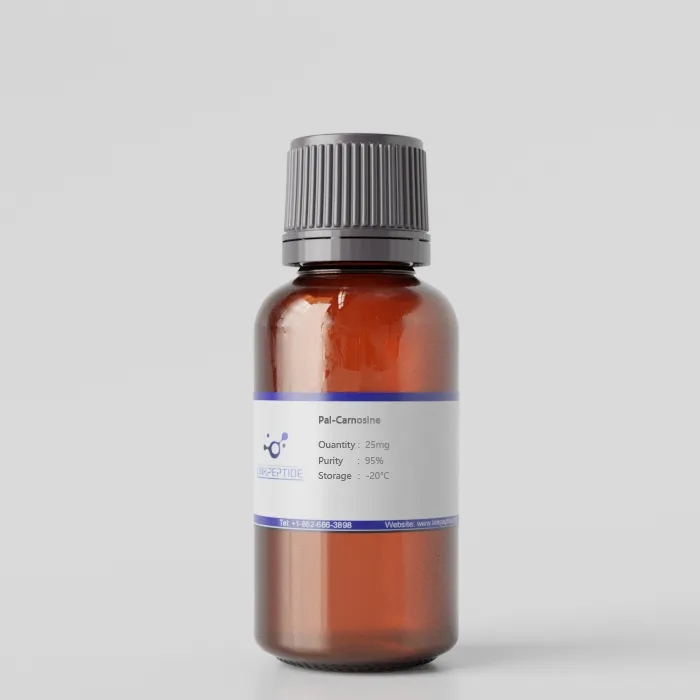
Product Name: Pal-Carnosine
Purity: 95%
Storage: Keep in dark and cool dry place -5~8 degree Celsius
Sequence: Pal-Carnosine
Application:
Pal-Carnosine is a lipidated form of the antioxidant dipeptide carnosine, designed to enhance skin absorption and long-lasting protective activity. Known for its powerful anti-glycation and anti-aging properties, Pal-Carnosine helps defend structural proteins from sugar-induced damage while reducing the appearance of dullness and fine lines. Its palmitoyl modification improves stability and affinity for the skin barrier, supporting research focused on firmness, elasticity, and overall revitalization. Ideal for serums, creams, and advanced anti-aging formulations, Pal-Carnosine contributes to a brighter, smoother, and more resilient complexion by protecting against oxidative and environmental stressors.
Current Research:
Pal-Carnosine (Palmitoyl Carnosine): Research Overview
Pal-Carnosine (Palmitoyl Carnosine) is a lipophilic derivative of the endogenous dipeptide carnosine (β-alanyl-L-histidine). It is produced by attaching a palmitoyl (C16) fatty acid chain to the peptide, typically at the N-terminus. This modification transforms carnosine from a hydrophilic, rapidly metabolized molecule into an amphiphilic, membrane-associating derivative with improved stability and topical delivery properties. In skin research, Pal-Carnosine is investigated primarily for anti-glycation, antioxidant, metal-chelation, and cytoprotective activities within the context of cutaneous aging and environmental stress.
Carnosine consists of β-alanine and histidine, with the histidine imidazole ring providing nucleophilic and metal-binding capacity. Palmitoylation introduces:
A hydrophobic C16 chain that promotes incorporation into lipid domains of the stratum corneum and cell membranes.
Increased resistance to enzymatic hydrolysis relative to free carnosine.
Amphiphilic behavior that supports localization at aqueous–lipid interfaces and potential reservoir formation in the outer epidermis.
This design is intended to preserve the core biochemical functions of carnosine while overcoming limitations in skin penetration and in situ degradation by carnosinase.
Carnosine is a well-characterized anti-glycation dipeptide, reacting with reactive carbonyl species derived from glucose and lipid peroxidation. Pal-Carnosine retains the histidine-based reactivity toward:
α-dicarbonyl compounds such as methylglyoxal.
Reactive aldehydes generated during oxidative degradation of lipids and sugars.
By competing with long-lived proteins (for example, collagen and elastin) for carbonyl reagents, the palmitoylated derivative is expected to reduce formation of advanced glycation end products (AGEs) and crosslinks in the dermal matrix. This mechanism is central in research models that examine:
Stiffening of collagen fibrils.
Loss of elasticity and increased matrix brittleness.
Accumulation of yellow-brown chromophores associated with glycation.
The lipophilic nature of Pal-Carnosine permits higher local concentrations within lipid-associated regions of the skin, potentially enhancing protection against glycation in situ.
The histidine imidazole ring in Pal-Carnosine provides:
Radical-quenching and singlet-oxygen–quenching capacity.
Chelation of transition metals such as copper and iron.
Interaction with lipid peroxyl intermediates in membrane environments.
These properties contribute to indirect antioxidant effects, including:
Reduced propagation of lipid peroxidation chains.
Attenuation of metal-catalyzed generation of hydroxyl radicals.
Lower accumulation of oxidized protein and lipid products in model systems.
Because the palmitoyl chain targets lipid domains, Pal-Carnosine is of particular interest in research on membrane and extracellular-matrix lipid protection under UV or pollution-induced oxidative stress.
Studies on carnosine-based systems describe several cytoprotective effects that are conceptually extended to Pal-Carnosine:
Limitation of protein carbonylation and maintenance of enzymatic activity under oxidative load.
Protection of mitochondrial function and reduction of stress-induced apoptosis in fibroblasts and keratinocytes.
Modulation of stress-response pathways relating to heat-shock proteins and redox-sensitive transcription factors.
Within this framework, Pal-Carnosine is positioned as a candidate molecule for attenuating “carbonyl stress” and oxidative components of cellular senescence in cutaneous tissues.
Anti-glycation and antioxidant actions converge on preservation of extracellular-matrix architecture. In skin-aging models, carnosine-based actives are associated with:
Reduced AGE formation in collagen and elastin.
Improved collagen fibril organization and flexibility.
Decreased fragmentation and irregularity of matrix fibers.
By localizing in lipid-rich domains and providing sustained histidine-mediated reactivity, Pal-Carnosine is expected to support similar outcomes, helping to maintain more homogeneous and elastic dermal structures in the presence of glycation and oxidative challenges.
The amphiphilic profile of Pal-Carnosine suggests additional roles at the level of the stratum corneum:
Incorporation into intercellular lipid lamellae, contributing to barrier stability.
Local buffering and metal-chelating capacity in the outer epidermis.
Potential modulation of surface oxidative processes that influence color, roughness, and microrelief.
These aspects place Pal-Carnosine within research themes that connect biochemical protection to visible surface properties through preservation of barrier function and matrix quality.
Pal-Carnosine is:
Lipophilic due to the palmitoyl chain, often supplied pre-dissolved in suitable cosmetic solvents or carriers.
Incorporated preferentially into oil phases, emulsions, liposomes, or other lipid-based delivery systems.
Used at low concentrations, consistent with its classification as a bioactive lipopeptide.
Formulation strategies typically seek to maintain peptide integrity, avoid excessive oxidation, and ensure distribution in both stratum corneum lipids and viable-epidermis–adjacent compartments.
Summary
Pal-Carnosine (Palmitoyl Carnosine) is a palmitoylated dipeptide derivative that combines the anti-glycation, antioxidant, metal-chelating, and carbonyl-stress–modulating properties of carnosine with enhanced lipophilicity, membrane association, and stability. In skin research, it is studied as a matrix-protective and cytoprotective lipopeptide targeting glycation, oxidative damage, and structural degradation processes associated with cutaneous aging and environmental stress.
Get a Quote
 LinkPeptide