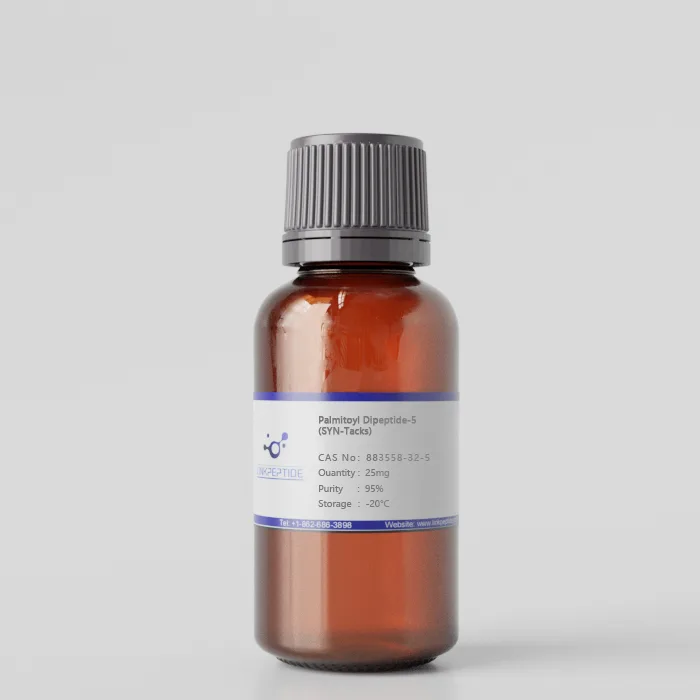
Product Name: Palmitoyl Dipeptide-5 (SYN-Tacks)
Cas No: 883558-32-5
Purity: 95%
Storage: Keep in dark and cool dry place -5~8 degree Celsius
Sequence: Pal-Lys-Val-Dab-Thr
Molar Mass: 913
Chemical Formula: C39H70F6N6O11
IUPAC Name: (2S,3R)-2-[[(2S)-4-amino-2-[[(2S)-2-[[(2S)-6-amino-2-(hexadecanoylamino)hexanoyl]amino]-3-methylbutanoyl]amino]butanoyl]amino]-3-hydroxybutanoic acid;bis(2,2,2-trifluoroacetic acid)
SMILES: CCCCCCCCCCCCCCCC(=O)N[C@@H](CCCCN)C(=O)N[C@@H](C(C)C)C(=O)N[C@@H](CCN)C(=O)N[C@@H]([C@@H](C)O)C(=O)O.C(=O)(C(F)(F)F)O.C(=O)(C(F)(F)F)O
InChIKey: MCCUAUFXOWFEEM-LAUWSANRSA-N
InChI: InChI=1S/C35H68N6O7.2C2HF3O2/c1-5-6-7-8-9-10-11-12-13-14-15-16-17-21-29(43)38-27(20-18-19-23-36)32(44)40-30(25(2)3)34(46)39-28(22-24-37)33(45)41-31(26(4)42)35(47)48;2*3-2(4,5)1(6)7/h25-28,30-31,42H,5-24,36-37H2,1-4H3,(H,38,43)(H,39,46)(H,40,44)(H,41,45)(H,47,48);2*(H,6,7)/t26-,27+,28+,30+,31+;;/m1../s1
Application:
Palmitoyl Dipeptide-5 (SYN-Tacks) is a synergistic bioactive peptide complex designed to support multi-level firmness and visible skin rejuvenation. By combining two palmitoylated dipeptides with strong affinity for the skin’s structural matrix, SYN-Tacks helps promote optimal collagen and laminin production, reinforcing the dermal–epidermal junction. In cosmetic research, it is widely used to explore improved elasticity, smoother texture, and reduced appearance of fine lines. Its excellent stability and compatibility with serums and advanced anti-aging creams make Palmitoyl Dipeptide-5 ideal for formulations targeting enhanced skin density, resilience, and a firmer, more youthful-looking complexion.
Current Research:
Palmitoyl Dipeptide-5 (SYN-Tacks): Research Overview
Palmitoyl Dipeptide-5, commercially known as SYN-Tacks, is a lipo-dipeptide complex developed for targeted modulation of the dermal–epidermal junction (DEJ) and upper dermal extracellular matrix. The system consists of two structurally related palmitoylated dipeptides, each containing a short peptide segment linked to a palmitic acid (C16) chain and additional functional groups that enhance aqueous solubility and biological interaction.
Each Palmitoyl Dipeptide-5 derivative in the complex features:
A dipeptide backbone with polar and basic residues, designed to mimic fragments of matrix- or receptor-related sequences.
A palmitoyl moiety that increases lipophilicity, supports insertion into stratum corneum lipid domains, and improves resistance to proteolytic degradation.
Additional small side-chain modifications (diaminobutyryl, hydroxy amino acid motifs) that promote water compatibility and interaction with cell-surface proteins.
The overall result is an amphiphilic micropeptide system capable of partitioning into both aqueous and lipid compartments, localizing near keratinocyte and fibroblast membranes and within the DEJ region.
The principal research focus for Palmitoyl Dipeptide-5 is the reinforcement of DEJ structure. The DEJ forms the mechanical and signaling interface between epidermis and dermis and gradually flattens with age, leading to reduced anchoring strength and altered mechanical behavior.
In ex vivo skin and reconstructed skin models, the Palmitoyl Dipeptide-5 complex has been characterized by:
Upregulation of basement membrane components such as laminin isoforms and collagen IV.
Increased expression of collagen VII, which forms anchoring fibrils that link the basement membrane to the underlying dermis.
Modulation of collagen XVII (BP180) and associated hemidesmosomal structures, supporting epidermal attachment.
These molecular changes point to improved continuity and density of the DEJ, with more pronounced rete-ridge structures and a less planar interface.
DEJ stability depends heavily on integrin-mediated adhesion between keratinocytes and the basement membrane. Palmitoyl Dipeptide-5 has been reported, in model systems, to increase levels of:
Integrin α6 and β4, key components of hemidesmosomes that link basal keratinocytes to laminin and collagen in the basement membrane.
Associated adhesion molecules that contribute to epidermal–dermal cohesion.
By influencing integrin expression and distribution, the peptide complex supports stronger mechanical coupling between epidermis and dermis, which is relevant to resistance against shear stress and wrinkle formation at skin folds.
In dermal fibroblast cultures and skin organ models, Palmitoyl Dipeptide-5 has been associated with changes in papillary dermis ECM:
Enhanced synthesis of fibronectin and other multi-adhesive glycoproteins that orchestrate matrix assembly.
Increased levels of selected collagen isoforms important in the upper dermis.
Influence on matrix organization around capillaries and DEJ-adjacent regions.
These observations place the peptide complex in the class of matrix-signaling lipopeptides that act not by direct mechanical filling but by regulating the biosynthesis and arrangement of structural proteins.
Cosmetic-style instrumental studies using formulations containing Palmitoyl Dipeptide-5 typically assess:
Wrinkle depth and volume via profilometry or optical 3D imaging.
Surface roughness and microrelief regularity, focusing on fine lines in periocular and perioral areas.
Firmness and elasticity indices obtained with mechanical devices (for example, cutometry).
Across these evaluations, the peptide complex is associated with improvements in parameters linked to DEJ integrity and dermal support, in line with the observed molecular changes in laminins, collagens, and integrins. The effects are interpreted as structural remodeling rather than transient swelling.
The name SYN-Tacks reflects the concept of “tacking” the epidermis more firmly to the dermis by strengthening key DEJ components. From a mechanistic standpoint, research on the Palmitoyl Dipeptide-5 system involves:
Enhancing anchoring structures (collagen VII, collagen XVII, laminins).
Optimizing cell–matrix adhesion via integrins and associated molecules.
Supporting papillary dermal ECM to provide a resilient mechanical base.
This multi-target action aligns with current understanding that age-related loss of skin firmness involves not only collagen quantity in the deeper dermis but also the quality and complexity of the DEJ and papillary matrix.
Palmitoyl Dipeptide-5 (SYN-Tacks) is supplied as a pre-formulated lipopeptide complex for ease of incorporation into cosmetic systems:
The palmitoyl segments favor dispersion in emulsions, liposomes, or nanoemulsions.
The peptide complex is typically added in the cool-down phase to preserve structural integrity.
Low usage levels are sufficient due to high specific activity and targeted signaling.
Stability considerations include protection from oxidation, controlled pH, and avoidance of excessive heat during processing.
Summary
Palmitoyl Dipeptide-5 (SYN-Tacks) is a dual lipo-dipeptide complex designed to act on dermal–epidermal junction components, adhesion molecules, and papillary dermal matrix. Research characterizes it as a DEJ-focused signal system that promotes laminin and collagen expression, enhances integrin-mediated adhesion, and supports upper-dermal structure, with downstream effects on skin firmness, cohesion, and surface microrelief in experimental and cosmetic-use models.
Get a Quote
 LinkPeptide