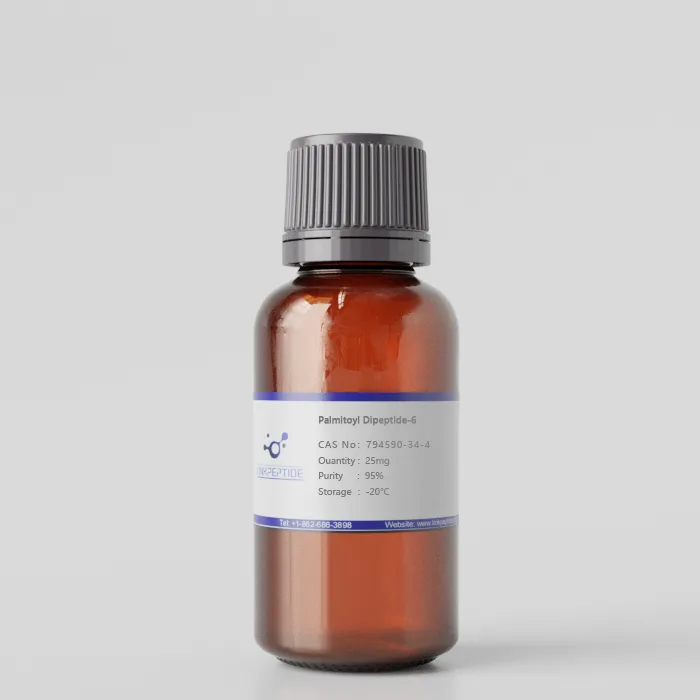
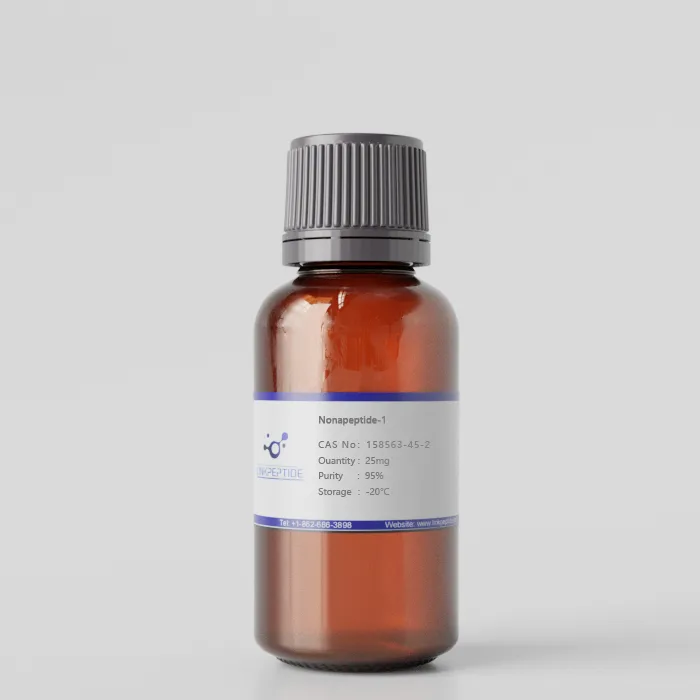
Product Name: Palmitoyl Dipeptide-6
Cas No: 794590-34-4
Purity: 95%
Storage: Keep in dark and cool dry place -5~8 degree Celsius
Sequence: Pal-Lys-Val-Dab-OH
Molar Mass: 811.9
Chemical Formula: C35H63F6N5O9
IUPAC Name: (2S)-4-amino-2-[[(2S)-2-[[(2S)-6-amino-2-(hexadecanoylamino)hexanoyl]amino]-3-methylbutanoyl]amino]butanoic acid;bis(2,2,2-trifluoroacetic acid)
SMILES: CCCCCCCCCCCCCCCC(=O)N[C@@H](CCCCN)C(=O)N[C@@H](C(C)C)C(=O)N[C@@H](CCN)C(=O)O.C(=O)(C(F)(F)F)O.C(=O)(C(F)(F)F)O
InChIKey: OJGGXQRQSFPREL-OVRRWYLESA-N
InChI: InChI=1S/C31H61N5O5.2C2HF3O2/c1-4-5-6-7-8-9-10-11-12-13-14-15-16-20-27(37)34-25(19-17-18-22-32)29(38)36-28(24(2)3)30(39)35-26(21-23-33)31(40)41;2*3-2(4,5)1(6)7/h24-26,28H,4-23,32-33H2,1-3H3,(H,34,37)(H,35,39)(H,36,38)(H,40,41);2*(H,6,7)/t25-,26-,28-;;/m0../s1
Application:
Palmitoyl Dipeptide-6 is a lipid-enhanced bioactive peptide designed to support skin firmness, smoothness, and visible rejuvenation. The palmitoyl modification improves penetration and stability, enabling the dipeptide to interact efficiently with the skin’s structural pathways. In cosmetic research, Palmitoyl Dipeptide-6 is widely used to explore enhanced collagen support, improved elasticity, and reduction in the appearance of fine lines. Its ability to promote a more refined and resilient complexion makes it ideal for anti-aging serums, creams, and targeted treatments. With excellent compatibility in both emulsions and water-based systems, it contributes to firmer, smoother, younger-looking skin.
Current Research:
Palmitoyl Dipeptide-6 (DIAMINOHYDROXYBUTYRATE): Research Overview
Palmitoyl Dipeptide-6 is a synthetic lipo-dipeptide used in cosmetic science as a small-molecule signaling ingredient targeting extracellular matrix (ECM) organization and dermal–epidermal junction (DEJ) integrity. Its INCI name is Palmitoyl Dipeptide-6 DIAMINOHYDROXYBUTYRATE. Structurally, it consists of a palmitoyl (C16) fatty acid linked to a dipeptide sequence Lys–Val, extended with a diaminobutyric acid (Dab) residue at the C-terminus (Pal–Lys–Val–Dab–OH).
This design combines a lipophilic anchor (palmitoyl chain) with a short, cationic/polar peptide motif intended to interact with ECM-associated targets and cell membranes in the upper dermis and DEJ region.
Key structural elements:
Palmitoyl chain (C16): Increases hydrophobicity, promotes incorporation into stratum corneum lipid domains, and enhances resistance to proteolytic degradation.
Lysine (Lys): Positively charged side chain allowing electrostatic interactions with negatively charged matrix proteins, glycosaminoglycans, and cell-surface components.
Valine (Val): Hydrophobic residue contributing to peptide–lipid and peptide–protein interfaces.
Diaminobutyric acid (Dab): Additional basic functionality and hydrogen-bonding capacity, increasing overall cationic character and interaction potential with ECM structures.
The resulting molecule is amphiphilic: the palmitoyl segment localizes in lipid phases, while the charged peptide segment remains available for interaction in the aqueous microenvironment around keratinocytes and fibroblasts.
Palmitoyl Dipeptide-6 is typically used in combination with another palmitoylated dipeptide (Palmitoyl Dipeptide-5), forming a dual-peptide system designed to act on DEJ components and papillary dermis. Together, these lipopeptides are studied for their capacity to influence:
Basement-membrane protein expression.
Cell–matrix adhesion structures.
ECM organization in the upper dermis.
Specifically for Palmitoyl Dipeptide-6, the presence of multiple basic groups (Lys and Dab) and the short peptide length suggest a role as a matrix-interacting ligand, able to modulate fibroblast responses through contact with receptors, integrins, or matrix-associated domains.
Supplier and technical literature for the combined system attribute to Palmitoyl Dipeptide-6 involvement in:
Stimulation of collagen synthesis (notably collagen types associated with papillary dermis and DEJ), at the level of dermal fibroblast cultures.
Upregulation of structural ECM proteins such as fibronectin, which orchestrate matrix assembly and cell adhesion.
Support of matrix density and organization in the DEJ-adjacent dermis in ex vivo and reconstructed-skin models.
In these contexts, Palmitoyl Dipeptide-6 is part of a matrix-regulating micropeptide pair, with its highly cationic profile favoring interaction with negatively charged ECM networks and influencing fibroblast biosynthetic activity.
The DEJ comprises laminins, collagen IV, collagen VII, collagen XVII, and associated anchoring complexes. With aging, the DEJ flattens and anchoring fibrils become less dense. Research on the Palmitoyl Dipeptide-5/6 system reports:
Increased expression of basement-membrane markers (laminins, collagen IV) in skin models.
Enhanced levels of anchoring fibril constituents, such as collagen VII, supporting dermal–epidermal cohesion.
Improved continuity and complexity of DEJ morphology, with more pronounced rete-ridge structures under microscopy.
Within this framework, Palmitoyl Dipeptide-6 is considered an upper-dermis/DEJ-focused lipopeptide, contributing to the reinforcement of anchoring structures and mechanical coupling between epidermis and dermis.
Instrumental studies on formulations containing the dual Palmitoyl Dipeptide-5/6 complex measure:
Changes in wrinkle depth and volume (profilometry, 3D optical imaging).
Modifications in surface roughness and microrelief regularity.
Variations in firmness and elasticity indices (cutometry or similar devices).
Observed improvements are interpreted as outcomes of structural remodeling—particularly at the DEJ and papillary dermis—rather than transient volumizing effects. Palmitoyl Dipeptide-6, through its matrix-interacting character, forms part of the mechanistic basis for these structural endpoints.
At the cell-signaling level, palmitoylated dipeptides of this type are associated with:
Modulation of integrin expression on basal keratinocytes, enhancing adhesion to basement-membrane laminins and collagens.
Support of fibroblast–matrix cross-talk, potentially shifting the balance toward matrix assembly versus degradation.
Indirect effects on MMP/TIMP balance, consistent with maintenance of ECM integrity in DEJ-proximal regions.
While specific receptor identities for Palmitoyl Dipeptide-6 remain incompletely defined in publicly available data, its structural class and experimental endpoints place it among short, cationic lipopeptides that act as matrix-signaling modulators.
Palmitoyl Dipeptide-6 is:
Supplied as a white powder with high purity, used at low concentrations typical for signal peptides.
Lipophilic, favoring incorporation into emulsions, lipid carriers, liposomes, or nanoemulsions.
Generally added during cool-down to minimize thermal degradation.
Stable under standard cosmetic pH conditions when stored in cool, dry, low-oxygen environments.
The amphiphilic structure supports localization at interfaces between oil and water phases, and facilitates distribution within the stratum corneum and upper dermal compartments.
Summary
Palmitoyl Dipeptide-6 (Palmitoyl Dipeptide-6 DIAMINOHYDROXYBUTYRATE) is a palmitoylated, lysine/valine/Dab-based micropeptide classified as a DEJ- and ECM-active lipopeptide. Research and technical data characterize it as part of a dual-peptide system that modulates basement-membrane components, anchoring structures, integrin-mediated adhesion, and papillary dermal ECM organization, with downstream effects on skin structure, cohesion, and surface microrelief in experimental models.
Get a Quote
 LinkPeptide