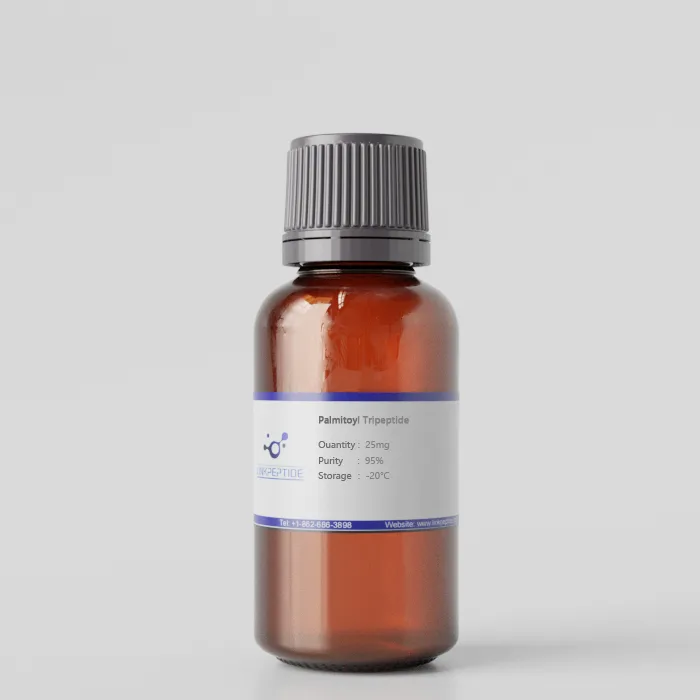
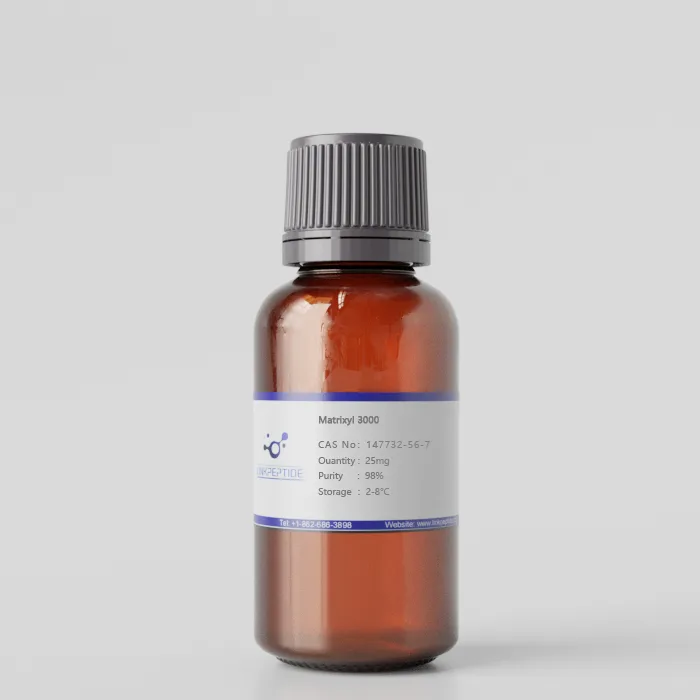
Product Name: Palmitoyl Tripeptide
Purity: 95%
Storage: Keep in dark and cool dry place -5~8 degree Celsius
Sequence: Pal-RFK-OH
Application:
Palmitoyl Tripeptide is a lipidated three–amino acid peptide designed to enhance delivery and support visible skin rejuvenation. The palmitoyl group improves penetration and stability, enabling the tripeptide to interact effectively with pathways involved in firmness and wrinkle reduction. In cosmetic research, Palmitoyl Tripeptide is valued for promoting collagen support, enhancing elasticity, and smoothing the appearance of fine lines. Its excellent compatibility with serums, creams, and advanced anti-aging treatments makes it a versatile ingredient for formulations targeting improved skin texture, suppleness, and a youthful, revitalized look.
Current Research:
Palmitoyl Tripeptide: Research Overview
Palmitoyl tripeptides are a class of acylated signal peptides consisting of a three–amino-acid sequence linked to a palmitic acid (C16) chain at the N-terminus. In skin research, they are studied as extracellular matrix–modulating peptides that influence collagen synthesis, matrix organization, and dermal–epidermal communication. The palmitoyl group increases lipophilicity, improves interaction with cell membranes, and protects the peptide from rapid enzymatic degradation, while the tripeptide segment carries the biological signaling information.
A palmitoyl tripeptide typically includes:
A palmitoyl fatty acid that anchors the molecule into lipid domains of the stratum corneum and cell membranes.
A tripeptide backbone (three amino acids) selected to mimic fragments of endogenous proteins such as collagen, growth factors, or immunoglobulins.
Terminal modifications (for example, amidation) that further stabilize the peptide and influence overall charge.
The resulting molecule is amphiphilic: the lipophilic tail localizes in membrane or intercellular lipids, while the peptide headgroup remains exposed to the aqueous environment, where it can interact with receptors or matrix components. Molecular weight is low enough to be compatible with topical delivery when supported by appropriate vehicles.
Many palmitoyl tripeptides are designed as matrikine analogues—small peptide fragments derived from larger structural proteins that act as endogenous messengers during matrix turnover. When collagen or other matrix proteins are remodeled, specific sequences released into the extracellular space can signal fibroblasts to adjust synthesis and repair activity.
Synthetic palmitoyl tripeptides reproduce these motifs in a stabilized, lipophilic form. Examples include sequences related to collagen fragments or short motifs derived from regulatory proteins. This design allows them to participate in feedback loops that regulate collagen production, fibronectin synthesis, and other ECM processes in vitro.
In fibroblast culture models, palmitoyl tripeptides are characterized by:
Stimulation of type I and/or type III collagen synthesis, quantified by procollagen assays and protein analysis.
Increased production of fibronectin and sometimes other glycoproteins, which organize and stabilize collagen fibrils.
Modulation of genes related to ECM assembly and cell–matrix adhesion.
These effects contribute to matrix renewal in dermal models. In aged or UV-exposed fibroblasts, palmitoyl tripeptides can partially restore collagen production rates closer to younger or non-stressed controls, indicating relevance to age- and photoaging-related matrix decline.
Collagen status reflects a balance between synthesis and degradation. Palmitoyl tripeptides have been investigated for their impact on matrix metalloproteinases (MMPs) and their tissue inhibitors (TIMPs):
Some studies show down-regulation of MMP-1 (collagenase) or related enzymes under stress conditions.
Others report increased expression of TIMP proteins, shifting the balance toward matrix preservation.
By moderating both synthesis and degradation, palmitoyl tripeptides support a more favorable ECM equilibrium in experimental systems, rather than simply increasing production alone.
Palmitoyl tripeptides are also evaluated in models of the dermal–epidermal junction (DEJ) and papillary dermis. Reported findings include:
Enhanced expression of basement-membrane components such as laminin and collagen IV.
Improved organization of collagen fibrils immediately beneath the DEJ.
More homogeneous and dense matrix architecture in the upper dermis.
Since DEJ flattening and papillary dermis thinning are hallmarks of cutaneous aging, these structural observations are central to the role of palmitoyl tripeptides in skin-structure research.
Formulations containing palmitoyl tripeptides are commonly tested in cosmetic-style studies that measure:
Wrinkle depth and volume by profilometry or 3D optical imaging.
Skin roughness and microrelief to capture fine-line changes.
Firmness and elasticity using biomechanical instruments.
Improvements in these parameters over weeks of application are interpreted as macroscopic correlates of underlying ECM changes—denser collagen networks, better DEJ quality, and more organized papillary matrix—rather than transient hydration alone.
In addition to ECM effects, research also explores the interaction of palmitoyl tripeptides with stress-related pathways:
Partial normalization of expression profiles in fibroblasts subjected to UV or oxidative stress.
Indirect effects on cellular responses to inflammatory mediators through changes in extracellular environment quality.
Potential contributions to “inflammaging” attenuation when used together with antioxidants and barrier-supporting actives.
These findings place palmitoyl tripeptides within multi-target approaches to structural and biochemical aspects of skin aging.
Palmitoyl tripeptides:
Are lipophilic, often supplied dissolved in suitable cosmetic solvents or dispersions.
Are incorporated into emulsions, serums, gels, liposomes, or nanoemulsions, typically during cool-down phases.
Require protection from excessive heat and oxidation to maintain peptide integrity.
Are used at low doses characteristic of high-affinity signal peptides.
Summary
“Palmitoyl Tripeptide” refers to a family of palmitoylated three–amino-acid signal peptides designed to act as matrikine-like regulators of dermal fibroblast activity and extracellular matrix organization. They are characterized in skin research by their ability to stimulate collagen and fibronectin synthesis, modulate matrix degradation, support DEJ and papillary dermis structure, and contribute to improved biomechanical and surface-aging parameters in experimental models.
Get a Quote
 LinkPeptide