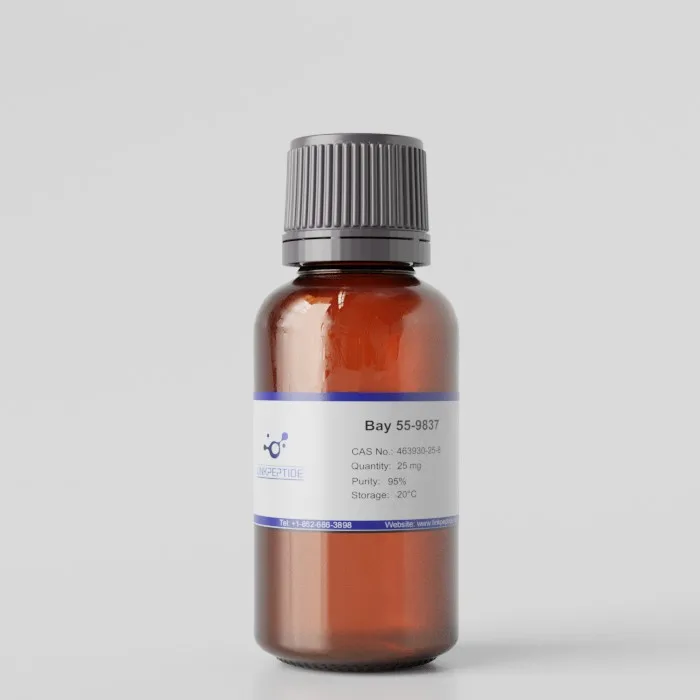
Product Name:PE-22-28
Cas No:1801959-12-5
Purity:95%
Chemical Formula:C35H55N11O9
Molar Mass:773.9
Synonyms:EX-A8193F; HY-P3581; L-Arginine, glycyl-L-valyl-L-seryl-L-tryptophylglycyl-L-leucyl-
IUPAC Name:(2S)-2-[[(2S)-2-[[2-[[(2S)-2-[[(2S)-2-[[(2S)-2-[(2-aminoacetyl)amino]-3-methylbutanoyl]amino]-3-hydroxypropanoyl]amino]-3-(1H-indol-3-yl)propanoyl]amino]acetyl]amino]-4-methylpentanoyl]amino]-5-(diaminomethylideneamino)pentanoic acid
SMILES:CC(C)C[C@@H](C(=O)N[C@@H](CCCN=C(N)N)C(=O)O)NC(=O)CNC(=O)[C@H](CC1=CNC2=CC=CC=C21)NC(=O)[C@H](CO)NC(=O)[C@H](C(C)C)NC(=O)CN
InChIKey:CMNBQRXBBJQIOA-YIHYGEMESA-N
InChI:InChI=1S/C35H55N11O9/c1-18(2)12-24(31(51)43-23(34(54)55)10-7-11-39-35(37)38)42-28(49)16-41-30(50)25(13-20-15-40-22-9-6-5-8-21(20)22)44-32(52)26(17-47)45-33(53)29(19(3)4)46-27(48)14-36/h5-6,8-9,15,18-19,23-26,29,40,47H,7,10-14,16-17,36H2,1-4H3,(H,41,50)(H,42,49)(H,43,51)(H,44,52)(H,45,53)(H,46,48)(H,54,55)(H4,37,38,39)/t23-,24-,25-,26-,29-/m0/s1
Storage:-20 degree Celsius
Sequence:GVSWGLR
Application:PE 22-28 is a synthetic peptide fragment derived from PACAP (pituitary adenylate cyclase-activating polypeptide), specifically representing amino acid residues 22 to 28. This short peptide retains the neuroprotective, anti-apoptotic, and memory-enhancing actions of full-length PACAP while offering greater stability and lower systemic reactivity. PE 22-28 is actively researched for its effects in cognitive decline, ischemic injury, oxidative stress, and neuroinflammation. It modulates intracellular signaling pathways, including cAMP and PI3K/Akt, promoting neuronal survival and synaptic plasticity. Its compact structure makes it a valuable tool in neuropharmacology, especially for exploring stroke recovery, dementia, and neurodegenerative disorders.
Current Research:
Introduction: What Is PE 22-28? PE 22-28 is a short bioactive peptide derived from the larger neuropeptide PACAP38, a member of the secretin/glucagon superfamily. PACAP is known for its diverse actions in the central nervous system, including neuroprotection, anti-apoptotic activity, anti-inflammatory signaling, and support of neurogenesis. While PACAP38 is highly potent, its full-length structure is unstable and can have systemic effects. PE 22-28—comprising amino acids 22 to 28 of PACAP—was developed to isolate its core neuroprotective region. This peptide has been shown to preserve neuronal function in a wide range of neurological and ischemic models. Mechanisms of Action: Intracellular Signaling and Apoptosis Inhibition PE 22-28 acts through multiple neuroprotective and intracellular pathways, including: PI3K/Akt signaling – Enhances neuronal survival and blocks apoptosis cAMP pathway activation – Stimulates neurotrophic factor expression (e.g., BDNF) MAPK/ERK pathway modulation – Supports synaptic plasticity and memory formation Downregulation of caspase-3 – Prevents cell death under oxidative or ischemic stress These pathways overlap with those activated by full-length PACAP, but PE 22-28 is smaller, more stable, and more selective, making it ideal for therapeutic and research applications targeting cell survival and regeneration. Applications in Stroke and Ischemic Brain Injury PE 22-28 is most prominently studied in stroke models, where it has demonstrated the ability to: Reduce infarct size after middle cerebral artery occlusion (MCAO) Inhibit neuronal apoptosis in penumbral regions Decrease oxidative and inflammatory markers, including TNF-α and IL-1β Improve functional recovery and motor coordination These effects position PE 22-28 as a strong candidate for acute neuroprotection and post-stroke rehabilitation strategies. Neurodegenerative Disease and Memory Support Research into Alzheimer’s disease and cognitive dysfunction has revealed that PE 22-28: Protects neurons from amyloid-beta toxicity Enhances long-term potentiation (LTP) in hippocampal circuits Increases BDNF expression, supporting learning and memory Reduces markers of oxidative stress in aging-related brain degeneration These properties make PE 22-28 a non-cholinergic, peptide-based cognitive enhancer, potentially useful for conditions like mild cognitive impairment (MCI), Alzheimer’s, and post-chemotherapy cognitive fog. Oxidative Stress and Mitochondrial Stability Neurons are especially sensitive to oxidative damage. PE 22-28 has been shown to: Increase antioxidant enzyme levels, including superoxide dismutase (SOD) and catalase Stabilize mitochondrial membrane potential Prevent cytochrome c release, a key step in apoptosis Protect against glutamate excitotoxicity, which plays a role in neurodegeneration Through these effects, PE 22-28 promotes neuronal integrity under metabolic and oxidative stress, making it suitable for research into Parkinson’s, ALS, and traumatic brain injury (TBI). Delivery and Stability Unlike PACAP38, which is rapidly degraded, PE 22-28 has improved resistance to proteolysis and can be administered via: Intracerebral injection (in animal models) Intranasal delivery, offering non-invasive CNS access Injectable formulations for acute neuroprotective studies Its smaller size and more focused bioactivity make it ideal for precise neurotherapeutic modeling. Conclusion: A Compact, Targeted Neuroprotective Peptide PE 22-28 is a streamlined yet potent derivative of PACAP with significant implications in neuroprotection, memory support, and brain repair research. Its selective signaling, anti-apoptotic strength, and stability make it a compelling agent in models of stroke, Alzheimer’s, and oxidative injury. As interest grows in short-acting, highly targeted peptides, PE 22-28 offers a promising bridge between natural neuropeptides and next-generation nootropic therapies.
Reference:
Get a Quote
 LinkPeptide

![[Ala17]-MCH](https://www.linkpeptide.com/wp-content/uploads/2024/08/Ala17-MCH-jpg.webp "[Ala17]-MCH")