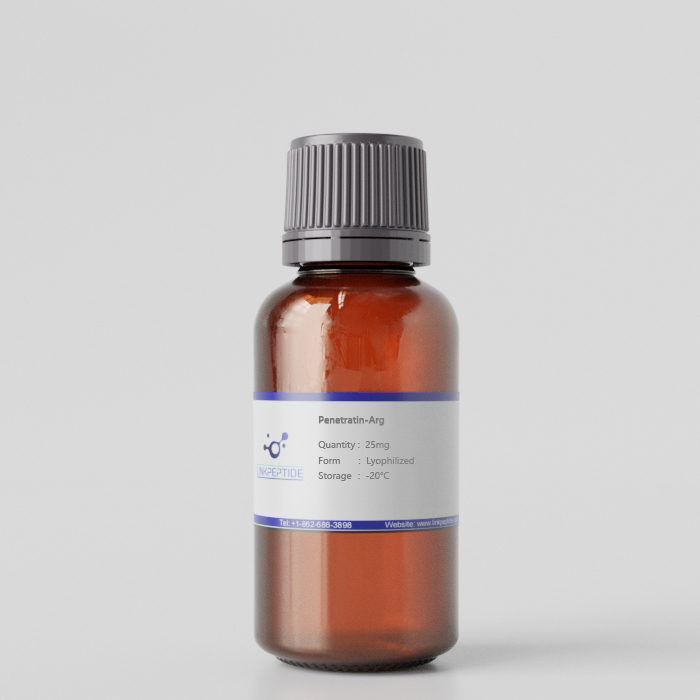
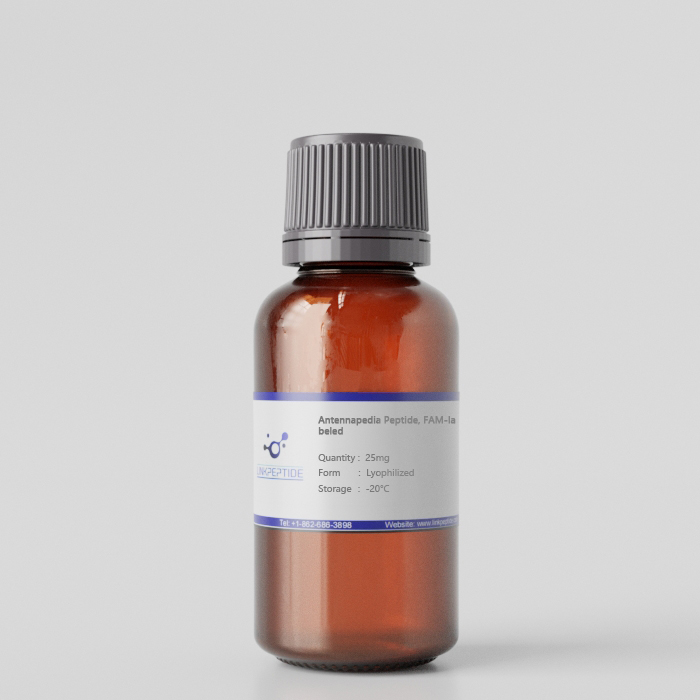
Product Name: Penetratin-Arg
Sequence One Letter Code: RQIRIWFQNRRMRWRR
Sequence Three Letter Code: Arg-Gln-Ile-Arg-Ile-Trp-Phe-Gln-Asn-Arg-Arg-Met-Arg-Trp-Arg-Arg-OH
Chemical Formula:C104H169N43O19S
Molecular Weight: 2358.9
Purity: 95%
Form: Lyophilized
Storage Conditions: - 20 °C
Research Area: Cell Penetrating Peptides
Source / Species: Drosophila
Conjugation: Unconjugated
Code Nacres: NA.26
Application: Penetratin-Arg is an arginine-enriched cell-penetrating peptide derived from the third helix of the Drosophila Antennapedia homeodomain protein. Substitution of lysine residues with arginine enhances membrane interaction and cellular uptake efficiency. In lipid environments, Penetratin-Arg adopts an α-helical conformation that facilitates rapid translocation across cellular membranes at low micromolar concentrations without significant membrane disruption. This peptide is widely used as a delivery vector for intracellular transport of peptides, proteins, nucleic acids, and other biomolecules. It supports applications in drug delivery research, gene transfection studies, and cellular uptake analysis, providing an effective platform for studying membrane permeability and targeted intracellular delivery strategies.
Current Research: Penetratin-Arg (often abbreviated PenArg) sits in a “sweet spot” of current cell-penetrating peptide (CPP) design: it preserves the compact, amphipathic scaffold of penetratin (derived from the third helix of the Drosophila Antennapedia homeodomain) while increasing guanidinium density through lysine-to-arginine substitutions. This modification measurably enhances cell-surface association and internalization efficiency. Mechanistically, this aligns with the broader consensus in the CPP field that arginine’s guanidinium group enables multidentate electrostatic and hydrogen-bonding interactions with anionic membrane components such as phospholipids and sulfated proteoglycans. As a result, Penetratin-Arg not only exhibits stronger membrane binding, but also improved uptake efficiency per bound peptide. A major focus of current research is clarifying how Penetratin-Arg enters cells. Like other arginine-rich CPPs, it can utilize both endocytic and non-endocytic (direct translocation) pathways depending on peptide concentration, cargo type, membrane composition, and experimental conditions. Rather than representing a single defined mechanism, direct translocation is now understood as a spectrum of processes involving transient membrane perturbation, lipid reorganization, and peptide–lipid complex formation. In lipid-mimetic environments, penetratin-derived sequences adopt α-helical conformations with distinct amphipathic character, facilitating rapid membrane crossing at low micromolar concentrations. Importantly, efficient internalization can occur without large-scale membrane disruption, indicating that Penetratin-Arg induces controlled and reversible membrane rearrangements rather than stable pore formation. Another active research direction involves dissecting how membrane composition influences Penetratin-Arg activity. Negatively charged phospholipids, cholesterol content, and glycosaminoglycan density all modulate peptide binding and uptake kinetics. Studies using model bilayers and heterogeneous membrane systems suggest that arginine-enriched CPPs can reorganize lipid domains, alter membrane fluidity, and transiently cluster anionic components. These interactions are particularly relevant for understanding uptake variability across different cell types and for optimizing delivery in complex biological environments. In applied research, Penetratin-Arg is widely used as a modular delivery vector. It has been conjugated to peptides, recombinant proteins, nucleic acids (including siRNA and plasmid DNA), and small bioactive molecules. Recent design strategies do not rely solely on increasing uptake; instead, they focus on improving functional intracellular delivery. A key bottleneck in CPP-mediated transport is endosomal escape. To address this, penetratin-based systems are increasingly combined with auxiliary domains or chemical modifications that enhance endosomal membrane destabilization under acidic conditions. Structural stabilization strategies—such as peptide stapling, cyclization, or multivalent presentation—are also under investigation to improve cellular uptake, serum stability, and intracellular bioavailability. Emerging trends in CPP research further highlight the importance of multivalency and supramolecular organization. By clustering CPP motifs or presenting them on nanoparticle surfaces, researchers can increase local charge density and membrane engagement while maintaining controlled peptide architecture. Penetratin-Arg is particularly suitable for such approaches because its arginine-rich profile promotes strong but tunable interactions with cellular membranes. Methodologically, current studies emphasize rigorous validation of intracellular delivery. Quantitative flow cytometry, live-cell confocal imaging, colocalization analysis with endosomal markers, and membrane integrity assays are routinely combined to distinguish genuine cytosolic delivery from endosomal entrapment or surface adsorption artifacts. Researchers also carefully control experimental variables such as fixation methods, temperature, serum conditions, and inhibitor specificity, as these factors significantly influence uptake interpretation. Overall, Penetratin-Arg remains a robust and adaptable CPP platform. Its arginine-enriched design aligns with contemporary mechanistic insights into membrane interaction and translocation. However, the frontier of research has shifted from simply maximizing uptake to achieving predictable intracellular trafficking, efficient endosomal escape, minimized off-target membrane effects, and cell-type–specific optimization. As a result, Penetratin-Arg continues to serve not only as a delivery vector, but also as a model system for advancing our understanding of membrane permeability and targeted intracellular transport strategies.
Get a Quote
 LinkPeptide