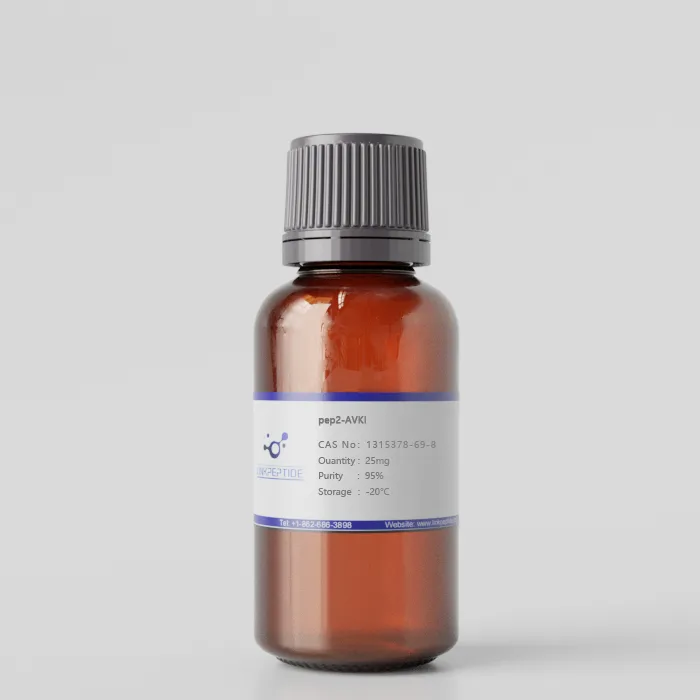
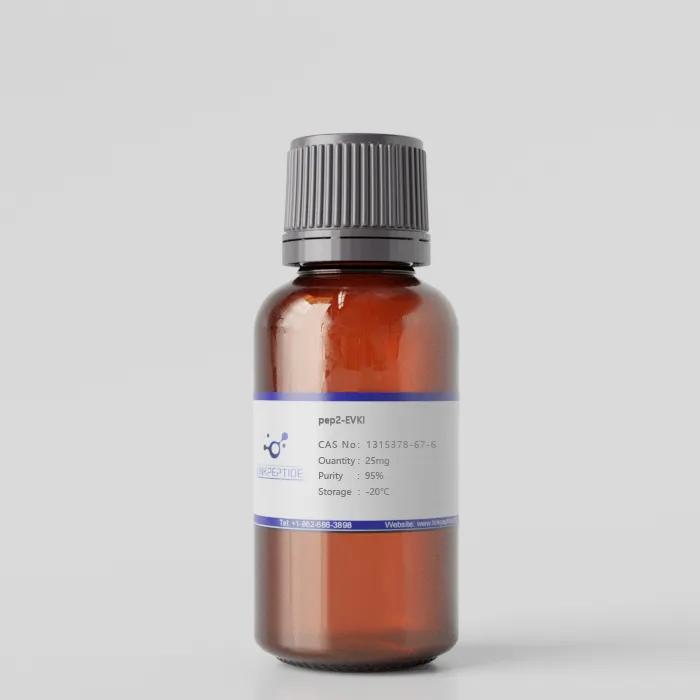
Product Name:pep2-AVKI
Synonyms:AKOS024456695
CAS No:1315378-69-8
Purity:95%
Molar Mass:1268.5
Chemical Formula:C60H93N13O17
Storage:Store at -20 degrees Celsius
Sequence:YNVYGIEAVKI
Application:
pep2-AVKI is a precision-engineered peptide designed to modulate key interactions within kinase-driven signaling pathways. This peptide is particularly valuable for investigating the regulatory mechanisms that control phosphorylation and its effects on cellular activities such as proliferation, survival, and apoptosis. pep2-AVKI mimics a specific sequence involved in these processes, making it an effective tool for disrupting pathological signaling and exploring novel therapeutic targets. With its high purity and consistent performance, pep2-AVKI is ideal for researchers focused on the detailed analysis of kinase activity and the development of targeted treatment strategies.
Current Research:
pep2-AVKI is a synthetic peptide inhibitor that selectively disrupts the interaction between the AMPA receptor subunit GluA2 and the protein interacting with C kinase 1 (PICK1) at the C-terminal PDZ-binding domain. This specificity allows for the precise modulation of synaptic transmission and plasticity, making it a valuable tool in neuropharmacological research. The GluA2 subunit of AMPA receptors plays a pivotal role in excitatory synaptic transmission. Its interaction with PICK1 is crucial for receptor trafficking and synaptic plasticity mechanisms, such as long-term depression (LTD). By inhibiting this specific protein-protein interaction, pep2-AVKI enables researchers to dissect the molecular underpinnings of synaptic modulation. Experimental studies have demonstrated that pep2-AVKI effectively disrupts GluA2-PICK1 binding without affecting interactions with other PDZ domain-containing proteins like GRIP or ABP. This selectivity ensures that the peptide's effects are targeted, minimizing off-target interactions that could confound experimental outcomes. Notably, pep2-AVKI does not alter AMPA receptor-mediated current amplitude nor does it interfere with the induction or expression of LTD, underscoring its specificity in modulating GluA2-PICK1 interactions. The application of pep2-AVKI has provided significant insights into the role of GluA2-PICK1 interactions in synaptic function. For instance, studies utilizing this peptide have elucidated the involvement of these interactions in the regulation of AMPA receptor localization and the dynamic processes underlying synaptic strength adjustments. Such findings have implications for understanding the molecular basis of learning and memory, as well as the pathophysiology of neurological disorders where synaptic dysfunction is evident. In summary, pep2-AVKI serves as a potent and selective inhibitor of the GluA2-PICK1 interaction, offering a precise approach to study the molecular mechanisms governing synaptic transmission and plasticity. Its specificity and efficacy make it an indispensable tool in neuropharmacological research, contributing to the advancement of therapeutic strategies targeting synaptic dysfunction.
Reference:
Get a Quote
 LinkPeptide