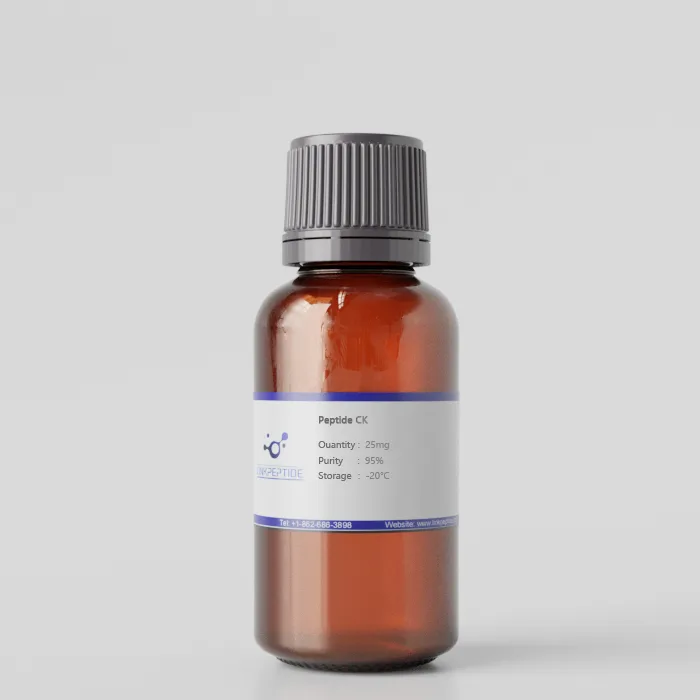
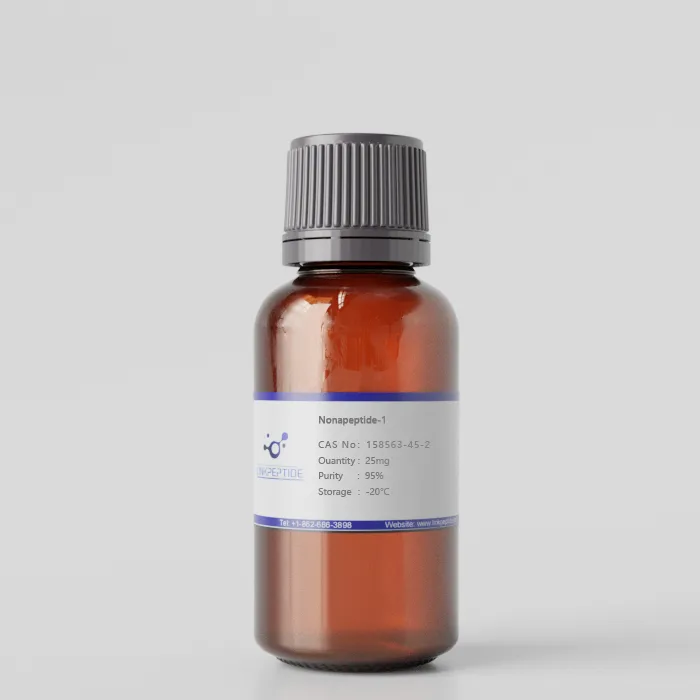
Product Name: Peptide CK
Purity: 95%
Storage: Keep in dark and cool dry place -5~8 degree Celsius
Sequence: Arg-Lys-Arg
Molar Mass: 458.6
Chemical Formula: C18H38N10O4
IUPAC Name: (2S)-2-[[(2S)-6-amino-2-[[(2S)-2-amino-5-(diaminomethylideneamino)pentanoyl]amino]hexanoyl]amino]-5-(diaminomethylideneamino)pentanoic acid
SMILES: C(CCN)C[C@@H](C(=O)N[C@@H](CCCN=C(N)N)C(=O)O)NC(=O)[C@H](CCCN=C(N)N)N
InChIKey: FSNVAJOPUDVQAR-AVGNSLFASA-N
InChI: InChI=1S/C18H38N10O4/c19-8-2-1-6-12(27-14(29)11(20)5-3-9-25-17(21)22)15(30)28-13(16(31)32)7-4-10-26-18(23)24/h11-13H,1-10,19-20H2,(H,27,29)(H,28,30)(H,31,32)(H4,21,22,25)(H4,23,24,26)/t11-,12-,13-/m0/s1
Application:
Peptide CK is a bioactive cosmetic peptide designed to support skin firmness, clarity, and overall rejuvenation. Known for its ability to help reinforce skin structure, Peptide CK is frequently used in research targeting improved elasticity, reduced appearance of fine lines, and enhanced smoothness. It also supports a more balanced, radiant complexion by promoting healthy cellular communication within the epidermis. With excellent stability and compatibility across serums, creams, and targeted anti-aging treatments, Peptide CK is ideal for formulations aimed at revitalizing dull or stressed skin and restoring a firmer, more youthful-looking appearance.
Current Research:
Peptide CK: Research Overview
Peptide CK is a short synthetic peptide composed of Cysteine–Lysine (Cys–Lys), frequently supplied in stabilized derivative form for cosmetic research applications. As a dipeptide with a thiol-containing residue (cysteine) and a cationic basic residue (lysine), Peptide CK belongs to the family of low–molecular-weight biofunctional peptides involved in antioxidant defense, structural-protein protection, and epidermal homeostasis.
Although less documented than larger cosmetic peptides, Peptide CK’s biochemical profile aligns with pathways related to thiol-based redox activity, anti-glycation, matrix preservation, and cellular protective signaling.
Peptide CK contains:
Cysteine, a sulfur-containing amino acid with a reactive thiol group capable of participating in redox reactions, metal binding, and thiol–disulfide exchange.
Lysine, a positively charged amino acid at physiological pH, enabling electrostatic interaction with negatively charged proteins, glycosaminoglycans, and membrane phospholipids.
The combination results in a dipeptide with:
High water solubility
Very low molecular weight, well below typical cutaneous-penetration thresholds
Strong chemical reactivity due to the cysteine thiol
These properties allow Peptide CK to diffuse into superficial epidermal layers and interact with oxidative species, carbonyl intermediates, and structural proteins.
The cysteine residue is central to Peptide CK’s function. Through its thiol group, the peptide can:
Donate electrons to neutralize reactive oxygen species
React with lipid peroxides and reactive aldehydes
Participate in thiol–disulfide exchange reactions affecting protein stability
Act as a secondary buffer in redox cycling alongside glutathione-related systems
In oxidative-stress models, cysteine-containing micropeptides reduce protein oxidation markers, preserve cellular protein structure, and limit accumulation of oxidized lipids. These antioxidant behaviors are relevant in preventing damage triggered by UV exposure, pollution, or inflammatory oxidants.
Cysteine-containing dipeptides can directly react with reactive carbonyl species (RCS)—intermediates formed during glycation and lipid peroxidation. By binding or neutralizing carbonyl groups, Peptide CK can:
Reduce advanced glycation end product (AGE) formation
Lower crosslinking of long-lived proteins such as collagen and elastin
Maintain flexibility and integrity of extracellular matrix fibers
Counteract yellowing, stiffening, and brittleness associated with glycation stress
This biochemical pathway aligns Peptide CK with ingredients used to protect against carbonyl stress, a known contributor to dermal aging.
Peptide CK may indirectly support dermal and epidermal structure through several mechanisms:
Protection of collagen and elastin from oxidative and glycation-induced modification
Modulation of protein disulfide balance, relevant to collagen fibril organization
Stabilization of matrix-associated proteins that rely on cysteine disulfide bonds
Short cysteine-containing peptides have been shown in experimental models to help maintain a more uniform extracellular matrix, especially under UV- or chemical-induced stress.
Because lysine facilitates binding to acidic ECM components, Peptide CK is positioned as a matrix-preserving micropeptide rather than a classical collagen-stimulating signal peptide.
Research on Cys-containing dipeptides highlights roles in:
Maintaining cell viability during oxidative challenges
Reducing mitochondrial membrane damage
Supporting keratinocyte metabolism under environmental stress
Modulating mild inflammatory cascades associated with “inflammaging”
Through control of reactive species and carbonyl stress, Peptide CK may help normalize stress-response pathways in keratinocytes and fibroblasts.
Peptide CK’s small size allows diffusion within the stratum corneum. The peptide can:
Interact with oxidized lipids in the barrier
Protect barrier lipids from peroxidation
Support recovery after chemical or environmental disruption
Improve surface smoothness by minimizing protein oxidation that affects corneocyte cohesion
These actions connect to improved epidermal resilience and microrelief quality in experimental observations.
Peptide CK:
Is highly water-soluble and typically delivered in aqueous serums or emulsions
Should be protected from air and oxidation to maintain cysteine thiol reactivity
Is normally incorporated during cool-down stages of formulation
Functions effectively at very low concentrations due to high chemical activity
Encapsulation or antioxidant systems are often used to preserve peptide stability.
Summary
Peptide CK (Cys–Lys) is a thiol-active micropeptide studied for antioxidant, anti-glycation, and matrix-preserving functions in skin biology. Its cysteine-driven redox and carbonyl-scavenging properties contribute to protection of structural proteins, moderation of oxidative stress, and support of barrier integrity. With its small size and chemical reactivity, Peptide CK is positioned as a protective and anti-stress cosmetic peptide within research frameworks addressing environmental damage and early-stage skin aging.
Get a Quote
 LinkPeptide