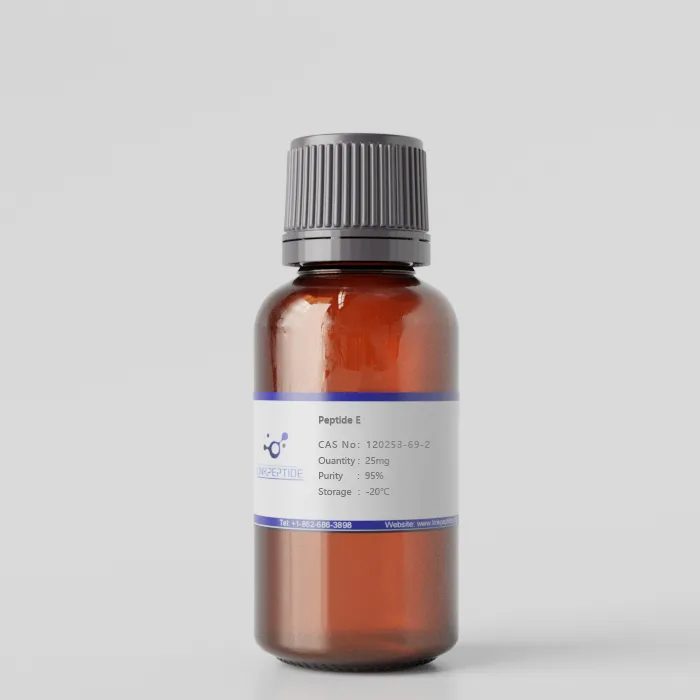
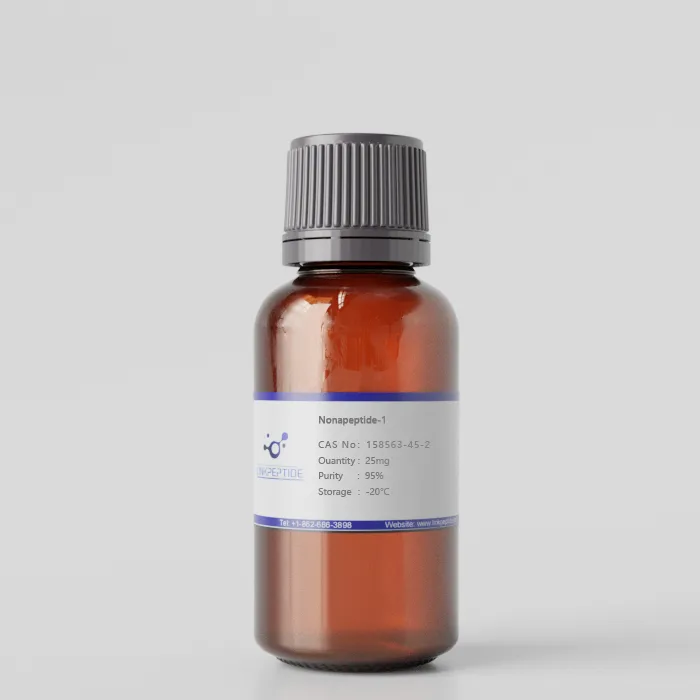
Product Name: Peptide E
Cas No: 120253-69-2
Purity: 95%
Storage: Keep in dark and cool dry place -5~8 degree Celsius
Sequence: Arg-Ser-Arg-Lys
Molar Mass: 2067.4
Chemical Formula: C83H155N39O21S
IUPAC Name: 4-amino-5-[[1-[[1-[[1-[2-[[1-[[6-amino-1-[[1-[[5-amino-1-[[2-[[1-[[1-[[5-carbamimidamido-1-[[5-carbamimidamido-1-[[5-carbamimidamido-1-[(1-carboxy-2-methylpropyl)amino]-1-oxopentan-2-yl]amino]-1-oxopentan-2-yl]amino]-1-oxopentan-2-yl]amino]-3-methyl-1-oxobutan-2-yl]amino]-3-hydroxy-1-oxopropan-2-yl]amino]-2-oxoethyl]amino]-1,5-dioxopentan-2-yl]amino]-5-carbamimidamido-1-oxopentan-2-yl]amino]-1-oxohexan-2-yl]amino]-5-carbamimidamido-1-oxopentan-2-yl]carbamoyl]pyrrolidin-1-yl]-5-carbamimidamido-1-oxopentan-2-yl]amino]-4-methylsulfanyl-1-oxobutan-2-yl]amino]-5-carbamimidamido-1-oxopentan-2-yl]amino]-5-oxopentanoic acid
SMILES: CC(C)C(C(=O)NC(CCCNC(=N)N)C(=O)NC(CCCNC(=N)N)C(=O)NC(CCCNC(=N)N)C(=O)NC(C(C)C)C(=O)O)NC(=O)C(CO)NC(=O)CNC(=O)C(CCC(=O)N)NC(=O)C(CCCNC(=N)N)NC(=O)C(CCCCN)NC(=O)C(CCCNC(=N)N)NC(=O)C1CCCN1C(=O)C(CCCNC(=N)N)NC(=O)C(CCSC)NC(=O)C(CCCNC(=N)N)NC(=O)C(CCC(=O)O)N
InChIKey: RLQBYTJEMHGNOD-UHFFFAOYSA-N
InChI: InChI=1S/C83H155N39O21S/c1-42(2)60(74(140)118-50(21-12-35-105-81(95)96)69(135)113-47(18-9-32-102-78(89)90)66(132)114-51(22-13-36-106-82(97)98)71(137)121-61(43(3)4)76(142)143)120-72(138)55(41-123)109-58(125)40-108-63(129)52(26-27-57(86)124)115-67(133)48(19-10-33-103-79(91)92)112-64(130)45(16-6-7-30-84)111-68(134)49(20-11-34-104-80(93)94)117-73(139)56-24-15-38-122(56)75(141)54(23-14-37-107-83(99)100)119-70(136)53(29-39-144-5)116-65(131)46(17-8-31-101-77(87)88)110-62(128)44(85)25-28-59(126)127/h42-56,60-61,123H,6-41,84-85H2,1-5H3,(H2,86,124)(H,108,129)(H,109,125)(H,110,128)(H,111,134)(H,112,130)(H,113,135)(H,114,132)(H,115,133)(H,116,131)(H,117,139)(H,118,140)(H,119,136)(H,120,138)(H,121,137)(H,126,127)(H,142,143)(H4,87,88,101)(H4,89,90,102)(H4,91,92,103)(H4,93,94,104)(H4,95,96,105)(H4,97,98,106)(H4,99,100,107)
Application:
Peptide E is a bioactive cosmetic peptide designed to support skin repair, firmness, and overall revitalization. Known for its ability to enhance cellular communication, Peptide E is widely used in research targeting improved elasticity, smoother texture, and reduced appearance of early fine lines. It also helps promote a healthier barrier function, contributing to improved hydration and enhanced resilience against environmental stress. With excellent stability and compatibility across serums, emulsions, and advanced anti-aging formulations, Peptide E is ideal for treatments aimed at restoring suppleness, boosting radiance, and achieving a more youthful, refreshed complexion.
Current Research:
Peptide E: Research Overview
Peptide E is a synthetic RGD-containing oligopeptide developed for anti-aging and skin-conditioning applications. It is a short amino-acid sequence that includes the arginine–glycine–aspartic acid (RGD) motif, a well-characterized recognition sequence for integrin receptors on cell surfaces. This motif is central to many cell–matrix interactions and underpins Peptide E’s classification as an adhesion- and matrix-signaling peptide in cosmetic science. Commercial technical data describe Peptide E as an active for improving wrinkles, hydration, and skin softness, supplied as a lyophilized powder for incorporation into topical formulations.
The key design feature of Peptide E is the RGD sequence, embedded in a short peptide chain flanked by additional residues that provide stability and modulate binding. The RGD motif is recognized by several integrin subtypes (for example, αvβ3 and α5β1) involved in:
Cell adhesion to extracellular matrix (ECM) proteins such as fibronectin and vitronectin
Mechanotransduction and cytoskeletal organization
Regulation of cell migration, proliferation, and survival
By presenting an RGD-containing fragment in a defined, soluble form, Peptide E can act as a competitive ligand for integrin receptors, influencing adhesion-related signaling pathways in keratinocytes and fibroblasts.
In dermal fibroblasts, integrin engagement modulates many aspects of ECM biology, including:
Expression and organization of collagen I and III
Deposition of fibronectin and other multi-adhesive glycoproteins
Crosstalk with matrix metalloproteinases (MMPs) and their inhibitors
RGD-containing peptides have been shown in experimental models to adjust integrin-mediated signaling, which can support matrix reorganization and tissue remodeling. Peptide E, by targeting similar receptor systems, is positioned as a matrix-interacting oligopeptide capable of contributing to dermal support and wrinkle reduction through structural rather than volumizing mechanisms.
The dermal–epidermal junction (DEJ) depends heavily on integrin-mediated adhesion between basal keratinocytes and basement-membrane components (laminins, collagen IV, nidogens). Age-related flattening of the DEJ is associated with reduced mechanical stability, impaired nutrient exchange, and greater visibility of wrinkles and folds.
Through its RGD motif, Peptide E can interact with integrins on basal keratinocytes and DEJ-adjacent fibroblasts, potentially influencing:
Cell attachment strength and distribution along the basement membrane
Organization of adhesion complexes and associated cytoskeletal structures
Local remodeling of ECM immediately beneath the DEJ
These actions support the conceptual role of Peptide E in reinforcing epidermal–dermal cohesion, which is relevant to firmness, resilience, and surface microrelief.
Integrin signaling in keratinocytes affects not only adhesion but also proliferation, differentiation, and barrier formation. In reconstructed epidermis and cell models, RGD-type ligands can modulate:
Migration and attachment of keratinocytes during regeneration
Expression of differentiation markers linked to stratum corneum structure
Organization of corneocyte layers and intercellular lipid domains
When translated into cosmetic endpoints, these effects relate to:
Smoother surface texture and more regular microrelief
Improved softness through better corneocyte cohesion and lipid organization
Indirect support of hydration via a more intact barrier and optimized cell–matrix interactions
The role of Peptide E in improving hydration is considered secondary to classical humectants, but structural and adhesion improvements can enhance water retention and tactile comfort.
In anti-aging research contexts, Peptide E is evaluated within formulations targeting:
Reduction in the appearance of fine lines and wrinkles, especially where mechanical folding and loss of dermal support are prominent
Improvement in firmness and elasticity indices measured by biomechanical devices
More uniform skin density and reflectance, consistent with a better-organized superficial matrix
These outcomes are interpreted as downstream effects of integrin-mediated matrix normalization and DEJ support, rather than neuromuscular or filler-type mechanisms.
Peptide E is typically supplied as a high-purity, lyophilized powder. Key technical characteristics include:
Water solubility, allowing incorporation into serums, gels, emulsions, and mask systems
Low molecular weight, supporting diffusion into the upper epidermis and DEJ region when aided by suitable delivery systems
Sensitivity to heat and oxidation, requiring addition during cool-down phases and formulation with appropriate stabilizers
It is usually used at low concentrations consistent with signal peptides, and can be combined with collagen-stimulating peptides, hyaluronic-acid boosters, antioxidants, and barrier-supporting lipids in multi-active anti-aging systems.
Summary
Peptide E is an RGD-containing cosmetic oligopeptide designed to interact with integrin receptors and modulate cell–matrix adhesion and extracellular matrix organization. Through these pathways it is investigated for contributions to wrinkle reduction, improved firmness and cohesion at the dermal–epidermal junction, and enhanced softness and hydration associated with better-structured epidermal and superficial dermal compartments.
Get a Quote
 LinkPeptide