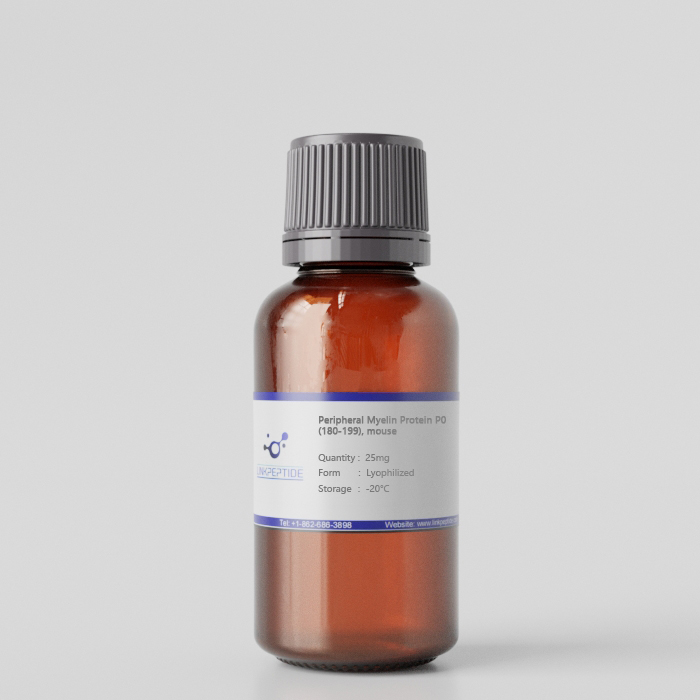
Product Name: Peripheral Myelin Protein P0 (180-199), mouse
Sequence One Letter Code: SSKRGRQTPVLYAMLDHSRS
Sequence Three Letter Code: H-Ser-Ser-Lys-Arg-Gly-Arg-Gln-Thr-Pro-Val-Leu-Tyr-Ala-Met-Leu-Asp-His-Ser-Arg-Ser-OH
Chemical Formula:C96H161N33O30S1
Molecular Weight: 2289.7
Purity: 95%
Form: Lyophilized
Storage Conditions: - 20 °C
Research Area: Neurological Disease Research
Source / Species: mouse
Conjugation: Unconjugated
Code Nacres: NA.26
Application: Peripheral Myelin Protein P0 (180–199), mouse is a synthetic peptide corresponding to residues 180–199 of murine myelin protein P0, a structural component of peripheral nerve myelin. This epitope is well established for its neuritogenic properties and is commonly used to induce experimental autoimmune neuritis (EAN) in mouse models. The peptide supports investigations into peripheral nerve inflammation, immune-mediated demyelination, and T cell–driven autoimmune responses. It is particularly useful in studies of antigen presentation, neuroinflammation mechanisms, and preclinical evaluation of immunomodulatory therapies. This sequence provides a reliable tool for modeling autoimmune neuropathies and analyzing peripheral nervous system pathology.
Current Research: Peripheral Myelin Protein P0 (180–199), mouse is a synthetic peptide corresponding to amino acid residues 180–199 of murine myelin protein zero (P0), the major structural glycoprotein of peripheral nerve myelin. P0 accounts for more than 50% of total protein content in peripheral myelin and plays a critical role in myelin compaction through homophilic adhesion between adjacent myelin lamellae. The 180–199 sequence lies within the extracellular domain and represents a well-characterized immunodominant epitope with strong neuritogenic potential in susceptible mouse strains. Current research consistently uses P0 (180–199) as a standard antigen for inducing experimental autoimmune neuritis (EAN), an established animal model that recapitulates key pathological and immunological features of human inflammatory demyelinating neuropathies, including Guillain–Barré syndrome (GBS) and chronic inflammatory demyelinating polyradiculoneuropathy (CIDP). Upon immunization with P0 (180–199), typically emulsified in complete Freund’s adjuvant and often combined with pertussis toxin depending on protocol, mice develop peripheral nerve inflammation characterized by mononuclear cell infiltration, demyelination, conduction deficits, and varying degrees of motor impairment. Mechanistically, P0 (180–199) induces a robust CD4⁺ T cell–mediated immune response. The peptide is processed and presented by antigen-presenting cells via MHC class II molecules, leading to the expansion of autoreactive T helper cells. Th1 and Th17 subsets have both been implicated in disease progression, producing cytokines such as IFN-γ, IL-17, and GM-CSF that promote macrophage recruitment and activation within peripheral nerves. These macrophages contribute directly to demyelination by stripping myelin sheaths and amplifying local inflammatory cascades. Consequently, P0 (180–199) serves as a highly controlled tool for dissecting antigen-specific T cell priming, epitope recognition, and downstream effector mechanisms in autoimmune neuropathy. Beyond T cell biology, this peptide supports investigation into antigen presentation dynamics. Studies frequently examine dendritic cell activation, costimulatory molecule expression (e.g., CD80/CD86), and cytokine polarization following exposure to P0 (180–199). The model enables precise evaluation of how peripheral tolerance mechanisms fail, including regulatory T cell (Treg) insufficiency or dysfunction. In this context, P0 (180–199)-induced EAN provides a quantitative platform for measuring shifts in Treg/Th17 balance and for assessing checkpoint modulation strategies. Neuroinflammation research also benefits from this defined epitope system. Induction of EAN with P0 (180–199) allows temporal mapping of immune cell infiltration, blood–nerve barrier permeability changes, complement deposition, and Schwann cell stress responses. Molecular analyses commonly include transcriptional profiling of sciatic nerve tissue, evaluation of pro-inflammatory mediators (TNF-α, IL-6, IL-1β), and assessment of demyelination markers such as myelin basic protein (MBP) degradation. Electrophysiological measurements—nerve conduction velocity and compound muscle action potentials—provide functional correlates to histopathological findings. Importantly, P0 (180–199) is widely applied in preclinical therapeutic evaluation. Immunomodulatory agents—including small molecules, monoclonal antibodies, tolerogenic vaccines, cytokine inhibitors, and cell-based therapies—are frequently tested in this model. Because disease onset and progression are reproducible, investigators can quantitatively assess treatment effects on clinical scoring, immune cell infiltration, cytokine profiles, and remyelination dynamics. The peptide-based induction system allows clear antigen specificity, improving interpretability compared to whole-protein immunization approaches. Recent research directions include peptide-based tolerance induction strategies using altered peptide ligands (APLs) derived from P0 (180–199), nanoparticle-mediated antigen delivery to promote immune regulation, and combination therapies targeting both adaptive and innate immune components. There is also growing interest in identifying cross-reactive microbial epitopes to better understand molecular mimicry mechanisms that may initiate autoimmune neuropathies. Overall, Peripheral Myelin Protein P0 (180–199), mouse remains a gold-standard neuritogenic peptide for modeling peripheral nerve autoimmunity. Its defined sequence, reproducible disease induction, and well-characterized immunopathology make it indispensable for mechanistic studies of antigen-specific T cell responses, neuroinflammatory signaling, and demyelination processes. As such, it continues to provide a robust and reliable experimental platform for advancing translational research in autoimmune neuropathies and peripheral nervous system pathology.
Get a Quote
 LinkPeptide