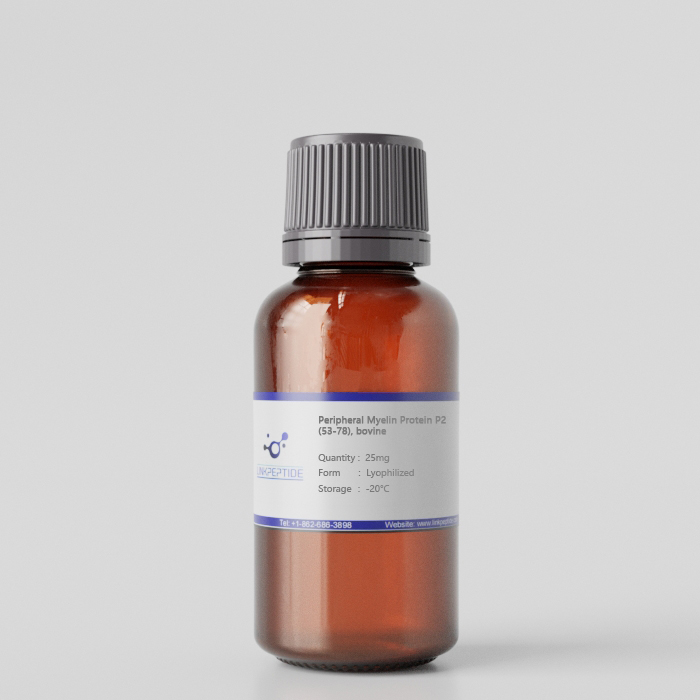
Product Name: Peripheral Myelin Protein P2 (53-78), bovine
Sequence One Letter Code: TESPFKNTEISFKLGQEFEETTADNR
Sequence Three Letter Code: H-Thr-Glu-Ser-Pro-Phe-Lys-Asn-Thr-Glu-Ile-Ser-Phe-Lys-Leu-Gly-Gln-Glu-Phe-Glu-Glu-Thr-Thr-Ala-Asp-Asn-Arg-OH
Chemical Formula:C131H200N34O48
Molecular Weight: 3019.4
Purity: 95%
Form: Lyophilized
Storage Conditions: - 20 °C
Research Area: Neurological Disease Research
Source / Species: Bovine
Conjugation: Unconjugated
Code Nacres: NA.26
Application: Peripheral Myelin Protein P2 (53–78), bovine is a synthetic peptide derived from residues 53–78 of bovine peripheral myelin protein P2, a lipid-binding protein critical for the structural integrity and stability of peripheral nerve myelin. This epitope is well characterized for its neuritogenic properties and is widely used to induce experimental autoimmune neuritis (EAN) in Lewis rat models. The peptide provides a robust platform for studying T cell–mediated immune responses, antigen-specific activation, and mechanisms of immune-driven demyelination. It is particularly useful for investigating inflammatory neuropathies, peripheral nerve pathology, and autoimmune disease mechanisms. This sequence also supports preclinical evaluation of immunomodulatory and neuroprotective therapeutic strategies targeting peripheral nervous system disorders.
Current Research: Peripheral Myelin Protein P2 (53–78), bovine is a synthetic peptide corresponding to amino acid residues 53–78 of bovine peripheral myelin protein P2 (also known as PMP2). P2 is a small, cytosolic fatty acid–binding protein highly expressed in Schwann cells of the peripheral nervous system (PNS). It plays a structural and metabolic role in peripheral myelin by binding and transporting lipids, thereby contributing to membrane stability, lipid homeostasis, and compact myelin organization. Disruption of P2 function has been linked to altered myelin integrity and peripheral neuropathic phenotypes. The 53–78 fragment represents a well-defined neuritogenic epitope that has been extensively characterized in experimental autoimmune neuritis (EAN), particularly in Lewis rat models. When administered with appropriate adjuvants, this peptide reliably induces an antigen-specific autoimmune response directed against peripheral myelin. Clinically and histopathologically, P2 (53–78)-induced EAN recapitulates hallmark features of human inflammatory demyelinating neuropathies, including immune cell infiltration of peripheral nerves, segmental demyelination, macrophage activation, and motor deficits. Because of its reproducibility and defined antigenic specificity, this epitope has become a standard tool in autoimmune neuropathy research. Mechanistically, P2 (53–78) drives a CD4⁺ T cell–mediated immune response. Following immunization, antigen-presenting cells process and present the peptide in the context of MHC class II molecules, leading to activation and clonal expansion of autoreactive T helper cells. Th1 and Th17 subsets are typically implicated, secreting pro-inflammatory cytokines such as IFN-γ, IL-17, and TNF-α. These cytokines promote recruitment and activation of macrophages within peripheral nerves, where they mediate myelin stripping and amplify local inflammatory cascades. The model therefore enables detailed analysis of antigen-specific T cell priming, cytokine polarization, and effector mechanisms underlying immune-driven demyelination. Beyond adaptive immunity, the P2 (53–78) model supports investigation into innate immune contributions to neuropathology. Macrophage–Schwann cell interactions, complement activation, and disruption of the blood–nerve barrier can be systematically examined following peptide-induced disease onset. Electrophysiological assessments—such as nerve conduction velocity and compound muscle action potential measurements—provide functional correlates to inflammatory demyelination and allow quantitative tracking of disease progression and recovery. The defined nature of the P2 (53–78) epitope makes it particularly valuable for studying antigen-specific immune regulation. Researchers frequently use this peptide to evaluate mechanisms of peripheral tolerance, including regulatory T cell (Treg) induction, costimulatory signaling modulation, and checkpoint pathway involvement. Altered peptide ligands (APLs) derived from the 53–78 sequence have also been explored to selectively modulate T cell activation, offering insight into fine epitope recognition and T cell receptor (TCR) specificity. In translational research, P2 (53–78)-induced EAN serves as a robust preclinical platform for testing immunomodulatory and neuroprotective therapies. Small molecules, biologics, cytokine inhibitors, antigen-specific tolerization strategies, and cell-based therapies are commonly evaluated using this model. Because disease induction is reproducible and antigen-driven, therapeutic effects can be assessed with high interpretability across clinical scoring systems, histological analyses, cytokine profiling, and remyelination markers. This facilitates comparative studies of candidate interventions targeting inflammatory pathways, macrophage activation, or Schwann cell protection. Recent research directions include examining molecular mimicry mechanisms that may initiate autoimmune neuropathies, mapping epitope spreading phenomena during disease progression, and characterizing metabolic changes in immune cells during EAN. The P2 (53–78) system is also increasingly integrated with transcriptomic and proteomic profiling of affected peripheral nerves, enabling systems-level analysis of inflammatory signaling networks and repair processes. Overall, Peripheral Myelin Protein P2 (53–78), bovine remains a gold-standard neuritogenic peptide for modeling peripheral nerve autoimmunity in Lewis rats. Its defined sequence, strong disease-inducing capacity, and well-characterized immunopathology make it an indispensable tool for dissecting T cell–mediated demyelination, inflammatory neuropathy mechanisms, and therapeutic response in peripheral nervous system disorders.
Get a Quote
 LinkPeptide