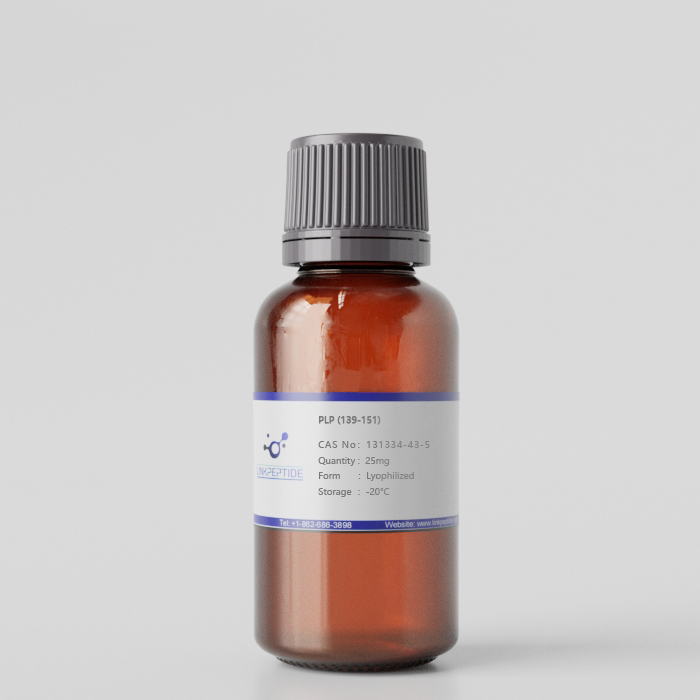
Product Name: PLP (139-151)
Sequence One Letter Code: HCLGKWLGHPDKF
Sequence Three Letter Code: H-His-Cys-Leu-Gly-Lys-Trp-Leu-Gly-His-Pro-Asp-Lys-Phe-OH
Cas No: 131334-43-5
Chemical Formula:C72H104N20O16S
Molecular Weight: 1537.8
Purity: 95%
Form: Lyophilized
Storage Conditions: - 20 °C
Research Area: Neurological Disease Research
SMILES: CC(C)C[C@@H](C(=O)NCC(=O)N[C@@H](CC1=CN=CN1)C(=O)N2CCC[C@H]2C(=O)N[C@@H](CC(=O)O)C(=O)N[C@@H](CCCCN)C(=O)N[C@@H](CC3=CC=CC=C3)C(=O)O)NC(=O)[C@H](CC4=CNC5=CC=CC=C54)NC(=O)[C@H](CCCCN)NC(=O)CNC(=O)[C@H](CC(C)C)NC(=O)[C@H](CS)NC(=O)[C@H](CC6=CN=CN6)N
IUPAC: (3S)-3-[[(2S)-1-[(2S)-2-[[2-[[(2S)-2-[[(2S)-2-[[(2S)-6-amino-2-[[2-[[(2S)-2-[[(2R)-2-[[(2S)-2-amino-3-(1H-imidazol-5-yl)propanoyl]amino]-3-sulfanylpropanoyl]amino]-4-methylpentanoyl]amino]acetyl]amino]hexanoyl]amino]-3-(1H-indol-3-yl)propanoyl]amino]-4-methylpentanoyl]amino]acetyl]amino]-3-(1H-imidazol-5-yl)propanoyl]pyrrolidine-2-carbonyl]amino]-4-[[(2S)-6-amino-1-[[(1S)-1-carboxy-2-phenylethyl]amino]-1-oxohexan-2-yl]amino]-4-oxobutanoic acid
INCHIKEY: VTBYVGRYDXYLHZ-UVIWMAFZSA-N
INCHI:
InChI=1S/C72H104N20O16S/c1-40(2)25-51(63(98)80-36-60(94)84-55(30-45-34-77-39-82-45)71(106)92-24-14-21-58(92)70(105)89-54(31-61(95)96)68(103)85-50(20-11-13-23-74)66(101)90-56(72(107)108)27-42-15-6-5-7-16-42)86-67(102)53(28-43-32-78-48-18-9-8-17-46(43)48)88-65(100)49(19-10-12-22-73)83-59(93)35-79-64(99)52(26-41(3)4)87-69(104)57(37-109)91-62(97)47(75)29-44-33-76-38-81-44/h5-9,15-18,32-34,38-41,47,49-58,78,109H,10-14,19-31,35-37,73-75H2,1-4H3,(H,76,81)(H,77,82)(H,79,99)(H,80,98)(H,83,93)(H,84,94)(H,85,103)(H,86,102)(H,87,104)(H,88,100)(H,89,105)(H,90,101)(H,91,97)(H,95,96)(H,107,108)/t47-,49-,50-,51-,52-,53-,54-,55-,56-,57-,58-/m0/s1
Source / Species: mouse, rat
Conjugation: Unconjugated
Code Nacres: NA.26
Application: PLP (139–151) is a synthetic peptide corresponding to residues 139–151 of myelin proteolipid protein, a major structural component of central nervous system myelin. This epitope is widely used to induce relapsing–remitting experimental autoimmune encephalomyelitis (RR-EAE), a well-established murine model that closely mimics key pathological features of multiple sclerosis. Immunization with PLP (139–151) triggers antigen-specific CD4⁺ T cell responses, leading to inflammatory demyelination and neurological deficits. The peptide is extensively employed to study autoimmune neuroinflammation, T cell–mediated tissue damage, cytokine regulation, and epitope-specific tolerance mechanisms. It also supports preclinical evaluation of immunomodulatory therapies targeting multiple sclerosis and related demyelinating disorders.
Current Research: Myelin proteolipid protein (PLP) is a major structural constituent of central nervous system (CNS) myelin and plays a critical role in maintaining axonal insulation and saltatory conduction. Autoimmune responses directed against myelin antigens, including PLP, are central to the pathogenesis of multiple sclerosis (MS), a chronic demyelinating disorder characterized by inflammatory lesions, neurological deficits, and episodes of relapse and remission. PLP (139–151) is a synthetic peptide corresponding to residues 139–151 of murine PLP and represents one of the most extensively studied encephalitogenic epitopes in experimental models of MS. Immunization with PLP (139–151) in susceptible mouse strains, particularly SJL/J mice, induces relapsing–remitting experimental autoimmune encephalomyelitis (RR-EAE). This model recapitulates key pathological and clinical features of human MS, including inflammatory infiltration of the CNS, demyelination, axonal damage, and episodic neurological impairment followed by partial recovery. Because of its reproducibility and defined antigen specificity, PLP (139–151)-induced EAE has become a cornerstone system for investigating mechanisms of autoimmune neuroinflammation. The peptide drives a robust antigen-specific CD4⁺ T cell response. Following immunization in the presence of adjuvant, PLP (139–151) is presented by MHC class II molecules to naïve T cells, leading to clonal expansion and differentiation into pathogenic effector subsets. Th1 cells producing interferon-γ (IFN-γ) and Th17 cells secreting interleukin-17 (IL-17) are particularly implicated in mediating CNS inflammation. These autoreactive T cells migrate across the blood–brain barrier, where they encounter cognate antigen presented by resident antigen-presenting cells such as microglia and infiltrating macrophages. The resulting cytokine milieu amplifies local inflammation, promotes demyelination, and contributes to neuronal dysfunction. PLP (139–151)-induced RR-EAE is especially valuable for studying relapse mechanisms. After initial disease onset and partial remission, secondary waves of T cell activation and epitope spreading can occur, modeling the cyclical nature of MS. This feature enables investigation of memory T cell responses, regulation of immune checkpoints, and factors that precipitate disease reactivation. The model also supports analysis of regulatory T cell (Treg) function and mechanisms of immune tolerance that may limit or resolve inflammatory episodes. Cytokine regulation and signaling pathways can be dissected using PLP (139–151)-specific responses. Experimental manipulation of IL-23, GM-CSF, TNF-α, and other inflammatory mediators has clarified their contributions to disease severity and relapse frequency. Genetic knockout or pharmacological inhibition studies frequently employ this defined epitope to evaluate how specific immune components influence T cell priming, CNS infiltration, and tissue injury. The peptide also provides a controlled platform for studying antigen-specific tolerance induction. Strategies such as mucosal administration of PLP (139–151), peptide-coupled nanoparticles, altered peptide ligands, and tolerogenic dendritic cell therapies have been assessed for their ability to suppress autoreactive T cell responses. Because the inciting antigen is precisely defined, researchers can directly measure antigen-specific proliferation, cytokine production, and regulatory cell expansion, facilitating mechanistic insight into immune modulation. From a translational perspective, PLP (139–151)–induced EAE is widely used in preclinical evaluation of immunomodulatory therapies relevant to MS. Monoclonal antibodies targeting adhesion molecules, cytokines, or co-stimulatory pathways can be tested for their capacity to reduce clinical scores and inflammatory pathology. Small-molecule inhibitors and biologics aimed at modulating T cell differentiation or migration are similarly evaluated in this antigen-specific context. In summary, PLP (139–151) is a well-characterized encephalitogenic peptide derived from myelin proteolipid protein that induces relapsing–remitting EAE in susceptible mice. By triggering antigen-specific CD4⁺ T cell responses and inflammatory demyelination, it provides a robust and clinically relevant model of autoimmune neuroinflammation. Its extensive use in mechanistic studies and therapeutic evaluation continues to advance understanding of multiple sclerosis pathogenesis and the development of targeted immunomodulatory interventions.
Get a Quote
 LinkPeptide