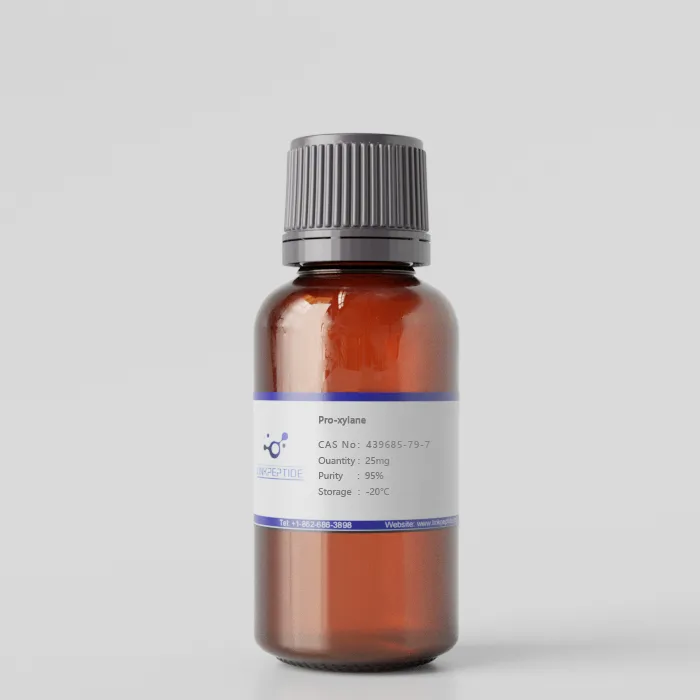
Product Name: Pro-xylane
Cas No: 439685-79-7
Purity: 95%
Storage: Keep in dark and cool dry place -5~8 degree Celsius
Sequence: Hydroxypropyl Tetrahydropyrantriol
Molar Mass: 192.21
Chemical Formula: C8H16O5
IUPAC Name: (2S,3R,4S,5R)-2-(2-hydroxypropyl)oxane-3,4,5-triol
SMILES: CC(C[C@H]1[C@@H]([C@H]([C@@H](CO1)O)O)O)O
InChIKey: KOGFZZYPPGQZFZ-QVAPDBTGSA-N
InChI: InChI=1S/C8H16O5/c1-4(9)2-6-8(12)7(11)5(10)3-13-6/h4-12H,2-3H2,1H3/t4?,5-,6+,7+,8+/m1/s1
Application:
Pro-Xylane is a biomimetic sugar-derived molecule (C-glycoside) renowned for its ability to enhance skin firmness, density, and long-term hydration. By stimulating glycosaminoglycan (GAG) synthesis, Pro-Xylane helps reinforce the skin’s extracellular matrix, improving elasticity and promoting a plumper, smoother appearance. In cosmetic research, it is widely used to explore visible wrinkle reduction, increased suppleness, and improved skin architecture. Its strong moisture-retaining capacity makes it ideal for rejuvenating serums, anti-aging creams, and firming treatments aimed at restoring youthful volume and resilience. Pro-Xylane offers targeted support for achieving firmer, more hydrated, and more radiant-looking skin.
Current Research:
Pro-Xylane (Hydroxypropyl Tetrahydropyrantriol): Research Overview
Pro-Xylane is the trade name for Hydroxypropyl Tetrahydropyrantriol, a synthetic sugar-derived molecule developed for targeted modulation of the extracellular matrix (ECM) and dermal–epidermal junction (DEJ). It is obtained from a xylopyranose core (derived from wood sugars) that is chemically modified to improve stability, solubility, and interaction with skin cells and matrix components.
In skin research, Pro-Xylane is primarily investigated as a glycan- and proteoglycan-regulating active, with particular focus on its effects on glycosaminoglycans (GAGs), proteoglycans, and structural organization in the dermis and DEJ.
Pro-Xylane is a small polyhydroxylated molecule built on a tetrahydropyran ring substituted with hydroxypropyl groups. Key characteristics include:
High hydrophilicity due to multiple hydroxyl groups.
Structural similarity to sugar moieties present in glycosaminoglycans and proteoglycans.
Adequate molecular size and polarity to interact with cell-surface receptors and ECM components in hydrated environments.
This architecture underlies its classification as a “glycomimetic” or “glycan booster” substance in cosmetic science.
A central research theme for Pro-Xylane is its effect on GAG and proteoglycan synthesis in dermal fibroblasts and DEJ-adjacent structures. In vitro and ex vivo models report:
Increased synthesis of sulfated GAGs (such as heparan sulfate and dermatan sulfate).
Enhanced production of hyaluronic acid, contributing to hydration and viscoelastic properties of the dermis.
Upregulation of proteoglycans such as decorin and lumican, which are key regulators of collagen fibril organization.
By modulating these matrix components, Pro-Xylane supports ECM density and organization, especially in the papillary dermis and DEJ region, where glycan-rich structures are critical for mechanical and signaling functions.
The DEJ flattens and becomes less complex with age, reducing mechanical coupling and affecting nutrient and signal exchange between epidermis and dermis. Research on Pro-Xylane in reconstructed skin and ex vivo tissue shows:
Increased expression of laminin and collagen IV, core basement-membrane components.
Improved expression of integrins and cell-adhesion molecules that link basal keratinocytes to the basement membrane.
Thickening and better continuity of the basement-membrane zone under histological examination.
These changes correspond to a more robust and undulating DEJ architecture, which is associated with greater resistance to shear forces and improved support of the overlying epidermis.
Beyond GAGs, Pro-Xylane has been studied for its impact on collagen architecture and dermal volume:
Increased production of collagen type I and III in fibroblast cultures.
Enhanced presence of decorin and lumican, which regulate collagen fibril diameter and spacing.
More homogeneous and dense collagen networks in skin explant models.
Rather than acting as a simple filler, Pro-Xylane appears to influence matrix quality, supporting a more organized and resilient network of collagen and associated proteoglycans.
Although the primary focus is dermal and DEJ remodeling, Pro-Xylane also shows activity in epidermal compartments:
Increased expression of markers associated with epidermal differentiation and cohesion.
Improved organization of the granular layer and stratum corneum in reconstructed-skin models.
Indirect support of barrier function via better DEJ structure and dermal hydration, which impact nutrient and signal supply to basal keratinocytes.
These effects relate to surface parameters such as microrelief regularity and overall epidermal thickness in long-term studies.
Topical formulations containing Pro-Xylane are commonly evaluated using instrumental measurements:
Skin firmness and elasticity assessed by biomechanical devices.
Surface roughness and wrinkle depth quantified by profilometry or 3D optical imaging.
Changes in dermal density and DEJ morphology assessed by imaging or histological analysis in biopsy-based studies.
Reported improvements over weeks to months of application are interpreted as macroscopic manifestations of the molecular changes in GAGs, proteoglycans, collagen, and basement-membrane components.
Pro-Xylane is often studied in combination with other actives:
With hyaluronic acid or HA fragments, to couple matrix regulation with direct hydration.
With peptides that stimulate collagen synthesis or protect against matrix degradation.
With antioxidants to address oxidative aspects of dermal and DEJ aging in parallel with glycan remodeling.
Mechanistically, Pro-Xylane is positioned as a glycan-focused structural modulator, complementing collagen-targeted peptides and barrier-focused lipids in multi-pathway anti-aging systems.
From a formulation standpoint, Pro-Xylane:
Is highly water-soluble, typically incorporated into aqueous or emulsion systems.
Requires appropriate stabilization against hydrolysis and oxidation, although it is less fragile than large peptides or proteins.
Is used at concentrations sufficient to influence fibroblast and keratinocyte behavior in vitro, but low enough to maintain good tolerability in cosmetic use.
Summary
Pro-Xylane (Hydroxypropyl Tetrahydropyrantriol) is a sugar-derived, glycomimetic active characterized in research by its ability to modulate glycosaminoglycans, proteoglycans, and basement-membrane components, thereby supporting dermal matrix density, DEJ architecture, and, indirectly, epidermal and surface properties.
Get a Quote
 LinkPeptide