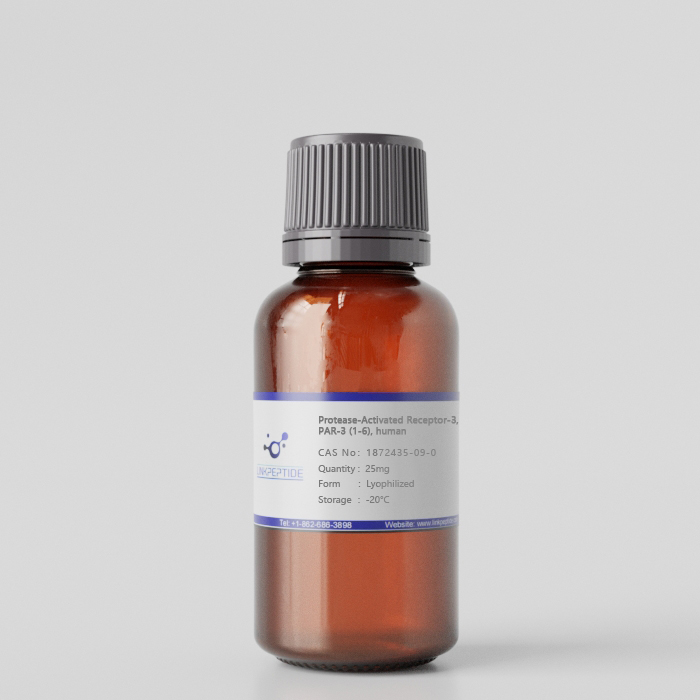
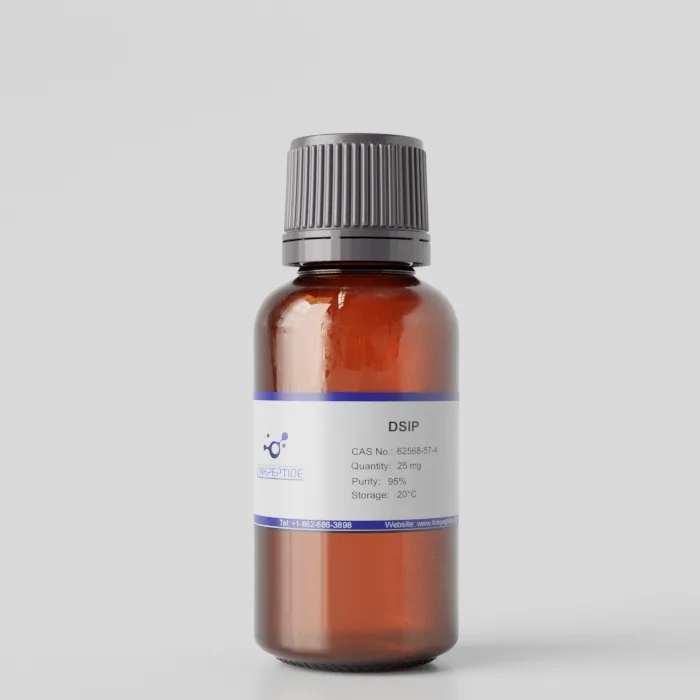
Product Name: Protease-Activated Receptor-3, PAR-3 (1-6), human
Sequence One Letter Code: TFRGAP-NH2
Sequence Three Letter Code: H-Thr-Phe-Arg-Gly-Ala-Pro-NH2
Cas No: 1872435-09-0
Chemical Formula:C29H46N10O7
Molecular Weight: 646.8
Purity: 95%
Form: Lyophilized
Storage Conditions: - 20 °C
Research Area: Inflammation and Immunology Research
SMILES: C[C@H]([C@@H](C(=O)N[C@@H](CC1=CC=CC=C1)C(=O)N[C@@H](CCCN=C(N)N)C(=O)NCC(=O)N[C@@H](C)C(=O)N2CCC[C@H]2C(=O)N)N)O
IUPAC: (2S)-1-[(2S)-2-[[2-[[(2S)-2-[[(2S)-2-[[(2S,3R)-2-amino-3-hydroxybutanoyl]amino]-3-phenylpropanoyl]amino]-5-(diaminomethylideneamino)pentanoyl]amino]acetyl]amino]propanoyl]pyrrolidine-2-carboxamide
INCHIKEY: SZHZUHWALRYMHX-WZZXNIEWSA-N
INCHI:
InChI=1S/C29H46N10O7/c1-16(28(46)39-13-7-11-21(39)24(31)42)36-22(41)15-35-25(43)19(10-6-12-34-29(32)33)37-26(44)20(14-18-8-4-3-5-9-18)38-27(45)23(30)17(2)40/h3-5,8-9,16-17,19-21,23,40H,6-7,10-15,30H2,1-2H3,(H2,31,42)(H,35,43)(H,36,41)(H,37,44)(H,38,45)(H4,32,33,34)/t16-,17+,19-,20-,21-,23-/m0/s1
Source / Species: human
Conjugation: Unconjugated
Code Nacres: NA.26
Application: PAR-3 (1–6) is a synthetic peptide corresponding to the N-terminal residues of human protease-activated receptor-3 (PAR-3). This peptide induces ERK activation in carcinoma cells expressing PAR-1 and PAR-3, highlighting its role in receptor cross-talk and modulation of downstream signaling pathways. PAR-3 regulates PAR-1 activity through receptor dimerization and contributes to endothelial permeability and vascular inflammatory responses. Although it does not directly influence VEGF signaling, PAR-3 (1–6) provides a useful tool for dissecting protease-activated receptor–mediated mechanisms. It enables investigation of G protein–coupled receptor interactions, signal amplification, and inflammatory modulation in vascular and tumor microenvironments. This peptide is suitable for research in vascular biology, inflammation, oncology, and studies focused on GPCR regulation and receptor cooperation.
Current Research: Protease-activated receptors (PARs) are a subfamily of G protein–coupled receptors (GPCRs) activated by proteolytic cleavage of their extracellular N-terminus. Cleavage exposes a tethered ligand sequence that binds intramolecularly to initiate signaling. PAR-3 (protease-activated receptor-3) is one of four PAR family members and has emerged as an important modulator of thrombin-driven signaling in vascular and tumor contexts. PAR-3 (1–6) is a synthetic peptide corresponding to the N-terminal residues of human PAR-3 and functions as a minimal agonist fragment that recapitulates aspects of receptor-mediated activation. This defined peptide provides a practical tool for dissecting PAR-dependent cross-talk, ERK activation, and inflammatory signaling mechanisms. Unlike PAR-1 and PAR-2, which possess well-characterized tethered ligand sequences capable of robust autonomous signaling, PAR-3 has been described primarily as a cofactor receptor. In endothelial and carcinoma cells co-expressing PAR-1 and PAR-3, PAR-3 modulates PAR-1 signaling output through receptor dimerization and cooperative activation. The PAR-3 (1–6) peptide mimics the newly exposed N-terminal sequence following proteolytic activation and has been shown to induce extracellular signal–regulated kinase (ERK) phosphorylation in carcinoma cells expressing both PAR-1 and PAR-3. This response highlights the functional interplay between PAR subtypes and demonstrates how minimal N-terminal fragments can initiate downstream mitogen-activated protein kinase (MAPK) signaling. Mechanistically, PAR-mediated signaling involves coupling to heterotrimeric G proteins such as Gq, Gi, and G12/13, leading to activation of phospholipase C, intracellular calcium mobilization, RhoA signaling, and MAPK cascades. ERK activation triggered by PAR-3 (1–6) reflects integration of these pathways and underscores the importance of receptor cooperation in amplifying signal output. By using a defined peptide agonist, researchers can examine early signaling events independent of upstream protease activity, thereby isolating receptor-level mechanisms. PAR-3 plays a regulatory role in thrombin signaling within the vasculature. It modulates PAR-1 responsiveness through heterodimer formation, influencing endothelial permeability and inflammatory gene expression. Increased endothelial barrier permeability is a hallmark of vascular inflammation, contributing to leukocyte extravasation and tissue edema. The PAR-3 (1–6) peptide allows investigators to probe how PAR-3 engagement affects cytoskeletal rearrangement, junctional integrity, and downstream inflammatory mediators in endothelial models. In tumor microenvironments, PAR signaling contributes to proliferation, invasion, and angiogenesis. Although PAR-3 does not directly regulate vascular endothelial growth factor (VEGF) signaling, its modulation of PAR-1–dependent ERK activation influences carcinoma cell behavior. By stimulating PAR-3 (1–6) in co-expressing cells, researchers can evaluate receptor cross-talk mechanisms that shape mitogenic and pro-inflammatory responses. This is particularly relevant in cancers where thrombin-rich microenvironments enhance PAR-driven tumor progression. The peptide also supports investigation of GPCR dimerization and cooperative signaling. GPCR heterodimerization can alter ligand specificity, G protein coupling efficiency, and signal duration. PAR-3 (1–6) provides a simplified system for studying how N-terminal–derived ligands engage receptor complexes and modify downstream pathways. Combined with pharmacological inhibitors or genetic knockdown approaches, this peptide helps delineate the relative contributions of PAR-1 and PAR-3 to observed signaling events. In vascular biology and inflammation research, PAR-3 (1–6) is useful for modeling protease-driven inflammatory responses without introducing exogenous proteases that may have off-target effects. This controlled activation format enhances experimental precision in studies of cytokine production, endothelial activation, and leukocyte recruitment. In summary, PAR-3 (1–6) is a synthetic N-terminal peptide that mimics activation of protease-activated receptor-3 and induces ERK signaling in cells co-expressing PAR-1 and PAR-3. By enabling targeted investigation of receptor cross-talk, GPCR dimerization, and inflammatory modulation, it serves as a valuable tool in vascular biology, oncology, and signal transduction research focused on protease-activated receptor cooperation.
Get a Quote
 LinkPeptide