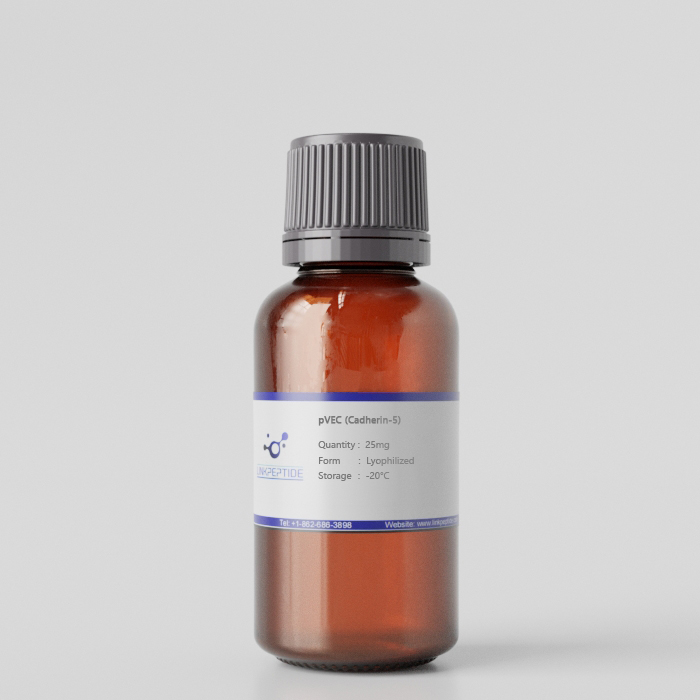
Product Name: pVEC (Cadherin-5)
Sequence One Letter Code: LLIILRRRIRKQAHAHSK
Sequence Three Letter Code: Leu-Leu-Ile-Ile-Leu-Arg-Arg-Arg-Ile-Arg-Lys-Gln-Ala-His-Ala-his-Ser-Lys-OH
Molecular Weight: 2209.9
Purity: 95%
Form: Lyophilized
Storage Conditions: - 20 °C
Research Area: Cell Penetrating Peptides
Source / Species: murine
Conjugation: Unconjugated
Code Nacres: NA.26
Application: pVEC (Cadherin-5) is a cell-penetrating peptide derived from murine vascular endothelial cadherin (VE-cadherin) that efficiently translocates across plasma membranes at low micromolar concentrations. It enters cells without significant membrane disruption or cytotoxicity, making it suitable for intracellular delivery applications. pVEC can be conjugated to peptides, proteins, nucleic acids, and other macromolecules to facilitate cytosolic uptake. This peptide supports investigations into membrane translocation mechanisms, endothelial biology, and targeted intracellular transport strategies. It is widely applied in drug delivery research, cellular uptake studies, and development of therapeutic cargo systems requiring efficient membrane penetration.
Current Research: pVEC (Cadherin-5) is a cell-penetrating peptide (CPP) derived from murine vascular endothelial cadherin (VE-cadherin/CD144), a transmembrane adhesion protein that plays a central role in endothelial junction integrity and vascular permeability regulation. The pVEC sequence originates from the N-terminal extracellular region of VE-cadherin and was identified based on its intrinsic ability to traverse plasma membranes efficiently at low micromolar concentrations. Biophysically, pVEC exhibits amphipathic characteristics that support interaction with lipid bilayers. Like several other CPPs, it can adopt secondary structures—often α-helical conformations—in membrane-mimetic environments, facilitating transient association with phospholipid head groups and insertion into the lipid interface. Importantly, pVEC translocates across cellular membranes without causing significant membrane lysis or overt cytotoxicity under controlled experimental conditions. This property distinguishes it from strongly lytic or pore-forming peptides and supports its application in intracellular delivery systems. Mechanistic studies indicate that pVEC uptake can occur through both endocytic and direct translocation pathways, depending on concentration, cell type, and cargo conjugation format. At lower concentrations, uptake may involve energy-dependent endocytosis, whereas higher local peptide densities can promote direct membrane penetration via transient destabilization of lipid packing. Importantly, these processes typically preserve overall membrane integrity, allowing researchers to investigate cytosolic delivery without confounding cell damage effects. In drug delivery research, pVEC functions as a modular carrier peptide. It can be covalently linked or non-covalently complexed with diverse cargo types, including short peptides, recombinant proteins, oligonucleotides, plasmid DNA, siRNA, and nanoparticle systems. By enhancing membrane translocation efficiency, pVEC improves intracellular bioavailability of therapeutic or experimental payloads that would otherwise be membrane-impermeable. Its relatively low cytotoxic profile supports repeated dosing or prolonged incubation in in vitro models. Beyond delivery applications, pVEC is used to study fundamental aspects of membrane translocation mechanisms. Investigations frequently include fluorescence-based uptake assays, confocal microscopy for intracellular localization, flow cytometric quantification of internalization efficiency, and membrane integrity assays to confirm non-lytic behavior. Biophysical approaches such as circular dichroism spectroscopy, lipid vesicle leakage assays, and surface plasmon resonance contribute to understanding peptide–membrane interactions at the molecular level. Because pVEC originates from VE-cadherin, it also holds relevance in endothelial biology. VE-cadherin is critical for adherens junction formation and vascular barrier maintenance. Although the CPP activity of pVEC is independent of full-length cadherin function, its endothelial origin has prompted investigations into tissue-selective uptake and potential vascular targeting strategies. This makes pVEC of interest not only for general intracellular delivery but also for studies focused on endothelial cells, vascular permeability, and targeted therapeutic transport across endothelial barriers. In therapeutic development contexts, pVEC is explored as a component of multifunctional delivery platforms. These may include fusion constructs combining CPP motifs with targeting ligands, endosomal escape domains, or stimuli-responsive elements. Such strategies aim to improve cytosolic release, reduce endosomal trapping, and enhance tissue specificity. As with other CPP-based systems, current research emphasizes optimizing balance between uptake efficiency, serum stability, and minimal off-target membrane interaction. Overall, pVEC (Cadherin-5) is a well-characterized cell-penetrating peptide that combines efficient membrane translocation with low cytotoxicity. Its ability to facilitate intracellular delivery of diverse macromolecular cargo makes it a valuable tool in drug delivery research, cellular uptake studies, and the development of advanced therapeutic transport systems. Additionally, it provides a useful model for investigating peptide–membrane interactions and mechanisms of controlled membrane penetration in mammalian cells.
Get a Quote
 LinkPeptide