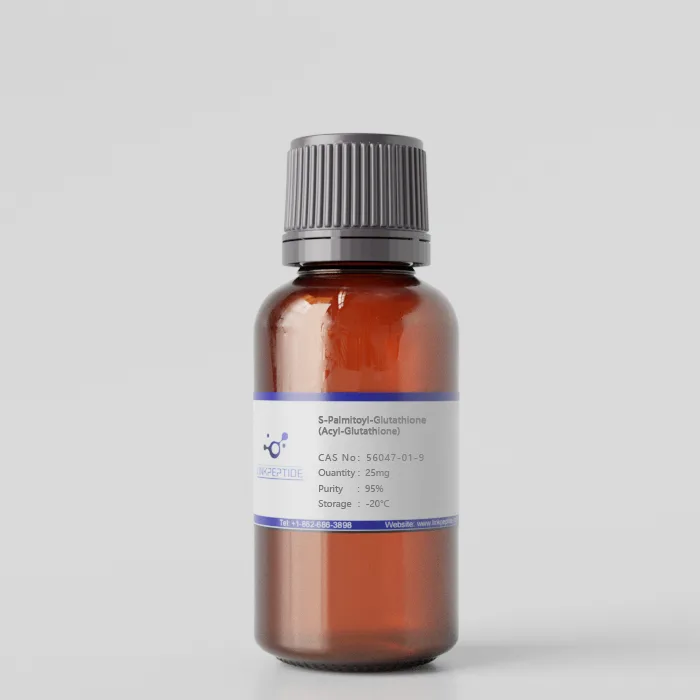
Product Name: S-Palmitoyl-Glutathione (Acyl-Glutathione)
Cas No: 56047-01-9
Purity: 95%
Storage: Keep in dark and cool dry place -5~8 degree Celsius
Sequence: S-Palmitoyl-y-Glu-Cys-Gly
Application:
S-Palmitoyl-Glutathione (Acyl-Glutathione) is a lipophilic glutathione derivative designed to enhance skin absorption and antioxidant performance. By combining glutathione’s detoxifying capabilities with a palmitoyl group, this ingredient helps protect the skin from oxidative stress, environmental damage, and signs of premature aging. In cosmetic research, it is valued for supporting skin vitality, smoothing the appearance of fine lines, and promoting a brighter, more even complexion. Its improved stability and compatibility with emulsions, serums, and anti-aging formulas make it ideal for evaluating next-generation protective and rejuvenating skincare actives.
Current Research:
Current Research & Cosmetic Positioning of S-Palmitoyl-Glutathione (Acyl-Glutathione)
Glutathione is one of the skin’s most important endogenous antioxidants, but in its native form it is hydrophilic, easily oxidized, and not very stable in cosmetic formulations. S-Palmitoyl-Glutathione (Acyl-Glutathione) was developed to overcome these limitations by attaching a palmitoyl (C16 fatty acid) group to the sulfur of glutathione. This acylation makes the molecule more lipophilic, membrane-affinitive, and formulation-friendly, while still preserving its core redox and detoxifying functions at the cosmetic level.
One of the key motivations behind Acyl-Glutathione is stability. Native glutathione tends to oxidize quickly and degrade in water-based systems. The palmitoyl group helps protect the thiol moiety and improves the molecule’s compatibility with emulsions and anhydrous textures.
Because of its increased lipophilicity, S-Palmitoyl-Glutathione shows better affinity for lipid phases and biological membranes, supporting its cosmetic positioning as a more “bioavailable” glutathione derivative. In practice, this means formulators can:
Incorporate Acyl-Glutathione into oil-in-water or water-in-oil emulsions with less risk of rapid degradation.
Use it in richer creams, balms, and targeted treatments around expression-prone areas such as nasolabial folds and forehead.
Some supplier and brand data suggest that this acylated form can reach the upper layers of the epidermis more effectively than unmodified glutathione, improving its ability to support the skin’s own antioxidant defenses.
Cosmetically, S-Palmitoyl-Glutathione is framed as a multifunctional anti-aging active that helps skin resist visible signs of oxidative stress:
It helps neutralize reactive oxygen species generated by UV exposure, pollution, and everyday environmental stress.
It supports the skin’s natural defense systems and helps protect cell components (lipids, proteins) from oxidative damage.
From a visible-results standpoint, products containing Acyl-Glutathione are typically associated with:
Softer, less pronounced expression lines and creases.
Improved overall skin smoothness and suppleness.
A more rested, less “tired” appearance, especially in areas of repetitive movement.
These effects are often explained by the combination of antioxidant activity, supportive action on skin barrier function, and protection of structural proteins involved in firmness and elasticity.
Beyond classic anti-aging, Acyl-Glutathione fits neatly into the “exposome” and “urban shield” narrative. Oxidative stress from pollution, blue light, and lifestyle factors accelerates the breakdown of collagen and lipids and contributes to dullness, uneven texture, and premature wrinkles.
By bolstering the skin’s antioxidative capacity at the cosmetic level, S-Palmitoyl-Glutathione is positioned to:
Help protect barrier lipids from peroxidation.
Support a more resilient, less reactive skin surface.
Complement ingredients such as vitamins C and E, niacinamide, and peptide complexes in anti-pollution or “anti-fatigue” formulas.
This makes it especially attractive in serums and creams marketed for stressed, urban, or mature skin.
In formulation practice, Acyl-Glutathione is rarely used alone. Current cosmetic concepts pair it with:
Vitamin C derivatives and other antioxidants, for broad-spectrum oxidative stress defense.
Peptides and amino acid complexes, to support firmness and skin density.
Barrier-supporting lipids (ceramides, cholesterol, fatty acids), where the lipophilic palmitoyl group integrates well into lipid-rich phases.
These combinations allow brands to position S-Palmitoyl-Glutathione as a “master antioxidant” or “youth molecule” helper, working alongside more familiar anti-aging ingredients.
As a derivative of a naturally occurring tripeptide (glutathione) and a common fatty acid (palmitic acid), S-Palmitoyl-Glutathione is generally presented as well tolerated in cosmetic use when formulated at recommended levels. Its lipophilic nature also lends itself to rich, cushiony textures that are popular in luxury anti-aging skincare, especially night creams and targeted treatments.
Get a Quote
 LinkPeptide