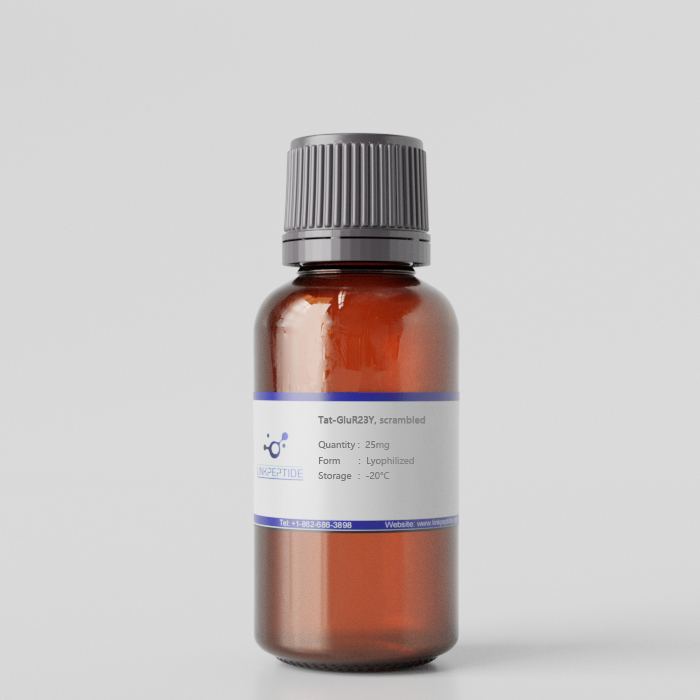
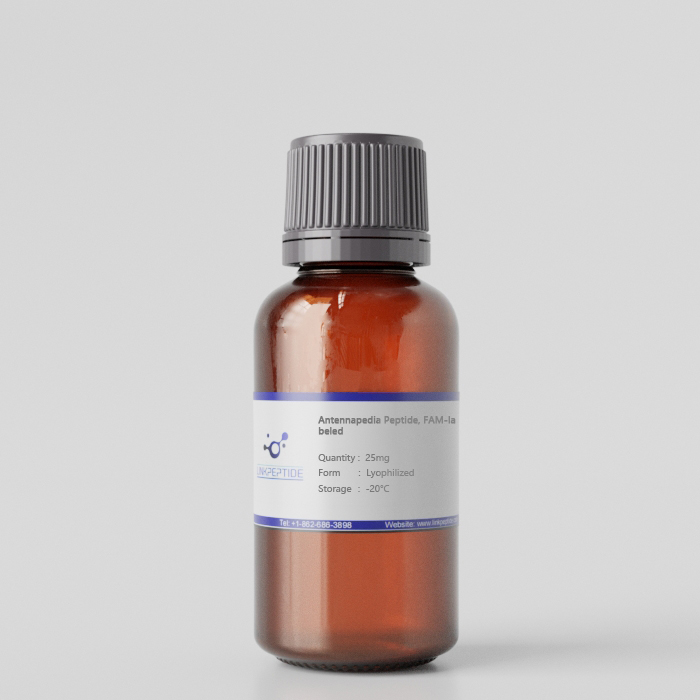
Product Name: Tat-GluR23Y, scrambled
Sequence One Letter Code: YGRKKRRQRRRVYKYGGYNE
Sequence Three Letter Code: H-Tyr-Gly-Arg-Lys-Lys-Arg-Arg-Gln-Arg-Arg-Arg-Val-Tyr-Lys-Tyr-Gly-Gly-Tyr-Asn-Glu-OH
Chemical Formula:C115H185N43O29
Molecular Weight: 2634
Purity: 95%
Form: Lyophilized
Storage Conditions: - 20 °C
Research Area: Peptide Series
Source / Species: HIV
Conjugation: Unconjugated
Code Nacres: NA.26
Application: Tat-GluR23Y, Scrambled is a synthetic control peptide used in neuroscience and receptor signaling research. It is derived from the Tat-GluR23Y sequence but contains a scrambled amino acid arrangement that eliminates its ability to inhibit phosphorylation-dependent endocytosis of the AMPA receptor. Although it retains the Tat cell-penetrating motif for efficient cellular uptake, the altered sequence prevents interference with AMPA receptor trafficking, making it a reliable negative control in studies of glutamatergic signaling and synaptic plasticity. In experimental models, Tat-GluR23Y, scrambled helps distinguish sequence-specific effects of the active Tat-GluR23Y peptide. Preclinical research also suggests the scrambled peptide may increase stress-related responses in animal models, contrasting with the stress-reducing effects of the active peptide and supporting its use in mechanistic and behavioral comparisons.
Current Research: In modern neuroscience research, peptides that modulate receptor signaling pathways are essential tools for understanding synaptic mechanisms and neuronal communication. Among these tools, Tat-GluR23Y has become widely recognized for its role in regulating AMPA receptor trafficking. To accurately evaluate the biological effects of this active peptide, researchers rely on Tat-GluR23Y, Scrambled, a synthetic control peptide designed specifically for mechanistic comparison in glutamatergic signaling studies. Tat-GluR23Y, Scrambled is engineered from the same amino acid components as the active Tat-GluR23Y peptide but arranged in a scrambled sequence. This deliberate rearrangement eliminates the peptide’s ability to interfere with phosphorylation-dependent internalization of AMPA receptors while maintaining similar biochemical properties such as molecular weight, charge distribution, and cell penetration capability. As a result, the scrambled peptide serves as a reliable negative control, enabling researchers to distinguish sequence-specific biological effects from nonspecific peptide activity. Understanding the Role of Tat-GluR23Y in AMPA Receptor Regulation AMPA receptors are central mediators of fast excitatory neurotransmission in the central nervous system. Their trafficking to and from the neuronal membrane is tightly regulated by phosphorylation events that control receptor internalization and recycling. These dynamic processes are crucial for synaptic plasticity, including long-term potentiation (LTP) and long-term depression (LTD), which underlie learning, memory formation, and adaptive neuronal responses. The active Tat-GluR23Y peptide was developed to inhibit phosphorylation-dependent endocytosis of the GluR2 subunit of AMPA receptors. By blocking this process, Tat-GluR23Y stabilizes receptor presence at the synaptic membrane, thereby modulating synaptic strength and neuronal signaling. Because of its ability to alter receptor trafficking, Tat-GluR23Y has been widely used in studies investigating neuroprotection, ischemic brain injury, addiction, and stress-related neurological disorders. However, to determine whether experimental outcomes arise specifically from the peptide’s sequence-driven interaction with the receptor machinery, researchers must employ an appropriate control. This is where Tat-GluR23Y, Scrambled plays an indispensable role. Design and Functional Characteristics of Tat-GluR23Y, Scrambled Tat-GluR23Y, Scrambled retains the Tat cell-penetrating peptide motif, derived from the HIV-1 Tat protein. This motif allows efficient translocation of the peptide across cellular membranes, ensuring intracellular delivery comparable to the active peptide. Maintaining this penetration capability is essential for experimental consistency because it ensures both peptides reach similar intracellular environments. The key distinction lies in the scrambled arrangement of amino acids within the functional region of the peptide. By altering the sequence, the peptide loses its ability to interact with the signaling components responsible for AMPA receptor phosphorylation and internalization. Consequently, Tat-GluR23Y, Scrambled does not inhibit receptor endocytosis or alter AMPA receptor trafficking. Because the scrambled peptide closely matches the active peptide in physical characteristics but lacks its functional activity, it provides an ideal experimental baseline. Researchers can compare biological responses between Tat-GluR23Y-treated samples and those treated with Tat-GluR23Y, Scrambled to determine whether observed effects are truly sequence-specific. Applications in Synaptic Plasticity and Glutamatergic Signaling Studies Tat-GluR23Y, Scrambled is commonly used in cellular, molecular, and behavioral neuroscience experiments focused on glutamatergic signaling pathways. In synaptic plasticity research, it allows investigators to verify that modulation of AMPA receptor trafficking arises specifically from the active peptide rather than from peptide delivery, cellular uptake, or nonspecific interactions. The peptide is frequently employed in studies involving: AMPA receptor trafficking and endocytosis Mechanisms of synaptic plasticity such as LTP and LTD Neuroprotection during excitotoxic or ischemic conditions Neuropharmacological models of addiction and stress Cellular signaling pathways involving receptor phosphorylation By serving as a negative control, Tat-GluR23Y, Scrambled enhances the experimental rigor and interpretability of studies examining glutamate receptor regulation. Behavioral Insights from Preclinical Research Beyond cellular signaling studies, Tat-GluR23Y, Scrambled has also been used in preclinical behavioral models. Interestingly, research findings suggest that the scrambled peptide may produce increased stress-related responses in certain animal models. These observations contrast with the stress-reducing or neuroprotective effects often reported for the active Tat-GluR23Y peptide. This difference highlights the importance of sequence-specific mechanisms in regulating neuronal signaling pathways. By comparing behavioral outcomes between the active peptide and its scrambled counterpart, researchers gain deeper insight into how AMPA receptor trafficking influences stress responses and neural adaptation. Supporting Reliable Mechanistic Comparisons In peptide-based neuroscience research, carefully designed control molecules are essential for validating experimental conclusions. Tat-GluR23Y, Scrambled fulfills this role by providing a structurally comparable yet functionally inactive counterpart to Tat-GluR23Y. Its preserved cell-penetrating capability ensures consistent intracellular delivery, while the scrambled sequence prevents interference with receptor signaling pathways. Through its use as a negative control peptide, Tat-GluR23Y, Scrambled helps researchers isolate sequence-dependent biological effects and strengthen the reliability of findings in studies of synaptic plasticity, glutamatergic signaling, and neurological disease mechanisms. As investigations into receptor trafficking and neuronal signaling continue to expand, tools such as Tat-GluR23Y, Scrambled remain indispensable for advancing precision neuroscience research and improving our understanding of how synaptic regulation shapes brain function.
Get a Quote
 LinkPeptide