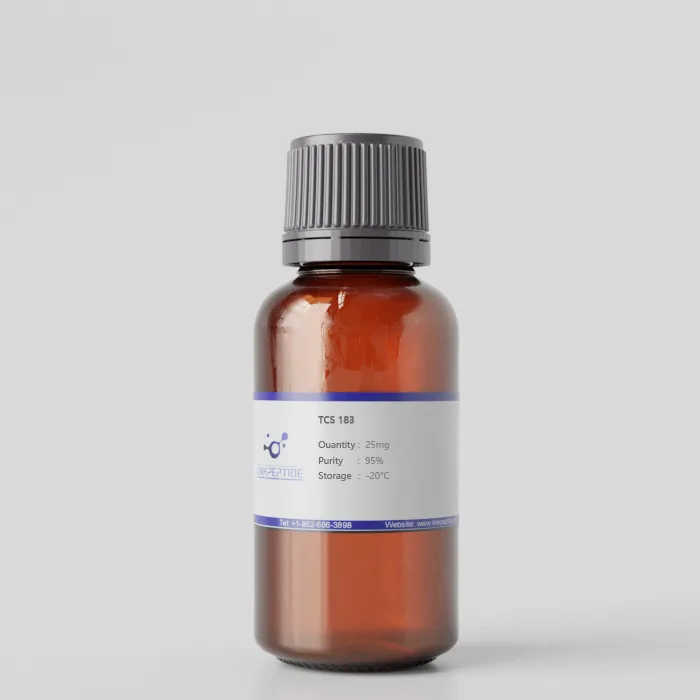
Product Name:TCS 183
Purity:95%
Molar Mass:1425.58
Chemical Formula:C58H96N20O20S
Storage:Store at -20 degrees Celsius
Sequence:MSGRPRTTSFAES
Target:competitive inhibitor of GSK-3β (Ser9) phosphorylation
Application:
TCS 183 is a competitive inhibitor specifically targeting the phosphorylation of GSK-3β at the Ser9 residue, thereby maintaining the enzyme in its active state. GSK-3β is crucial for regulating various cellular processes, including glycogen metabolism, cell proliferation, and apoptosis. By preventing Ser9 phosphorylation, TCS 183 influences key signaling pathways, particularly those implicated in cancer and neurodegenerative diseases. This inhibitor is widely utilized in research to explore the role of GSK-3β in cellular function and disease, offering insights into potential therapeutic strategies aimed at modulating GSK-3β activity for treating conditions linked to its dysregulation.
Current Research:
TCS 183 is a synthetic peptide corresponding to the first 13 amino acids of human and mouse glycogen synthase kinase-3 beta (GSK-3β). It is designed to mimic the Akt phosphorylation site on GSK-3β, potentially serving as a competitive inhibitor of GSK-3β phosphorylation at serine 9 (Ser9). By inhibiting this phosphorylation, TCS 183 can modulate GSK-3β activity, which plays a crucial role in various cellular processes, including glycogen metabolism, gene expression, and neuronal functions.
Biological Activity
TCS 183 has been utilized in research to investigate the regulation of long-term depression (LTD) in the hippocampus. By mimicking the Akt phosphorylation site on GSK-3β, it can prevent the conditioning of LTD, thereby providing insights into synaptic plasticity mechanisms.
Research Applications
Due to its specific interaction with GSK-3β, TCS 183 is employed in studies focusing on:
Elucidating the role of GSK-3β in synaptic plasticity and memory formation.
Understanding the molecular mechanisms underlying neurodegenerative diseases.
Exploring therapeutic targets for conditions associated with dysregulated GSK-3β activity.
Handling and Storage
For optimal stability, TCS 183 should be stored desiccated at -20°C. It is soluble in water up to 1 mg/mL, facilitating its use in various experimental protocols.
Availability
Please note that TCS 183 has been discontinued by some suppliers for commercial reasons. Researchers interested in this peptide may need to consult alternative sources or consider custom synthesis options.
Conclusion
TCS 183 serves as a valuable tool in neuroscience research, particularly in studies investigating the regulation of synaptic plasticity and the role of GSK-3β in neuronal functions. Its application has contributed to a deeper understanding of the molecular mechanisms governing learning and memory.
Reference:
Get a Quote
 LinkPeptide