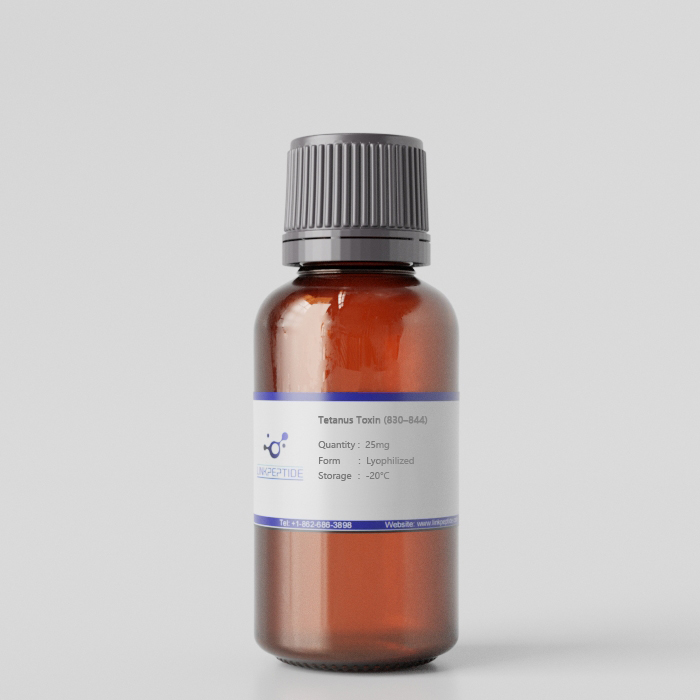
Product Name: Tetanus Toxin (830–844)
Sequence One Letter Code: QYIKANSKFIGITEL
Sequence Three Letter Code: H-Gln-Tyr-Ile-Lys-Ala-Asn-Ser-Lys-Phe-Ile-Gly-Ile-Thr-Glu-Leu-OH
Chemical Formula:C80H129N19O23
Molecular Weight: 1725.1
Purity: 95%
Form: Lyophilized
Storage Conditions: - 20 °C
Research Area: Inflammation and Immunology Research
Source / Species: Clostridium tetani
Conjugation: Unconjugated
Code Nacres: NA.26
Application: Tetanus Toxin (830–844) is a synthetic peptide derived from residues 830 to 844 of the tetanus toxin heavy chain. This sequence contains a broadly recognized helper T cell epitope capable of binding multiple MHC class II molecules, enabling robust CD4⁺ T cell activation. Due to its promiscuous MHC binding profile, it is frequently used as a universal helper epitope in immunological assays and vaccine development studies. The peptide supports investigations into antigen presentation, T cell activation, and immune responses to bacterial toxins. It is also commonly incorporated as a carrier or control epitope in peptide-based vaccine constructs and immune modulation research.
Current Research: Tetanus Toxin (830–844) is a synthetic peptide derived from residues 830 to 844 of the heavy chain (HC) of Clostridium tetani tetanus neurotoxin. This region contains a well-characterized CD4⁺ T helper (Th) cell epitope that exhibits promiscuous binding to multiple human MHC class II alleles, including several HLA-DR variants. Because of this broad MHC restriction profile, the peptide has become a widely used “universal” helper epitope in experimental immunology and vaccine development. Current research continues to leverage Tetanus Toxin (830–844) as a benchmark antigen for studying antigen presentation and CD4⁺ T cell activation. The peptide is efficiently processed and presented by professional antigen-presenting cells (APCs), including dendritic cells, macrophages, and B cells. Upon MHC class II presentation, it induces strong CD4⁺ T cell proliferation and cytokine secretion, particularly in individuals previously vaccinated against tetanus toxoid. This recall capacity makes it highly useful for evaluating functional competence of antigen-presenting pathways and T helper cell responsiveness in vitro. In vaccine research, the 830–844 epitope is frequently incorporated into multiepitope constructs to provide T cell help for otherwise weakly immunogenic antigens. Many subunit and peptide-based vaccines suffer from insufficient CD4⁺ T cell activation, which is essential for robust antibody production and memory formation. By fusing or co-delivering Tetanus Toxin (830–844) with B cell epitopes or cytotoxic T lymphocyte (CTL) epitopes, researchers enhance germinal center formation, class-switch recombination, and long-term immune memory. This strategy has been applied across infectious disease, oncology, and allergy immunotherapy platforms. Recent immuno-oncology studies utilize helper epitopes such as Tetanus Toxin (830–844) to augment antitumor responses. When incorporated into cancer vaccine constructs, the peptide provides CD4⁺ T cell help that supports expansion and persistence of tumor-specific CD8⁺ T cells. The presence of a broadly recognized recall epitope can improve immunogenicity, especially in adult populations with established tetanus immunity. This approach has been evaluated in peptide-based melanoma, glioma, and personalized neoantigen vaccine trials, where inclusion of universal helper sequences enhances overall T cell responses. In mechanistic immunology, Tetanus Toxin (830–844) serves as a model epitope for dissecting MHC class II binding promiscuity. Structural and computational studies investigate how this peptide accommodates multiple HLA-DR binding grooves while maintaining stable peptide–MHC complexes. Understanding these binding determinants informs rational design of next-generation universal helper epitopes and synthetic vaccine platforms. The peptide is also applied in immune monitoring assays. Because a large proportion of individuals possess pre-existing memory CD4⁺ T cells against tetanus toxoid, 830–844 is used as a positive control in T cell functional assays, including proliferation assays, intracellular cytokine staining, and ELISPOT measurements. It provides a reliable measure of immune competence in clinical and translational studies assessing vaccine responses, immune suppression, or immunodeficiency. In addition to vaccine enhancement, emerging research explores the peptide’s role in immune modulation. Coupling tetanus helper epitopes to tolerogenic carriers or nanoparticle systems has been investigated to fine-tune immune activation thresholds. Depending on formulation and context, helper epitopes can influence polarization toward Th1, Th2, or regulatory T cell responses, offering tools to modulate immunity in autoimmune or inflammatory conditions. Furthermore, advances in epitope-based vaccine engineering emphasize modular design, where defined B cell, CD8⁺ T cell, and CD4⁺ T cell epitopes are assembled into synthetic constructs. Tetanus Toxin (830–844) remains a preferred CD4⁺ helper component in such designs due to its extensive validation and cross-population applicability. Overall, current research positions Tetanus Toxin (830–844) as a versatile and reliable universal helper epitope. Its broad MHC class II binding capacity, strong CD4⁺ T cell activation profile, and compatibility with multiepitope vaccine platforms make it indispensable in studies of antigen presentation, T cell biology, vaccine immunogenicity, and immune modulation strategies targeting infectious diseases, cancer, and immune regulation.
Get a Quote
 LinkPeptide