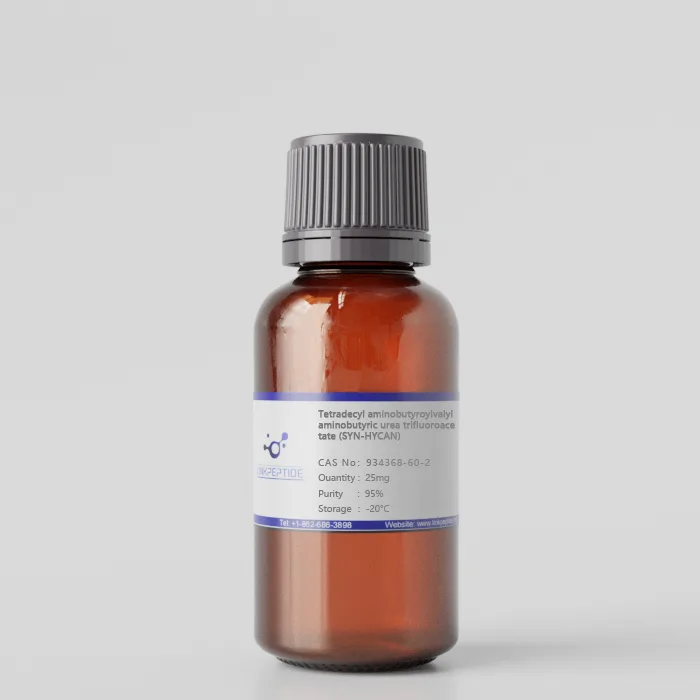
Product Name: Tetradecyl aminobutyroylvalylaminobutyric urea trifluoroacetate (SYN-HYCAN)
Cas No: 934368-60-2
Purity: 95%
Storage: Keep in dark and cool dry place -5~8 degree Celsius
Sequence: XVX
Molar Mass: 784.8
Chemical Formula: C32H58F6N6O9
IUPAC Name: (2S)-4-amino-2-[[(2S)-2-[[(2S)-4-amino-2-(tetradecylcarbamoylamino)butanoyl]amino]-3-methylbutanoyl]amino]butanoic acid;bis(2,2,2-trifluoroacetic acid)
SMILES: CCCCCCCCCCCCCCNC(=O)N[C@@H](CCN)C(=O)N[C@@H](C(C)C)C(=O)N[C@@H](CCN)C(=O)O.C(=O)(C(F)(F)F)O.C(=O)(C(F)(F)F)O
InChIKey: PUHIYNTXUULLTL-YZYZGRISSA-N
InChI: InChI=1S/C28H56N6O5.2C2HF3O2/c1-4-5-6-7-8-9-10-11-12-13-14-15-20-31-28(39)33-22(16-18-29)25(35)34-24(21(2)3)26(36)32-23(17-19-30)27(37)38;2*3-2(4,5)1(6)7/h21-24H,4-20,29-30H2,1-3H3,(H,32,36)(H,34,35)(H,37,38)(H2,31,33,39);2*(H,6,7)/t22-,23-,24-;;/m0../s1
Application:
Tetradecyl Aminobutyroylvalylaminobutyric Urea Trifluoroacetate (SYN-HYCAN) is an advanced lipo-tripeptide engineered to boost skin firmness and redefine facial contours by enhancing hyaluronic acid (HA) production and quality. Known for promoting the synthesis of decorin and lumican—key HA-binding proteoglycans—SYN-HYCAN helps improve skin density, elasticity, and visible plumpness. In cosmetic research, it is widely used to explore reduced sagging, improved jawline definition, and a more sculpted, youthful appearance. With excellent formulation stability, it is ideal for serums, creams, and high-performance anti-aging treatments targeting firmness, volume recovery, and long-term skin resilience.
Current Research:
SYN-HYCAN: Current Research Overview
Tetradecyl aminobutyroylvalylaminobutyric urea trifluoroacetate, better known by its trade name SYN-HYCAN, is a patented cosmetic tripeptide positioned as a hyaluronic-acid booster and firming agent. It is often referred to as a “hyaluronic acid peptide” because its primary claim is to stimulate the skin’s own production of hyaluronan (hyaluronic acid) from within, rather than simply supplying it topically.
Chemically, this ingredient is a lipo-modified small peptide with a tetradecyl (C14) chain attached to a tripeptide backbone. The lipophilic tail is designed to improve interaction with cell membranes and enhance bioavailability in the upper dermis. It is supplied as a glycerin-based aqueous solution under the INCI name Tetradecyl aminobutyroylvalylaminobutyric urea trifluoroacetate.
Mechanism of Action: Hyaluronan Boost + Proteoglycans + Collagen Quality
Current mechanistic data place SYN-HYCAN firmly in the category of matrix-remodeling peptides. Its key points:
Activation of TGF-β signaling
SYN-HYCAN is described as mimicking the body’s own mechanism for converting latent TGF-β into its active form. TGF-β is a central regulator of extracellular matrix (ECM) turnover and is required for the synthesis of collagen and glycosaminoglycans (GAGs), including hyaluronan. By enhancing TGF-β activation, the peptide is proposed to “switch on” a pro-regenerative ECM program in the dermis.
Increased hyaluronan synthesis
In fibroblast and skin-explant models, SYN-HYCAN significantly increases endogenous hyaluronan production, in some reports up to several-fold. This internal HA boost contributes to dermal volume, water binding, and tissue turgor, addressing skin sagging and loss of plumpness in a way that topical HA alone cannot match. Topical HA mainly acts as a humectant on the surface; by contrast, SYN-HYCAN supports HA renewal inside the dermal compartment.
Up-regulation of decorin and lumican
The peptide also increases the expression of decorin and lumican, two small leucine-rich proteoglycans that regulate collagen fibrillogenesis. More decorin and lumican help form thinner, more regularly organized collagen fibrils with higher structural quality. This improves firmness and mechanical resilience rather than just adding volume.
Taken together, SYN-HYCAN supports a more hydrated, better organized dermal matrix: more hyaluronan for volume and water retention, and higher-quality collagen fibers for firmness and contour.
Position Within Modern Cosmetic Peptide Science
SYN-HYCAN represents a “from-within hyaluronic acid” strategy that fits well with current trends in cosmetic science:
Moving from simple moisturization to true dermal remodeling.
Combining GAG stimulation (HA) with collagen-matrix quality improvements.
Offering a needle-free alternative concept to volumizing or contouring injections for consumers who want visible reshaping but prefer topical products.
In the typical peptide taxonomy, SYN-HYCAN is considered a bioactive matrix peptide: it stimulates GAG biosynthesis and proteoglycan production rather than acting purely as a classic collagen signal peptide. This gives you a strong scientific story around firmness, volume, and facial contour.
In Vitro, Ex Vivo, and Clinical Data
Most available data are from the manufacturer and technical reviews, but they are relatively detailed and consistent:
In vitro (fibroblasts)
Increased synthesis of skin-identical hyaluronan.
Marked up-regulation of decorin and lumican expression.
These changes correlate with improved collagen fiber formation and water-binding capacity in the ECM.
Ex vivo (human skin explants)
UV-stressed skin explants treated with SYN-HYCAN show substantially higher HA staining after several days, indicating enhanced HA biosynthesis even under damage conditions.
Microscopy reveals denser, more homogeneous dermal structure, supportive of firming and remodeling claims.
In vivo (facial remodeling studies)
Double-blind studies on mature volunteers (typically women 40–65 with visible sagging) using formulations containing SYN-HYCAN over 4–8 weeks show:
Increased skin firmness, tension, and tonicity measured with non-contact mechanical devices.
Visible improvements in cheek, jawline, and under-chin sagging, assessed by high-resolution 3D imaging and facial topography analysis.
Consumer-perceived improvements in softness, smoothness, elasticity, and hydration after a few weeks of use.
Overall, the data support a measurable remodeling effect across multiple facial zones, with a particular focus on lower-face sagging and volume loss.
Safety and Regulatory Status
Tetradecyl aminobutyroylvalylaminobutyric urea trifluoroacetate is included in major cosmetic ingredient inventories (for example, the 2021 used cosmetic ingredient catalogue in China) as a skin-protecting, firming agent and is not listed as a prohibited substance. Safety assessments referencing standard toxicology endpoints (acute toxicity, irritation, sensitization, genotoxicity, repeated-dose toxicity, etc.) conclude that it is safe under normal cosmetic use conditions at the concentrations typically employed in leave-on products.
In practice, SYN-HYCAN is used at low active levels in serums, creams, and specialized firming treatments, focusing on the face, jawline, neck, and sometimes body-contouring concepts.
Get a Quote
 LinkPeptide