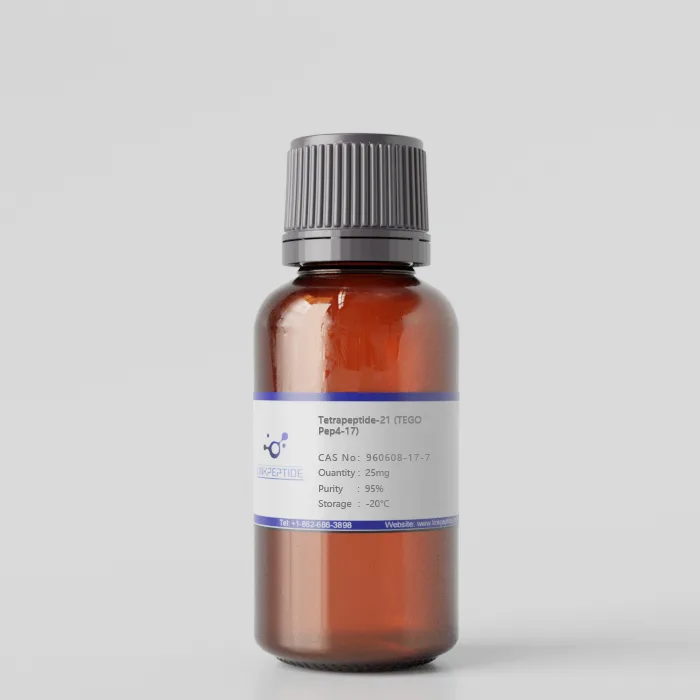
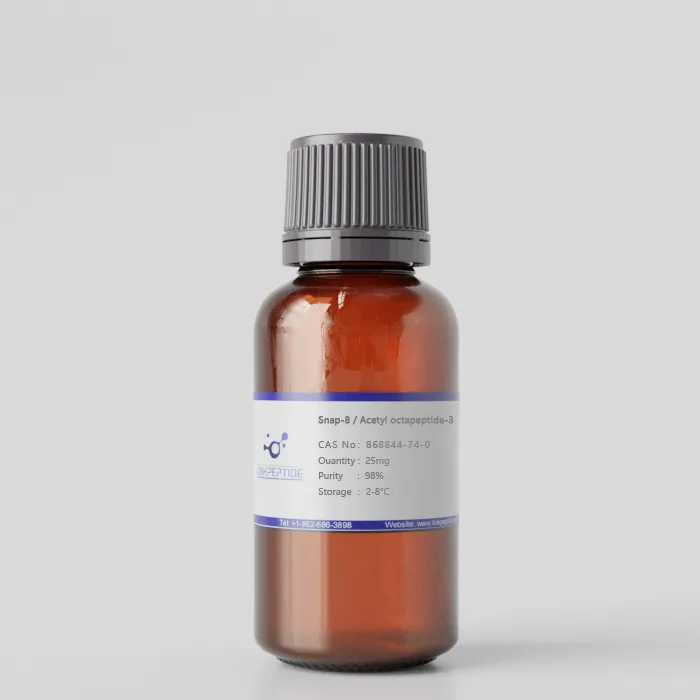
Product Name: Tetrapeptide-21 (TEGO Pep4-17)
Cas No: 960608-17-7
Purity: 95%
Storage: Keep in dark and cool dry place -5~8 degree Celsius
Sequence: GEKG-OH
Molar Mass: 389.4
Chemical Formula: C15H27N5O7
IUPAC Name: (4S)-4-[(2-aminoacetyl)amino]-5-[[(2S)-6-amino-1-(carboxymethylamino)-1-oxohexan-2-yl]amino]-5-oxopentanoic acid
SMILES: C(CCN)C[C@@H](C(=O)NCC(=O)O)NC(=O)[C@H](CCC(=O)O)NC(=O)CN
InChIKey: CUVSTAMIHSSVKL-UWVGGRQHSA-N
InChI: InChI=1S/C15H27N5O7/c16-6-2-1-3-9(14(26)18-8-13(24)25)20-15(27)10(4-5-12(22)23)19-11(21)7-17/h9-10H,1-8,16-17H2,(H,18,26)(H,19,21)(H,20,27)(H,22,23)(H,24,25)/t9-,10-/m0/s1
Application:
Tetrapeptide-21 (TEGO Pep4-17) is a biomimetic peptide designed to support visible skin regeneration, firmness, and smoothness. By stimulating key components of the extracellular matrix—such as collagen, fibronectin, and hyaluronic acid—Tetrapeptide-21 helps improve elasticity and reduce the appearance of fine lines. In cosmetic research, it is valued for promoting a more refined texture and enhancing overall radiance through targeted skin-repair pathways. With excellent stability and solubility, TEGO Pep4-17 is ideal for serums, creams, and advanced anti-aging formulations focused on rejuvenation, hydration balance, and restoring a youthful, resilient complexion.
Current Research:
Tetrapeptide-21 (TEGO Pep4-17): Research Overview
Tetrapeptide-21 is a synthetic GEKG tetrapeptide (Gly-Glu-Lys-Gly) developed from extracellular matrix (ECM) protein sequences using a bioinformatic screening approach. It reproduces a short motif found repeatedly in human collagens (types I–V), elastin, and pro-elastin, placing it in the family of matrikine-like peptides that mimic natural matrix breakdown fragments involved in tissue repair and regeneration.
Sequence: Gly-Glu-Lys-Gly (GEKG)
Molecular weight: ~389 Da
Nature: linear, hydrophilic tetrapeptide
By scanning collagen and elastin sequences for frequently occurring short motifs, GEKG was identified as one of the most abundant ECM tetrapeptides. This motif was then synthesized as Tetrapeptide-21 and screened for its ability to stimulate dermal matrix production in fibroblast cultures.
During physiological matrix remodeling, proteolytic cleavage releases small peptide fragments from collagens and elastin. These fragments can function as matrikines, signaling fibroblasts to upregulate synthesis of new ECM components. Tetrapeptide-21 was designed to exploit this mechanism:
It repeats a motif present in multiple ECM proteins.
It acts as a matrix-derived signal peptide, interacting with fibroblasts to modulate gene expression.
This concept links Tetrapeptide-21 directly to the skin’s intrinsic repair language, focusing on ECM renewal rather than simple surface effects.
Human dermal fibroblasts treated with Tetrapeptide-21 show:
Strong stimulation of collagen production:
At 1 ppm, secreted collagen protein increases by about 2.5-fold versus untreated control.
At 10 ppm, collagen levels rise even further, with higher response than a reference palmitoylated pentapeptide used as a benchmark.
Significant induction of COL1A1 gene expression, confirming transcriptional upregulation of type I collagen.
These results identify Tetrapeptide-21 as a high-potency collagen-inducing tetrapeptide in vitro at very low concentrations.
Beyond collagen, Tetrapeptide-21 influences other key ECM components in fibroblast cultures:
Hyaluronic acid:
Upregulates hyaluronic-acid synthase gene expression.
Increases hyaluronic acid production, which contributes to water-binding capacity, tissue turgor, and viscoelastic behavior of the dermis.
Fibronectin:
Enhances fibronectin gene expression and protein levels.
Fibronectin acts as a multi-adhesive glycoprotein that links collagen, elastin, and GAGs into a cohesive network.
Together, these effects show that Tetrapeptide-21 does not act on collagen alone, but boosts a coordinated ECM program covering fibrillar proteins, adhesive glycoproteins, and glycosaminoglycans.
A punch-biopsy study in human volunteers (>40 years) evaluated a formulation containing Tetrapeptide-21:
Application:
0.01% Tetrapeptide-21 in a topical formulation, once daily on defined body areas, for 8 weeks.
Outcomes at biopsy:
Increased COL1A1 mRNA in treated skin compared with vehicle.
Immunohistochemical staining showed elevated levels of:
Pro-collagen I
Fibronectin
Hyaluronic acid
These in vivo results confirm that Tetrapeptide-21:
Induces collagen gene expression in real human skin.
Translates gene changes into higher protein levels for multiple ECM constituents.
The pattern matches the in vitro findings and supports a robust ECM-boosting profile at both genetic and protein levels.
By simultaneously increasing collagen I, hyaluronic acid, and fibronectin, Tetrapeptide-21 contributes to:
Denser and better-organized collagen networks in the papillary dermis.
Improved ECM hydration and viscoelastic behavior via increased hyaluronic acid.
Enhanced linking of matrix components (collagen, elastin, GAGs) through higher fibronectin content, supporting a more integrated matrix architecture.
In anti-aging research contexts, these molecular changes are associated with improved dermal support, reduced surface roughness, and mitigation of fine lines and wrinkles in experimental and cosmetic studies.
Key technical features:
Small, water-soluble tetrapeptide.
Typically supplied in viscous aqueous carriers (for example, with glycerin and butylene glycol).
Cold-processable, usually added in the cool-down phase of emulsions or directly into serums and gels.
Compatible with other ECM-active peptides, hyaluronic acid, antioxidants, and barrier-supporting lipids.
Its low molecular weight and hydrophilicity favor diffusion into the viable epidermis and upper dermis when supported by appropriate delivery systems.
Summary
Tetrapeptide-21 (TEGO Pep4-17) is a GEKG-based matrikine tetrapeptide derived from abundant motifs in collagen and elastin. Research shows that it:
Strongly stimulates type I collagen synthesis.
Enhances hyaluronic acid and fibronectin production.
Upregulates ECM-related genes and proteins in both fibroblast models and human skin biopsies.
These findings position Tetrapeptide-21 as a targeted ECM-regulating peptide focused on collagen, GAG, and fibronectin support, with clear relevance to structural skin aging and dermal-matrix quality.
Get a Quote
 LinkPeptide