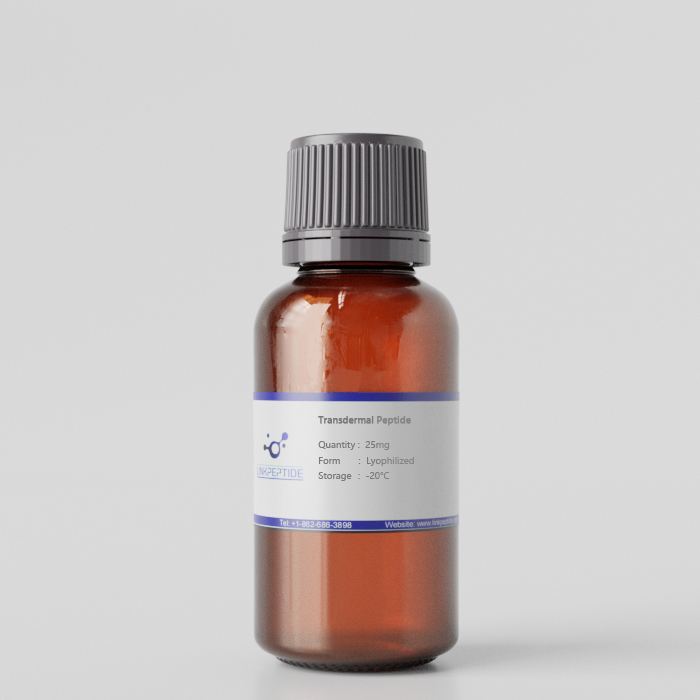
Product Name: Transdermal Peptide
Sequence One Letter Code: ACSSSPSKHCG
Sequence Three Letter Code: H-Ala-Cys-Ser-Ser-Ser-Pro-Ser-Lys-His-Cys-Gly-OH
Chemical Formula:C40H64N14O16S2
Molecular Weight: 1063.2
Purity: 95%
Form: Lyophilized
Storage Conditions: - 20 °C
Research Area: Diabetes and Metabolic Syndrome
Conjugation: Unconjugated
Code Nacres: NA.26
Application: Transdermal Peptide is a synthetic peptide engineered to enhance transdermal delivery of macromolecular therapeutics across intact skin. It transiently modulates the skin barrier, facilitating systemic absorption of co-administered proteins and peptides without causing lasting tissue disruption. In preclinical models, co-administration with insulin has increased circulating insulin levels and reduced blood glucose in diabetic rats, demonstrating functional delivery capability. This peptide is used in studies of noninvasive drug administration, skin permeability modulation, and formulation development for transdermal delivery systems. It supports research aimed at improving systemic delivery strategies for peptide and protein therapeutics.
Current Research: Transdermal Peptide is a synthetic, membrane-active peptide engineered to enhance the delivery of macromolecular therapeutics across intact skin. Unlike conventional chemical penetration enhancers that disrupt lipid organization in a relatively nonspecific manner, this class of peptide is designed to transiently and reversibly modulate the stratum corneum barrier, facilitating systemic absorption of co-administered proteins and peptides without causing sustained structural damage. The outermost layer of skin, the stratum corneum, represents the principal barrier to transdermal drug delivery. Its tightly packed corneocytes embedded in a lipid-rich matrix restrict passive diffusion to small, lipophilic molecules. Large hydrophilic biomolecules such as insulin typically cannot penetrate this barrier in therapeutically relevant quantities. Transdermal Peptides are engineered to interact with skin lipids and possibly tight junction components, temporarily increasing permeability through controlled perturbation of lipid packing or formation of transient aqueous channels. Mechanistically, these peptides are thought to insert into lipid bilayers within the stratum corneum, altering membrane organization and enhancing paracellular or transcellular transport. Importantly, the effect is reversible, with barrier function recovering after peptide clearance. This distinguishes them from harsh surfactants or mechanical disruption techniques that may cause irritation or long-term barrier impairment. Preclinical studies have demonstrated functional delivery capability using insulin as a model therapeutic. In diabetic rat models, co-administration of insulin with Transdermal Peptide resulted in measurable increases in circulating insulin concentrations and corresponding reductions in blood glucose levels. These findings provide pharmacodynamic evidence that intact protein therapeutics can reach systemic circulation when delivered with an appropriate peptide-based enhancer. Current research focuses on optimizing peptide sequence, amphipathicity, charge distribution, and stability to balance permeability enhancement with biocompatibility. Structure–activity relationship (SAR) studies examine how modifications influence skin interaction, transport efficiency, and potential irritation. Analytical approaches such as transepidermal water loss (TEWL) measurements, confocal microscopy, and Franz diffusion cell assays are commonly used to evaluate barrier modulation and permeation kinetics. Transdermal Peptides are also investigated in the context of formulation science. Integration into patches, hydrogels, microneedle-assisted systems, or nanoparticle carriers can further improve delivery efficiency. Combination strategies may exploit synergistic mechanisms, such as pairing peptides with mild physical enhancement methods (e.g., iontophoresis or ultrasound), to achieve clinically relevant systemic exposure while maintaining safety. Beyond insulin, these peptides are being evaluated for delivery of other biologics, including growth hormones, vaccines, monoclonal antibody fragments, and nucleic acid–based therapeutics. The noninvasive nature of transdermal administration offers potential advantages in patient compliance, reduced injection-related complications, and improved chronic disease management. Safety profiling remains a key area of investigation. Studies assess local skin irritation, inflammatory responses, and histological integrity following repeated exposure. Reversibility of barrier modulation is critical to ensure that protective skin function is not permanently compromised. Early data suggest that properly optimized peptide enhancers can achieve transient permeability increases without significant cytotoxicity or structural damage. Overall, Transdermal Peptide represents an emerging strategy in noninvasive drug delivery research. By transiently modulating the skin barrier to permit systemic absorption of large biomolecules, it supports the development of alternative administration routes for peptide and protein therapeutics. Its application spans formulation development, pharmacokinetic optimization, and translational research aimed at expanding the clinical feasibility of transdermal biologic delivery systems.
Get a Quote
 LinkPeptide