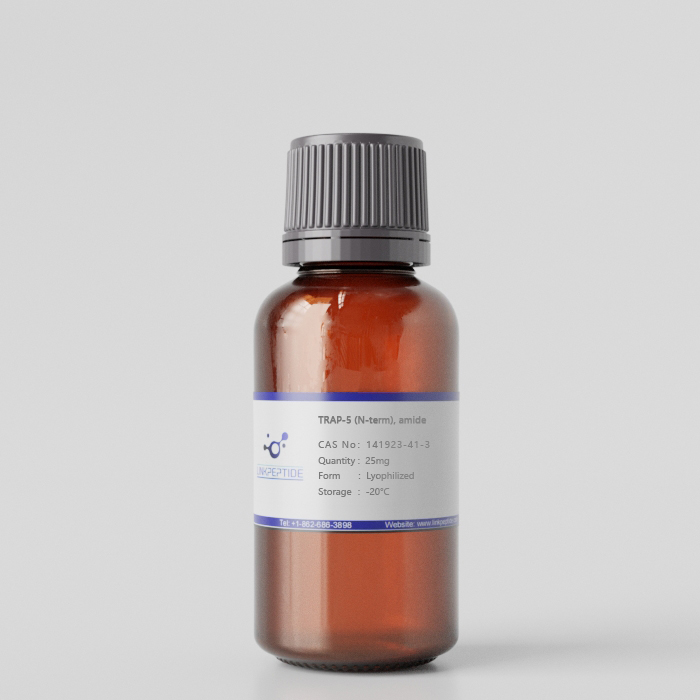
Product Name: TRAP-5 (N-term), amide
Sequence One Letter Code: SFLLR-NH2
Sequence Three Letter Code: H-Ser-Phe-Leu-Leu-Arg-NH2
Cas No: 141923-41-3
Chemical Formula:C30H51N9O6
Molecular Weight: 633.8
Purity: 95%
Form: Lyophilized
Storage Conditions: - 20 °C
Research Area: Cardiovascular Disease Research
SMILES: CC(C)C[C@@H](C(=O)N[C@@H](CC(C)C)C(=O)N[C@@H](CCCN=C(N)N)C(=O)N)NC(=O)[C@H](CC1=CC=CC=C1)NC(=O)[C@H](CO)N
IUPAC: (2S)-N-[(2S)-1-[[(2S)-1-amino-5-(diaminomethylideneamino)-1-oxopentan-2-yl]amino]-4-methyl-1-oxopentan-2-yl]-2-[[(2S)-2-[[(2S)-2-amino-3-hydroxypropanoyl]amino]-3-phenylpropanoyl]amino]-4-methylpentanamide
INCHIKEY: CDBPTZOOUNAWQA-LSBAASHUSA-N
INCHI:
InChI=1S/C30H51N9O6/c1-17(2)13-22(27(43)36-21(25(32)41)11-8-12-35-30(33)34)38-28(44)23(14-18(3)4)39-29(45)24(37-26(42)20(31)16-40)15-19-9-6-5-7-10-19/h5-7,9-10,17-18,20-24,40H,8,11-16,31H2,1-4H3,(H2,32,41)(H,36,43)(H,37,42)(H,38,44)(H,39,45)(H4,33,34,35)/t20-,21-,22-,23-,24-/m0/s1
Source / Species: human
Conjugation: Unconjugated
Code Nacres: NA.26
Application: TRAP-5 (N-term), amide (P5-NH₂) is a minimal PAR-1 agonist peptide engineered to reproduce the endogenous tethered ligand sequence exposed after thrombin-mediated receptor cleavage. By directly engaging PAR-1 without proteolytic activation, TRAP-5 enables controlled interrogation of G protein–coupled signaling cascades, including PLC activation, calcium mobilization, and MAPK pathway induction. This short N-terminal fragment retains full agonistic efficacy, making it particularly valuable for dissecting thrombin receptor–specific responses independent of coagulation proteases. The peptide is extensively applied in platelet aggregation studies, endothelial activation assays, and investigations of vascular inflammation and thrombosis. Its defined sequence and reproducible bioactivity support mechanistic studies of PAR-1–dependent signal transduction in cardiovascular and hemostasis research models.
Current Research: TRAP-5 (N-term), amide (P5-NH₂) is a minimal synthetic agonist derived from the N-terminal tethered ligand sequence of Protease-Activated Receptor-1 (PAR-1). PAR-1 is a thrombin-activated G protein–coupled receptor (GPCR) that plays a central role in platelet activation, endothelial signaling, vascular tone regulation, and thromboinflammatory responses. Under physiological conditions, thrombin cleaves the extracellular N-terminus of PAR-1 to expose a new tethered ligand sequence, which then binds intramolecularly to activate the receptor. TRAP-5 mimics this exposed ligand, allowing receptor activation in the absence of proteolytic cleavage and eliminating confounding effects of thrombin’s enzymatic activity on other substrates. Minimal Agonist Design and Receptor Specificity The five–amino acid N-terminal fragment retains full agonistic efficacy by preserving the essential recognition motif required for PAR-1 activation. C-terminal amidation enhances structural stability and receptor interaction fidelity. Because TRAP-5 directly engages the ligand-binding domain of PAR-1, it enables highly controlled stimulation with defined concentration–response characteristics. A key advantage of this minimal agonist is receptor selectivity. Thrombin activates multiple substrates in plasma and on cell surfaces, including fibrinogen, PAR-4, and other coagulation factors. TRAP-5 isolates PAR-1–dependent signaling, permitting precise mechanistic analysis of downstream pathways without triggering fibrin formation or parallel protease-activated receptor cascades. Downstream Signaling Pathways Activation of PAR-1 by TRAP-5 induces classical GPCR signaling via multiple G protein families: G_q coupling, leading to phospholipase Cβ (PLCβ) activation, inositol trisphosphate (IP₃) production, and intracellular Ca²⁺ mobilization. G_12/13 activation, promoting RhoA signaling and cytoskeletal rearrangement. G_i engagement, modulating adenylyl cyclase activity and PI3K/Akt pathways. Recent studies emphasize that PAR-1 signaling is context-dependent and can involve β-arrestin–mediated scaffolding that contributes to ERK1/2 and MAPK pathway activation. The use of TRAP-5 supports investigation of signaling bias, receptor desensitization kinetics, and differential pathway engagement in various cell types. Applications in Platelet Research In human platelets, PAR-1 is a primary thrombin receptor responsible for rapid activation responses. TRAP-5 is widely employed in aggregation assays to induce platelet activation independently of thrombin-mediated coagulation. This allows researchers to: Quantify integrin αIIbβ3 activation Measure granule secretion (e.g., P-selectin expression) Assess intracellular calcium dynamics Evaluate cross-talk with ADP and collagen signaling pathways Because TRAP-5 avoids fibrin formation, it is particularly useful in isolating receptor-mediated platelet responses in washed platelet preparations or flow cytometric analyses. Endothelial and Vascular Biology PAR-1 is broadly expressed in endothelial cells and vascular smooth muscle cells, where it regulates permeability, inflammatory gene expression, and contractile responses. TRAP-5 stimulation is used to characterize endothelial barrier modulation, cytokine production, and adhesion molecule upregulation. In vascular smooth muscle models, it supports analysis of Rho kinase–dependent contractility and proliferative signaling. Recent research has linked PAR-1 activation to thromboinflammatory processes, including leukocyte recruitment and vascular dysfunction. TRAP-5 facilitates studies aimed at disentangling PAR-1–specific contributions from broader thrombin effects in models of atherosclerosis, sepsis, and ischemia-reperfusion injury. Thrombosis and Inflammation Research The growing interest in PAR-1 as a therapeutic target—illustrated by clinical PAR-1 antagonists—has intensified the need for well-defined agonists for benchmarking pharmacological modulation. TRAP-5 provides a standardized tool for evaluating receptor antagonists, biased ligands, and genetic modifications affecting receptor signaling. In inflammatory models, TRAP-5 is applied to investigate NF-κB activation, MAPK phosphorylation, and endothelial–platelet interactions. Its short, defined sequence ensures reproducibility across biochemical, cellular, and ex vivo systems. Experimental Advantages Key attributes that support widespread research use include: Protease-independent receptor activation Concentration-dependent, reproducible responses High specificity for PAR-1 Compatibility with platelet, endothelial, and vascular smooth muscle assays Overall, TRAP-5 (N-term), amide (P5-NH₂) functions as a precise molecular tool for dissecting PAR-1–dependent GPCR signaling. By replicating the endogenous tethered ligand sequence without requiring thrombin cleavage, it enables controlled interrogation of platelet activation, vascular inflammation, and thrombotic signaling pathways central to cardiovascular and hemostasis research.
Get a Quote
 LinkPeptide