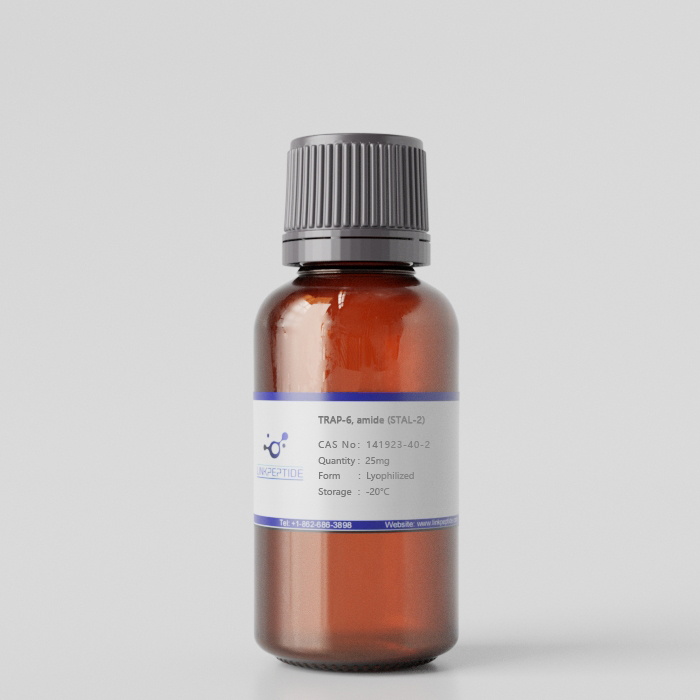
Product Name: TRAP-6, amide (STAL-2)
Sequence One Letter Code: SFLLRN-NH2
Sequence Three Letter Code: H-Ser-Phe-Leu-Leu-Arg-Asn-NH2
Cas No: 141923-40-2
Chemical Formula:C34H57N11O8
Molecular Weight: 747.9
Purity: 95%
Form: Lyophilized
Storage Conditions: - 20 °C
Research Area: Cardiovascular Disease Research
SMILES: CC(C)C[C@@H](C(=O)N[C@@H](CC(C)C)C(=O)N[C@@H](CCCN=C(N)N)C(=O)N[C@@H](CC(=O)N)C(=O)N)NC(=O)[C@H](CC1=CC=CC=C1)NC(=O)[C@H](CO)N
IUPAC: (2S)-2-[[(2S)-2-[[(2S)-2-[[(2S)-2-[[(2S)-2-[[(2S)-2-amino-3-hydroxypropanoyl]amino]-3-phenylpropanoyl]amino]-4-methylpentanoyl]amino]-4-methylpentanoyl]amino]-5-(diaminomethylideneamino)pentanoyl]amino]butanediamide
INCHIKEY: HRYITGOEDRTTLM-FRSCJGFNSA-N
INCHI:
InChI=1S/C34H57N11O8/c1-18(2)13-24(31(51)41-22(11-8-12-40-34(38)39)30(50)42-23(28(37)48)16-27(36)47)44-32(52)25(14-19(3)4)45-33(53)26(43-29(49)21(35)17-46)15-20-9-6-5-7-10-20/h5-7,9-10,18-19,21-26,46H,8,11-17,35H2,1-4H3,(H2,36,47)(H2,37,48)(H,41,51)(H,42,50)(H,43,49)(H,44,52)(H,45,53)(H4,38,39,40)/t21-,22-,23-,24-,25-,26-/m0/s1
Source / Species: human
Conjugation: Unconjugated
Code Nacres: NA.26
Application: TRAP-6, amide (STAL-2) is a synthetic hexapeptide agonist of protease-activated receptor-1 (PAR-1) that reproduces the tethered ligand sequence exposed following thrombin cleavage. Unlike thrombin, TRAP-6 activates PAR-1 directly, enabling selective receptor stimulation without enzymatic proteolysis. This property allows precise investigation of PAR-1–dependent intracellular signaling, including calcium flux, PKC activation, and MAPK pathway engagement. TRAP-6 is widely used in platelet aggregation assays, endothelial activation studies, and cardiovascular signaling research. Its short, well-defined structure ensures consistent biological activity and facilitates mechanistic dissection of thrombin receptor pathways in vitro. The peptide is particularly valuable for evaluating PAR-1–specific responses in hemostasis, thrombosis, and vascular inflammation models.
Current Research: TRAP-6, Amide (STAL-2) TRAP-6, amide (STAL-2) is a synthetic hexapeptide agonist of protease-activated receptor-1 (PAR-1) designed to replicate the endogenous tethered ligand sequence revealed after thrombin-mediated receptor cleavage. PAR-1 is a G protein–coupled receptor (GPCR) that plays a central role in platelet activation, vascular signaling, and thromboinflammatory responses. By directly engaging the receptor’s ligand-binding domain, TRAP-6 activates PAR-1 independently of enzymatic proteolysis, enabling precise and receptor-specific stimulation in controlled experimental systems. Mechanism of PAR-1 Activation Under physiological conditions, thrombin cleaves the extracellular N-terminus of PAR-1, exposing a new N-terminal sequence that folds back intramolecularly to activate the receptor. TRAP-6 mimics this tethered ligand motif and binds directly to PAR-1, bypassing thrombin cleavage. This eliminates confounding effects of thrombin on other substrates, including fibrinogen, PAR-4, and additional coagulation factors. Upon binding, TRAP-6 triggers canonical PAR-1 signaling through multiple G protein pathways: G_q activation, leading to phospholipase Cβ (PLCβ) stimulation, IP₃ production, and intracellular calcium mobilization G_12/13 signaling, promoting RhoA activation and cytoskeletal rearrangement G_i engagement, influencing PI3K/Akt signaling and modulation of cyclic nucleotide pathways In addition to classical G protein–dependent signaling, PAR-1 activation can recruit β-arrestins, contributing to MAPK (ERK1/2) pathway engagement and receptor internalization dynamics. TRAP-6 supports detailed investigation of these signaling axes in isolation. Applications in Platelet Research In human platelets, PAR-1 mediates rapid thrombin-induced activation responses. TRAP-6 is extensively used in platelet aggregation assays to induce receptor-specific activation without fibrin formation. This allows researchers to dissect early intracellular signaling events that precede integrin engagement and clot formation. Common platelet-based applications include: Measurement of intracellular calcium flux Assessment of integrin αIIbβ3 activation Granule secretion analysis (e.g., P-selectin exposure) Evaluation of receptor desensitization and resensitization kinetics Pharmacological profiling of PAR-1 antagonists Because TRAP-6 does not initiate coagulation cascade amplification, it provides a clean system for studying platelet GPCR signaling independent of protease activity. Endothelial and Vascular Biology PAR-1 is broadly expressed in endothelial cells and vascular smooth muscle cells, where it regulates barrier permeability, inflammatory signaling, and contractile responses. TRAP-6 is widely employed in endothelial activation assays to examine calcium mobilization, PKC activation, MAPK phosphorylation, and expression of adhesion molecules. In vascular smooth muscle models, TRAP-6 supports analysis of Rho kinase–mediated contraction and proliferative signaling pathways. These functions are relevant in studies of vascular remodeling, hypertension, and atherosclerosis. Role in Thrombosis and Inflammation Research PAR-1 signaling contributes to thrombus formation and vascular inflammation. Selective activation using TRAP-6 allows researchers to evaluate PAR-1–specific contributions to thromboinflammatory signaling networks without activating parallel protease-activated receptors. This peptide is particularly valuable for: Investigating platelet–endothelial interactions Studying inflammatory cytokine induction downstream of PAR-1 Benchmarking PAR-1 inhibitors and biased ligands Characterizing GPCR signaling selectivity and pathway bias Given the therapeutic interest in PAR-1 antagonism for cardiovascular disease, TRAP-6 serves as a reference agonist for mechanistic and pharmacodynamic studies. Experimental Advantages Protease-independent receptor activation High specificity for PAR-1 Concentration-dependent and reproducible responses Compatibility with platelet, endothelial, and smooth muscle assays Suitable for signaling pathway mapping and inhibitor evaluation The short, amide-terminated structure ensures consistent biological activity and stability across in vitro applications. Its defined sequence facilitates reproducible stimulation and quantitative analysis of downstream signaling events. Overall, TRAP-6, amide (STAL-2) provides a precise molecular tool for dissecting PAR-1–dependent GPCR signaling in cardiovascular, thrombosis, and vascular inflammation research. By isolating receptor activation from proteolytic complexity, it enables focused investigation of thrombin receptor pathways and their contribution to hemostatic and inflammatory processes.
Get a Quote
 LinkPeptide