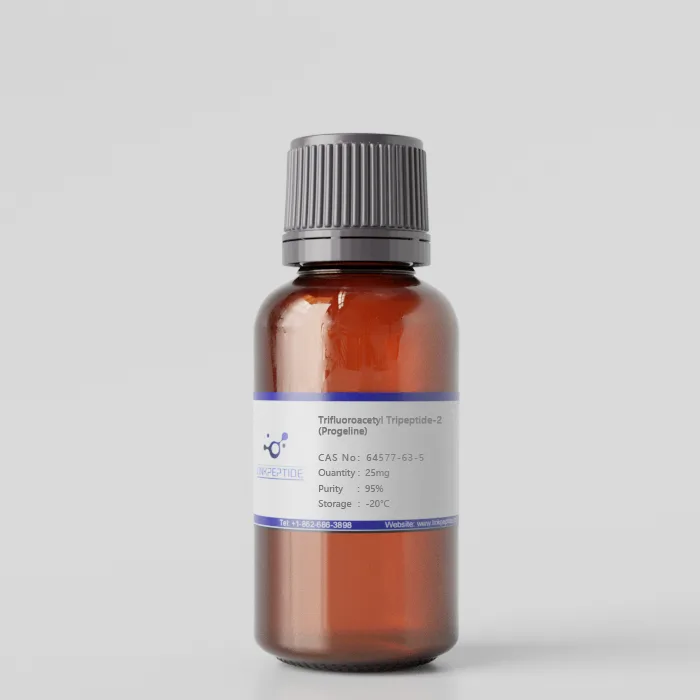
Product Name: Trifluoroacetyl Tripeptide-2 (Progeline)
Cas No: 64577-63-5
Purity: 95%
Storage: Keep in dark and cool dry place -5~8 degree Celsius
Sequence: TFA-Val-Try-Val-OH
Molar Mass: 475.5
Chemical Formula: C21H28F3N3O6
IUPAC Name: (2S)-2-[[(2S)-3-(4-hydroxyphenyl)-2-[[(2S)-3-methyl-2-[(2,2,2-trifluoroacetyl)amino]butanoyl]amino]propanoyl]amino]-3-methylbutanoic acid
SMILES: CC(C)[C@@H](C(=O)N[C@@H](CC1=CC=C(C=C1)O)C(=O)N[C@@H](C(C)C)C(=O)O)NC(=O)C(F)(F)F
InChIKey: SAVSLMGBKQKUAV-JYJNAYRXSA-N
InChI: InChI=1S/C21H28F3N3O6/c1-10(2)15(27-20(33)21(22,23)24)18(30)25-14(9-12-5-7-13(28)8-6-12)17(29)26-16(11(3)4)19(31)32/h5-8,10-11,14-16,28H,9H2,1-4H3,(H,25,30)(H,26,29)(H,27,33)(H,31,32)/t14-,15-,16-/m0/s1
Application:
Trifluoroacetyl Tripeptide-2 (Progeline) is a biomimetic peptide designed to help counteract visible signs of aging linked to skin sagging, elasticity loss, and structural decline. By targeting key pathways associated with protease activity—particularly progerin accumulation—Progeline supports improved firmness, smoother contours, and enhanced skin density. In cosmetic research, it is valued for refining texture, reducing the appearance of wrinkles, and promoting a more sculpted, youthful look. Its excellent stability and formulation compatibility make it ideal for advanced serums, lifting creams, and contour-enhancing treatments focused on restoring resilience and redefining facial architecture.
Current Research:
Trifluoroacetyl Tripeptide-2 (Progeline): Current Research Overview
Trifluoroacetyl Tripeptide-2, widely known by its trade name Progeline, is a synthetic biomimetic tripeptide positioned as a high-end anti-aging active for sagging skin, wrinkles, and loss of firmness, especially around the jawline and neck. Chemically, it is a short peptide with the sequence TFA-Val-Tyr-Val, designed to mimic aspects of elafin, an endogenous elastase inhibitor involved in protecting the extracellular matrix (ECM).
Progeline’s key innovation is its focus on progerin, a recently highlighted “senescence protein” associated with accelerated cellular aging. This shifts the marketing story from simple wrinkle reduction to “anti-senescence” and deep remodeling.
Mechanism of Action: Progerin Modulation + ECM Protection
Current technical literature and vendor data describe several complementary mechanisms for Trifluoroacetyl Tripeptide-2:
Reduction of progerin synthesis
Progerin is a truncated form of lamin A, linked to nuclear envelope instability and accelerated cellular aging. Higher progerin levels are associated with increased wrinkles, sagging, and tissue fragility. Progeline is reported to down-regulate progerin expression in fibroblast models, helping preserve nuclear structure and slow visible signs of aging at the cellular level.
Biomimetic elafin activity and enzyme inhibition
As an elafin-mimetic tripeptide, Progeline can inhibit proteolytic enzymes that degrade structural proteins, particularly:
Elastase
Selected matrix metalloproteinases (MMPs), including collagenase and other MMP isoforms
By moderating elastase and MMP activity, it helps protect elastin and collagen from accelerated breakdown, contributing to improved firmness and elasticity.
ECM remodeling and proteoglycan support
Studies on dermal cells indicate that Progeline can:
Increase proteoglycan production
Support collagen contraction and reorganization
Up-regulate structural markers such as syndecan, involved in cell–matrix communication
Together, these actions support a more compact, better organized dermal matrix—important for jawline definition and resistance to gravitational sagging.
Position Within Modern Cosmetic Peptide Science
Within the cosmetic peptide “ecosystem,” Trifluoroacetyl Tripeptide-2 sits at the intersection of:
Senescence-targeting actives (focusing on progerin as a new aging marker)
Matrix-protecting peptides (inhibiting elastase and MMPs)
Remodeling peptides (improving collagen architecture and tissue tension rather than just line depth)
It is typically framed as a remodeling and contouring peptide rather than a simple anti-wrinkle ingredient. Brands often emphasize its role in:
Improving jawline and lower-face definition
Reducing the look of neck laxity and jowls
Supporting global firmness and elasticity in mature skin
This aligns well with current anti-aging trends: focusing on shape and structure (lifting, contour, anti-sagging) rather than only fine lines.
In Vitro, Ex Vivo, and Clinical Evidence
Most of the data on Progeline come from manufacturer and distributor studies, plus a few independent technical reviews. Key points include:
In vitro / mechanistic data
Significant reduction of progerin expression in stimulated fibroblast cultures.
Strong elastase inhibition and partial inhibition of collagenase and multiple MMP isoforms, suggesting broad ECM protection.
Increased proteoglycan production and syndecan expression, with evidence of enhanced collagen fiber contraction and better organization in cell-based assays.
In vivo cosmetic studies
Progeline has been evaluated in small split-face or controlled volunteer studies using creams containing around 2% of a commercial Progeline solution. Reported outcomes include:
Improved skin firmness and elasticity (around 20% improvement) after approximately 28 days, measured by biomechanical instruments.
Jawline lifting in the range of up to about 10% improvement in sagging parameters after roughly 56 days, assessed by profilometry and 3D imaging.
Subjective improvements in skin density, tightness, and contour reported by mature volunteers (typically women in their 50s–60s).
These findings are promising but should be framed as cosmetic-grade, small-sample studies, mainly generated by or for the ingredient manufacturer rather than large independent clinical trials.
Safety, Use Levels, and Formulation
Trifluoroacetyl Tripeptide-2 appears in major cosmetic ingredient inventories and is considered suitable for leave-on products when used at recommended levels. Typical usage:
Pure peptide: roughly 0.001–0.01%
Commercial solutions: often used at about 0.5–2% in finished formulas
It is generally formulated in firming serums, contouring creams, and neck/jawline treatments, often combined with hydrating, barrier-supporting, or retinoid/antioxidant systems. Standard irritation and sensitization tests show good tolerance, though, as for any active, patch testing is advisable in sensitive skin.
Get a Quote
 LinkPeptide