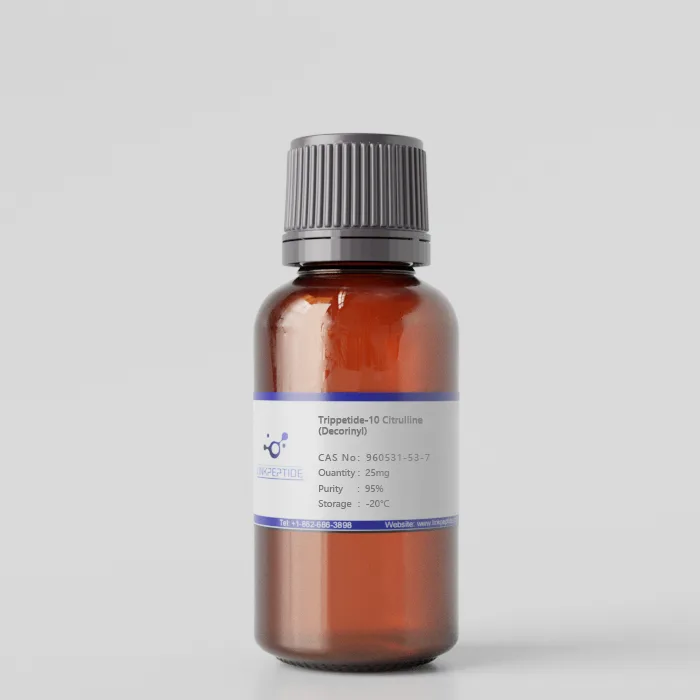
Product Name: Trippetide-10 Citrulline (Decorinyl)
Cas No: 960531-53-7
Purity: 95%
Storage: Keep in dark and cool dry place -5~8 degree Celsius
Sequence: Lys-alpha-Asp-Ile-Citrulline
Molar Mass: 530.6
Chemical Formula: C22H42N8O7
IUPAC Name: (3S)-4-[[(2S,3S)-1-[[(2S)-1-amino-5-(carbamoylamino)-1-oxopentan-2-yl]amino]-3-methyl-1-oxopentan-2-yl]amino]-3-[[(2S)-2,6-diaminohexanoyl]amino]-4-oxobutanoic acid
SMILES: CC[C@H](C)[C@@H](C(=O)N[C@@H](CCCNC(=O)N)C(=O)N)NC(=O)[C@H](CC(=O)O)NC(=O)[C@H](CCCCN)N
InChIKey: GKPMARPRXONRJX-BWJWTDLKSA-N
InChI: InChI=1S/C22H42N8O7/c1-3-12(2)17(21(36)28-14(18(25)33)8-6-10-27-22(26)37)30-20(35)15(11-16(31)32)29-19(34)13(24)7-4-5-9-23/h12-15,17H,3-11,23-24H2,1-2H3,(H2,25,33)(H,28,36)(H,29,34)(H,30,35)(H,31,32)(H3,26,27,37)/t12-,13-,14-,15-,17-/m0/s1
Application:
Tripeptide-10 Citrulline (Decorinyl) is a biomimetic peptide designed to help regulate collagen organization for smoother, firmer-looking skin. Inspired by decorin, a natural proteoglycan, it supports research focused on improving collagen uniformity, enhancing elasticity, and reducing the appearance of fine lines. By promoting a more structured extracellular matrix, Tripeptide-10 Citrulline helps refine texture and restore suppleness to aging or stressed skin. Its excellent stability and compatibility with serums, creams, and advanced anti-aging formulations make it ideal for treatments targeting firmness, resilience, and a more youthful, harmonious complexion.
Current Research:
Tripeptide-10 Citrulline (Decorinyl): Research Overview
Tripeptide-10 Citrulline is a synthetic decorin-mimetic peptide designed to regulate collagen fibrillogenesis and extracellular matrix (ECM) organization. It consists of a short tripeptide sequence coupled to citrulline, a neutral ureido-containing amino acid derived from arginine. This combination yields a small, water-soluble peptide that can interact with dermal fibroblasts and collagen networks, modelling some functions of the proteoglycan decorin, which is a key regulator of collagen fiber formation in skin.
Decorin is a small leucine-rich proteoglycan that binds to collagen fibrils and controls:
Fibril diameter and spacing
Lateral packing and regularity of collagen bundles
Mechanical properties and resilience of the dermal matrix
With intrinsic and photo-induced aging, decorin content and function decline, leading to:
Irregular collagen fibril diameters
Disorganized collagen bundles
Reduced tissue elasticity and increased stiffness
Tripeptide-10 Citrulline was developed to biomimetically replace part of this regulatory function, supporting more uniform collagen assembly in aged or stressed skin.
Tripeptide-10 Citrulline is composed of:
A short tripeptide backbone selected through screening of ECM-related motifs for activity on fibroblasts and collagen.
A citrulline residue, which is non-charged but highly polar, providing hydrogen-bonding capacity and affinity for collagen and matrix proteins.
Key properties:
Low molecular weight (micro-peptide range), favorable for topical diffusion into superficial dermis when properly delivered.
Hydrophilic character, allowing incorporation into aqueous phases, serums, and emulsions.
Peptide-based signaling ability, enabling modulation of ECM-related gene and protein expression.
Tripeptide-10 Citrulline is positioned as a decorin-functional analogue at the cosmetic level:
It binds near sites of collagen assembly and influences fibril growth.
It helps regulate collagen fibril diameter and uniformity, aiming to restore a more “youth-like” distribution of fiber sizes in aged skin models.
It supports a finer, more homogeneous collagen network in the papillary dermis, which is crucial for elasticity and mechanical response.
In this context, the peptide does not simply stimulate collagen synthesis; it primarily modulates the quality and architecture of collagen fibers.
In fibroblast cultures and dermal-equivalent models, Tripeptide-10 Citrulline has been reported to:
Moderate expression of ECM components such as collagen I and III, decorin, and related proteoglycans.
Influence the balance between matrix metalloproteinases (MMPs) and their inhibitors (TIMPs), supporting more controlled collagen turnover.
Promote deposition of collagen with more regular fibril diameter and improved interfibrillar spacing compared with untreated aged or UV-damaged controls.
Electron microscopy of collagen matrices formed in the presence of decorin-mimetic peptides shows narrower diameter distributions and more parallel, tightly controlled fibril organization, consistent with decorin-like regulatory behavior.
In ex vivo human skin and reconstructed skin models, exposure to Tripeptide-10 Citrulline is associated with:
Densification of the papillary dermis, with collagen fibers appearing finer and more uniformly arranged.
Reduction in “rope-like” or clumped collagen bundles characteristic of aged or photo-damaged tissue, replaced by more organized networks.
Improved integration between the upper dermis and the dermal–epidermal junction (DEJ), reflecting more coherent matrix architecture beneath the basement membrane.
These observations support the concept of Tripeptide-10 Citrulline as a matrix-organizing peptide rather than a simple proliferative stimulus.
Because dermal mechanical behaviour depends on both collagen quantity and fibril architecture, the decorin-mimetic activity of Tripeptide-10 Citrulline is relevant to structural aging endpoints, including:
Elastic recoil and resistance to deformation
Fine-line and wrinkle formation driven by repetitive mechanical stress
Optical smoothness and uniformity related to subsurface matrix distribution
Instrumental studies on formulations containing this peptide typically assess surface roughness, microrelief regularity, and firmness/elasticity indices. Improvements in these parameters are interpreted as macroscopic manifestations of underlying changes in collagen fibril organization and papillary dermal structure.
Tripeptide-10 Citrulline is frequently considered as part of multi-pathway ECM strategies, where:
Collagen-stimulating peptides or retinoid-like actives enhance synthesis.
Decorin-mimetic peptides such as Tripeptide-10 Citrulline refine fibrillogenesis and fiber geometry.
Anti-glycation and antioxidant agents protect collagen from chemical damage.
In this framework, Tripeptide-10 Citrulline addresses the “quality control” phase of collagen matrix assembly, complementing ingredients that primarily act on quantity or protection.
Technical characteristics:
Supplied as a water-soluble peptide, often in a carrier solution.
Typically incorporated in the cool-down phase of emulsions or directly into aqueous serums to avoid thermal degradation.
Compatible with other peptides, hyaluronic acid, antioxidants, and barrier-supporting lipids.
Used at low concentrations typical for signal peptides, reflecting its activity at the level of cell signaling and matrix organization rather than bulk material contribution.
Summary
Tripeptide-10 Citrulline (Decorinyl) is a decorin-mimetic, collagen-organizing tetrapeptide derivative designed to regulate collagen fibrillogenesis and restore more uniform fibril architecture in aged or stressed skin. Research characterizes it as an ECM-modulating peptide that refines collagen fiber diameter and spacing, supports papillary dermal organization, and complements collagen-stimulating and protective actives within comprehensive dermal-structure strategies.
Get a Quote
 LinkPeptide