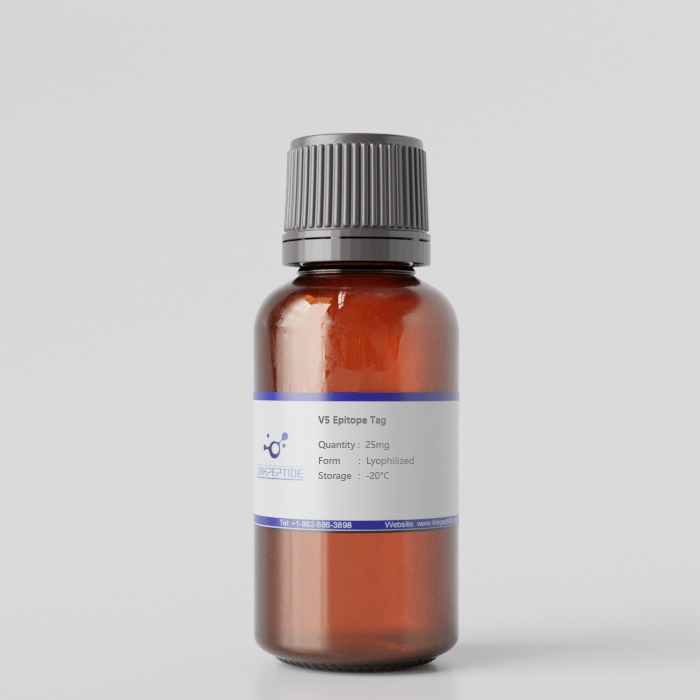
Product Name: V5 Epitope Tag
Sequence One Letter Code: GKPIPNPLLGLDST
Sequence Three Letter Code: H-Gly-Lys-Pro-Ile-Pro-Asn-Pro-Leu-Leu-Gly-Leu-Asp-Ser-Thr-OH
Chemical Formula:C64H108N16O20
Molecular Weight: 1421.8
Purity: 95%
Form: Lyophilized
Storage Conditions: - 20 °C
Research Area: Inflammation and Immunology Research
Source / Species: Simian virus
Conjugation: Unconjugated
Code Nacres: NA.26
Application: The V5 epitope tag is a short peptide sequence derived from the C-terminal region of the P and V proteins of Simian Virus 5 and is widely used as a molecular tag for recombinant protein detection and purification. Its small size minimizes interference with the structure and biological activity of fused proteins, making it suitable for a wide range of expression systems. The V5 tag is specifically recognized by high-affinity monoclonal antibodies, enabling reliable detection through common immunological techniques such as Western blotting, immunoprecipitation, and immunofluorescence microscopy. Because of its versatility and strong antibody recognition, the V5 epitope tag is widely applied in molecular biology, protein expression analysis, and cell biology research involving tagged recombinant proteins.
Current Research: The V5 epitope tag is a short peptide sequence commonly used in molecular biology as a molecular marker for the detection and analysis of recombinant proteins. Derived from the C-terminal region of the P and V proteins of Simian Virus 5 (SV5), the V5 tag has become a widely adopted tool in protein expression studies due to its small size, strong antibody recognition, and compatibility with multiple experimental techniques. Because the tag is relatively short, it can be fused to either the N-terminus or C-terminus of target proteins without significantly altering their structure, localization, or biological activity. This makes the V5 epitope tag particularly valuable in studies requiring reliable identification and analysis of recombinant proteins across diverse expression systems. Structure and Characteristics of the V5 Tag The V5 epitope tag consists of a short peptide sequence that is easily recognized by high-affinity monoclonal antibodies. Its compact structure offers several advantages in recombinant protein design. Key features of the V5 tag include: Small peptide size, minimizing interference with protein folding High specificity recognition by anti-V5 antibodies Compatibility with a wide range of expression vectors and host systems Flexibility for fusion at the N- or C-terminal end of target proteins These characteristics allow researchers to integrate the tag into many different experimental workflows involving recombinant protein production and detection. Use in Recombinant Protein Expression Epitope tagging is a widely used strategy in molecular biology for studying protein expression and function. By attaching a short peptide sequence such as the V5 tag to a protein of interest, researchers can track the presence and localization of that protein using antibody-based detection methods. The V5 tag is commonly incorporated into plasmid expression vectors, enabling the tagged protein to be expressed in various systems such as: Mammalian cell cultures Yeast expression systems Bacterial expression platforms Insect cell expression systems Once expressed, the tagged protein can be detected using anti-V5 antibodies, allowing researchers to verify successful expression and analyze protein levels. Detection Through Immunological Techniques One of the major advantages of the V5 epitope tag is its compatibility with widely used immunological detection methods. Because the tag is recognized by specific monoclonal antibodies, researchers can use these antibodies to identify V5-tagged proteins in complex biological samples. Common detection techniques include: Western blotting – Used to detect and quantify tagged proteins following electrophoretic separation. Immunoprecipitation – Allows selective isolation of the tagged protein and its interacting partners from cell lysates. Immunofluorescence microscopy – Enables visualization of the intracellular localization of V5-tagged proteins within cells. These methods provide powerful tools for analyzing protein expression, interactions, and cellular distribution. Applications in Protein Interaction Studies In addition to protein detection, the V5 tag is frequently used in experiments designed to investigate protein–protein interactions. Through immunoprecipitation techniques, researchers can isolate V5-tagged proteins along with associated binding partners. Such experiments help identify molecular interactions involved in: Cellular signaling pathways Protein complex formation Regulatory mechanisms within cells By combining V5 tagging with immunological detection, researchers can explore how proteins interact within biological systems. Advantages of the V5 Epitope Tag Compared with larger fusion tags such as fluorescent proteins or enzymatic reporters, the V5 tag offers several practical advantages. Its compact size and minimal structural impact make it suitable for applications where maintaining the native behavior of the target protein is important. Additional benefits include: Strong and specific antibody recognition Compatibility with multiple detection platforms Minimal impact on protein folding or activity Broad use across different experimental systems These characteristics contribute to the widespread adoption of the V5 tag in molecular biology research. Role in Cell Biology and Molecular Research The versatility of the V5 epitope tag makes it a valuable tool in a variety of experimental contexts. Researchers frequently use the tag in studies involving: Recombinant protein expression analysis Subcellular localization of proteins Investigation of protein interactions Characterization of signaling pathways Because the tag can be easily incorporated into recombinant constructs and detected with high sensitivity, it remains a standard component of many molecular biology workflows. Conclusion The V5 epitope tag is a short peptide sequence derived from the P and V proteins of Simian Virus 5 that is widely used for recombinant protein detection and analysis. Its small size minimizes interference with the structure and activity of fused proteins, while its strong recognition by monoclonal antibodies enables reliable detection through techniques such as Western blotting, immunoprecipitation, and immunofluorescence microscopy. Due to its versatility and compatibility with multiple expression systems, the V5 tag continues to play an important role in molecular biology, protein expression studies, and cell biology research involving tagged recombinant proteins.
Get a Quote
 LinkPeptide